REST (RE1-silencing transcription factor)
2010-05-01 Monica Faronato , Judy M Coulson AffiliationPhysiology Department, School of Biomedical Sciences, Faculty of Health, Life Sciences, University of Liverpool, Crown Street, Liverpool, L69 3BX, UK
Identity
HGNC
LOCATION
4q12
LOCUSID
ALIAS
DFNA27,GINGF5,HGF5,NRSF,WT6,XBR
FUSION GENES
DNA/RNA
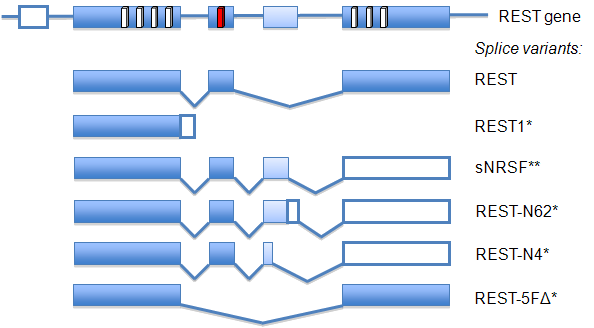
Schematic illustrating REST mRNA and alternative splice variants. The human REST gene is shown (top) illustrating the three main exons (dark blue), an alternative exon (light blue) and one of three alternative 5 non-coding exons (white). The approximate position of sequence encoding eight zinc fingers are illustrated by boxes, these are associated with DNA binding (white) or nuclear import (red). Six alternative mRNAs are illustrated below, the REST reference sequence (NM_005612.3) codes for the major isoform 1. Splice variants described in human *neuroblastoma (Palm et al., 1999) or **SCLC (Coulson et al., 2000) are also shown. REST 1 and REST-5FΔ code for isoform 2 or isoform 4 respectively. The alternative exon in REST-N62, REST-N4 and sNRSF (N50) introduces a premature stop codon and all three transcripts encode isoform 3 (sNRSF/REST4).
Description
The REST gene spans 24 kb of genomic DNA. It is composed of: three alternative 5 non-coding exons associated with different gene promoters, three coding exons, an internal alternative exon that is spliced into some neural and disease associated transcripts.
Transcription
According to Entrezgene the REST gene encodes a single reference sequence mRNA of 3663 bp (NM_005612.3) that is composed of four exons. However, the literature indicates that at least six different splice variants of REST exist and are associated with neural gene expression and certain disease states.
Proteins
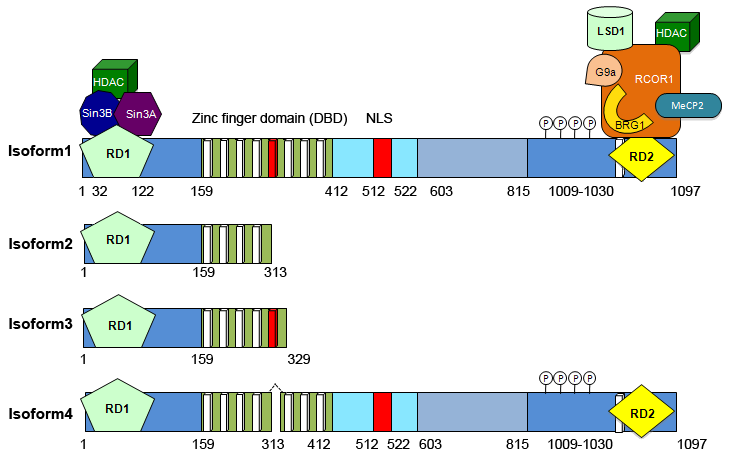
Schematic illustrating REST protein and alternative isoforms. Uniprot.org shows the existence of 4 REST isoforms. Isoform 1 is the canonical sequence; it comprises two repression domains (RD1 and RD2), lysine-rich (400-603) and proline-rich (595-815) domains, a DNA binding domain (159-412) of eight zinc fingers (boxes), two nuclear localization signals (shown in red), a phosphodegron (E1009/S1013 or S1027/S1030) and a ninth C-terminal zinc finger (1006-1082). REST can recruit a variety of transcriptional co-repressors through interaction at RD1 or RD2; examples are illustrated including Sin3A (interaction maps to 32-122), Sin3B (43-57) and RCOR1 (1009-1087). Isoform 2 is truncated, retaining only zinc fingers 1-4 and localizes to the cytoplasm. Isoform 3, also called REST4 or sNRSF, is expressed in neuroblastoma and SCLC; it lacks RD2 and has a truncated DNA binding domain, but retains zinc fingers 1-5 and nuclear localization. Isoform 4 has selective deletion of zinc finger 5. (Palm et al., 1999; Coulson et al., 2000; Shimojo et al., 2001).
Description
Isoform 1: 1097 amino acids, 122 kDa protein,
Isoform 2: (Δ314-1097), 313 amino acids, 35 kDa protein,
Isoform 3: (Δ330-1097), 329 amino acids, 37 kDa protein,
Isoform 4: (Δ304-326), 1074 amino acids, 119 kDa protein.
Isoform 2: (Δ314-1097), 313 amino acids, 35 kDa protein,
Isoform 3: (Δ330-1097), 329 amino acids, 37 kDa protein,
Isoform 4: (Δ304-326), 1074 amino acids, 119 kDa protein.
Expression
REST shows specific expression patterns during development, and exhibits tissue-specific, cell cycle associated or disease dependent expression. This context-dependent expression of REST is regulated through differential transcription, splicing and proteasome-mediated degradation. REST is under expressed in differentiated neuronal tissue, however it plays an essential role during embryogenesis as mice that lack REST die by embryonic day 11.5. Although these mice appear normal until embryonic day 9.5, widespread apoptotic death then results in malformations in the developing nervous system and restricted growth (Chen et al., 1998). In other adult tissues, REST is ubiquitously expressed showing preferential accumulation in tissues of the lymphocytic compartment, including spleen, thymus, peripheral blood lymphocytes, and also in ovary (Scholl et al., 1996).
Localisation
REST is predicted to localize to the nucleus, however the literature reports differential localization of some isoforms. REST undergoes nucleocytoplasmic shuttling, its nuclear targeting is dependent on either a classical NLS or zinc finger 5 (Shimojo et al., 2001) and is influenced by association with other proteins such as PRICKLE1 (RILP) (Shimojo and Hersh, 2003), HTT (Zuccato et al., 2003) and DCTN1 (p150-Glued) (Shimojo, 2008). REST may also be recruited to nuclear PML bodies by association with TRF2 (Zhang et al., 2008).
Function
REST is a transcriptional repressor with a role in regulating gene expression. It was identified in 1995 as a protein that bound to the repressor element 1 (RE1 or NRSE) motif, primarily located in promoter regions of neuron-specific genes. For this reason, REST was initially proposed to silence the transcription of neuronal genes in non-neuronal cells. However, it has subsequently emerged as both a master regulator of neurogenesis and a factor with other essential roles in both neuronal and non-neuronal cells. Indeed, inappropriate REST expression can trigger apoptosis (Lawinger et al., 2000; Neumann et al., 2004).
A combination of bioinformatics and biochemical approaches has been used to identify binding sites and potential target genes of REST. Genome-wide chromatin immunoprecipitation studies have shown that REST can occupy several thousand RE1 motifs with the potential to regulate hundreds of different genes (Johnson et al., 2007; Otto et al., 2007). REST is therefore implicated in multiple biological processes and signalling pathways, for example regulating ion channels, growth factors or hormones, cytoskeletal proteins and other transcription factors (Bruce et al., 2004). Specific examples include regulation of MAD2 that impacts on mitosis and DNA recombination (Guardavaccaro et al., 2008), many neurosecretory proteins that affect presynaptic vesicle processing and exocytosis of secreted factors (Bruce et al., 2006; Pance et al., 2006; DAlessandro et al., 2009), the deubiquitinating enzyme UCHL1 affecting ubiquitination and proteasome-mediated stability (Barrachina et al., 2007), and the VEGF receptor NRP1 that influences cell migration and angiogenesis (Kurschat et al., 2006). REST ablation impairs the production of laminin extracellular matrix components (Sun et al., 2008) and plays a role as a switch regulating potassium channel expression (Cheong et al., 2005). REST also interacts with several intracellular signal transduction cascades, including the PI3K (Westbrook et al., 2005), WNT (Nishihara et al., 2003) and Hedgehog (Gates et al., 2010) pathways. In addition to directly regulating mRNA transcription, REST also controls expression of a family of micro-RNAs that indirectly control other mRNA targets (Conaco et al., 2006), for example REST-mediated repression of micro-RNAs directs a switch of chromatin regulatory complexes essential for the transition to post-mitotic neurons (Yoo et al., 2009).
REST mediates its actions through interaction with a large repertoire of proteins that modify chromatin including the transcriptional repressor SIN3A/SIN3B at RD1, and the methylated CpG binding protein MeCP2 (Lunyak et al., 2002) along with many others at RD2. For example, the SMARCA4 (BRG1), SMARCC2 (BAF170) and SMARCE1 (BAF57) components of the SWI/SNF ATP-dependent chromatin-remodeling complex are recruited (Battaglioli et al., 2002). RCOR1 (coREST) is also recruited by REST to occupy RE1, and co-ordinates assembly of the BHC complex comprising the SWI/SNF component HMG20 (BRAF35), the scaffold PHF21A (BHC80), the histone deacetylases HDAC1/HDAC2 and the H3K4 demethylase KDM1A (LSD1) (Lee et al., 2005). Recruitment of the H3K9/H3K27 methyltransferase EHMT2 (G9a) (Roopra et al., 2004) appears to be dependent on MED12 (Ding et al., 2008) and CDYL (Mulligan et al., 2008). Together these complexes mediate transcriptional repression by remodeling chromatin so that histones become more tightly associated with DNA and less accessible to the transcriptional machinery (Ooi and Wood, 2007).
A combination of bioinformatics and biochemical approaches has been used to identify binding sites and potential target genes of REST. Genome-wide chromatin immunoprecipitation studies have shown that REST can occupy several thousand RE1 motifs with the potential to regulate hundreds of different genes (Johnson et al., 2007; Otto et al., 2007). REST is therefore implicated in multiple biological processes and signalling pathways, for example regulating ion channels, growth factors or hormones, cytoskeletal proteins and other transcription factors (Bruce et al., 2004). Specific examples include regulation of MAD2 that impacts on mitosis and DNA recombination (Guardavaccaro et al., 2008), many neurosecretory proteins that affect presynaptic vesicle processing and exocytosis of secreted factors (Bruce et al., 2006; Pance et al., 2006; DAlessandro et al., 2009), the deubiquitinating enzyme UCHL1 affecting ubiquitination and proteasome-mediated stability (Barrachina et al., 2007), and the VEGF receptor NRP1 that influences cell migration and angiogenesis (Kurschat et al., 2006). REST ablation impairs the production of laminin extracellular matrix components (Sun et al., 2008) and plays a role as a switch regulating potassium channel expression (Cheong et al., 2005). REST also interacts with several intracellular signal transduction cascades, including the PI3K (Westbrook et al., 2005), WNT (Nishihara et al., 2003) and Hedgehog (Gates et al., 2010) pathways. In addition to directly regulating mRNA transcription, REST also controls expression of a family of micro-RNAs that indirectly control other mRNA targets (Conaco et al., 2006), for example REST-mediated repression of micro-RNAs directs a switch of chromatin regulatory complexes essential for the transition to post-mitotic neurons (Yoo et al., 2009).
REST mediates its actions through interaction with a large repertoire of proteins that modify chromatin including the transcriptional repressor SIN3A/SIN3B at RD1, and the methylated CpG binding protein MeCP2 (Lunyak et al., 2002) along with many others at RD2. For example, the SMARCA4 (BRG1), SMARCC2 (BAF170) and SMARCE1 (BAF57) components of the SWI/SNF ATP-dependent chromatin-remodeling complex are recruited (Battaglioli et al., 2002). RCOR1 (coREST) is also recruited by REST to occupy RE1, and co-ordinates assembly of the BHC complex comprising the SWI/SNF component HMG20 (BRAF35), the scaffold PHF21A (BHC80), the histone deacetylases HDAC1/HDAC2 and the H3K4 demethylase KDM1A (LSD1) (Lee et al., 2005). Recruitment of the H3K9/H3K27 methyltransferase EHMT2 (G9a) (Roopra et al., 2004) appears to be dependent on MED12 (Ding et al., 2008) and CDYL (Mulligan et al., 2008). Together these complexes mediate transcriptional repression by remodeling chromatin so that histones become more tightly associated with DNA and less accessible to the transcriptional machinery (Ooi and Wood, 2007).
Homology
REST is a member of the mammalian family of Krüppel-type zinc finger transcription factors. The closest paralog based on sequence homology to REST is ZNF407.
Mutations
Somatic
Deletions of varying size encompassing the REST locus on chromosome 4 were detected in one-third of primary human colon tumors and colon cancer cell lines, suggesting that chromosomal deletions targeting REST are a frequent event in colon cancer (Westbrook et al., 2005). The REST locus has also been implicated in brain tumors, as an amplification site identified in human malignant glioma mapped to chromosome 4q12 (Schrock et al., 1994) and this region was lost in 30-80% of oligodendrogliomas or anaplastic oligodendrogliomas (Zhu et al., 1998). Another study of 161 patients diagnosed with nervous system tumors also screened samples for genetic alterations in REST (Blom et al., 2006). Although two non-synonymous SNPs were found in REST exon 3, which might affect the capacity of REST to bind target DNA, these were germ line changes and no cancer-associated truncating or activating mutations of REST were found. The same study reported low-level amplification of REST in both glioma and medulloblastoma, although high-level amplification was rare.
Implicated in
Entity name
Colon cancer
Note
Deletions of the chromosome 4q12, region where REST is located, are frequent events in colon cancer.
Cytogenetics
A single nucleotide deletion within REST exon 4 was identified in one cell line derived from colorectal adenocarcinoma. This results in a frameshift mutation and expression of REST-FS, a truncated variant with eight zinc fingers, but lacking the C-terminal repression domain RD2 (Westbrook et al., 2005).
Entity name
Small cell lung carcinoma (SCLC)
Note
Altered REST function is associated with SCLC, because of reduced REST expression and an increased production of the REST splice variant sNRSF, that lacks part of the DNA-binding domain and the C-terminal repression domain RD2 (Coulson et al., 2000). This leads to inappropriate expression of genes like arginine vasopressin and the glycine receptor alpha in SCLC (Coulson et al., 1999; Neumann et al., 2004).
Prognosis
For all types and stages of lung cancer diagnosed in the UK, the 1-year and 5-year survival is 28% and 8% respectively (Cancer Research UK CancerStats, 2006). SCG3 mRNA, a component of the REST-dependent neurosecretory transcriptional profile in lung cancer cells, was evaluated as a biomarker for noninvasive monitoring of neuroendocrine lung cancers and found to be associated with poor prognosis in limited disease SCLC patients (Moss et al., 2009).
Entity name
Non small cell lung carcinoma (NSCLC)
Note
BRM/BRG1 are integral components of the SWI/SNF chromatin-remodeling complex, which forms part of a larger repression complex associated with REST. Loss of BRM/BRG1 is observed in some human NSCLC cell lines, and leads to de-repression of REST-restricted genes (Watanabe et al., 2006).
Prognosis
Around 10% of NSCLC patients are reported to have BRM/BRG1 deficient lung carcinoma and this is associated with poor prognosis (Reisman et al., 2003; Fukuoka et al., 2004).
Entity name
Breast cancer
Note
A tumor suppressor function for REST was identified through an RNAi library screen for genes that contributed to transformation in a breast cancer model associated with PI3K signaling (Westbrook et al., 2005). The TAC1 gene has been implicated in the development of breast and other cancers through production of peptides including substance P, which mediate resistance to apoptosis and radiation therapy. It was recently shown that, together with NFkB, REST represses TAC1 expression in mesenchymal stem cells. However, the level of REST decreases in breast cancer cells and inversely correlates with substance P production and an aggressive cellular phenotype (Reddy et al., 2009).
Entity name
Prostate cancer
Note
Prostate tumors with a prominent neuroendocrine component are typically androgen independent and highly aggressive. In prostate adenocarcinoma cells, this acquisition of a neuroendocrine phenotype is associated with tumor progression and REST/NRSF levels decrease as the androgen resistance progresses. This directly induces IB1/JIP-1 transcription, which in turn modulates the JNK signaling pathway (Tawadros et al., 2005).
Entity name
Medulloblastoma
Note
REST expression is generally low in adult brain permitting expression of RE1-restricted neuronal genes. However, REST is elevated in medulloblastoma cell lines and in 80% of human medulloblastoma tumors relatively to normal cerebellum sections, suggestive of an oncogenic role. Blocking endogenous REST function results in neuronal gene re-expression and apoptosis in both in vitro and in vivo medulloblastoma models (Lawinger et al., 2000; Fuller et al., 2005).
Entity name
Neuroblastoma
Note
Alternative splice variants of REST were identified in murine and human neuroblastoma. It was suggested that changes in the structure or regulation of the REST gene may reflect or lead to the formation and progression of neuroblastoma tumors, and that the neuronal-specific exon/flanking introns may define a locus of somatic recombination (Palm et al., 1999).
Entity name
Huntingtons disease
Note
Wild type huntingtin protein (HTT) sequesters REST in the cytoplasm, inhibiting its function, whereas the mutant HTT protein cannot interact with REST resulting in higher levels of REST in the nucleus and repression of many target genes (Zuccato et al., 2007).
Entity name
Ischemia
Note
Global ischemia triggers REST mRNA and protein expression. Knockdown of the REST gene rescues post-ischemic neurons from ischemia-induced cell death in an in vitro model (Calderone et al., 2003).
Entity name
Epilepsy
Note
REST and the REST4 variant are differentially regulated in rodent hippocampal seizure models and correlate with expression of the proconvulsant substance P (Spencer et al., 2006). PRICKLE1 (REST/NRSF interacting LIM domain protein) normally binds to REST mediating its translocation to the cytoplasm, thereby preventing REST from silencing target genes. A PRICKLE1 mutation identified in individuals with progressive myoclonus epilepsy blocks the PRICKLE1 and REST interaction in vitro, resulting in constitutively active REST and inappropriate downregulation of REST target genes (Bassuk et al., 2008).
Article Bibliography
| Pubmed ID | Last Year | Title | Authors |
|---|---|---|---|
| 17823282 | 2007 | Target genes of neuron-restrictive silencer factor are abnormally up-regulated in human myotilinopathy. | Barrachina M et al |
| 18976727 | 2008 | A homozygous mutation in human PRICKLE1 causes an autosomal-recessive progressive myoclonus epilepsy-ataxia syndrome. | Bassuk AG et al |
| 12192000 | 2002 | REST repression of neuronal genes requires components of the hSWI.SNF complex. | Battaglioli E et al |
| 16823502 | 2006 | Molecular genetic analysis of the REST/NRSF gene in nervous system tumors. | Blom T et al |
| 15240883 | 2004 | Genome-wide analysis of repressor element 1 silencing transcription factor/neuron-restrictive silencing factor (REST/NRSF) target genes. | Bruce AW et al |
| 16945103 | 2006 | The transcriptional repressor REST is a critical regulator of the neurosecretory phenotype. | Bruce AW et al |
| 12657670 | 2003 | Ischemic insults derepress the gene silencer REST in neurons destined to die. | Calderone A et al |
| 9771705 | 1998 | NRSF/REST is required in vivo for repression of multiple neuronal target genes during embryogenesis. | Chen ZF et al |
| 16209944 | 2005 | Downregulated REST transcription factor is a switch enabling critical potassium channel expression and cell proliferation. | Cheong A et al |
| 7697725 | 1995 | REST: a mammalian silencer protein that restricts sodium channel gene expression to neurons. | Chong JA et al |
| 16461918 | 2006 | Reciprocal actions of REST and a microRNA promote neuronal identity. | Conaco C et al |
| 10766169 | 2000 | A splice variant of the neuron-restrictive silencer factor repressor is expressed in small cell lung cancer: a potential role in derepression of neuroendocrine genes and a useful clinical marker. | Coulson JM et al |
| 16139198 | 2005 | Transcriptional regulation: cancer, neurons and the REST. | Coulson JM et al |
| 19161390 | 2009 | Expression of dense-core vesicles and of their exocytosis are governed by the repressive transcription factor NRSF/REST. | D'Alessandro R et al |
| 18691967 | 2008 | Mediator links epigenetic silencing of neuronal gene expression with x-linked mental retardation. | Ding N et al |
| 15240517 | 2004 | Chromatin remodeling factors and BRM/BRG1 expression as prognostic indicators in non-small cell lung cancer. | Fukuoka J et al |
| 15767543 | 2005 | Many human medulloblastoma tumors overexpress repressor element-1 silencing transcription (REST)/neuron-restrictive silencer factor, which can be functionally countered by REST-VP16. | Fuller GN et al |
| 20122919 | 2010 | The transcriptional repressor REST/NRSF modulates hedgehog signaling. | Gates KP et al |
| 18354482 | 2008 | Control of chromosome stability by the beta-TrCP-REST-Mad2 axis. | Guardavaccaro D et al |
| 17540862 | 2007 | Genome-wide mapping of in vivo protein-DNA interactions. | Johnson DS et al |
| 16330548 | 2006 | Neuron restrictive silencer factor NRSF/REST is a transcriptional repressor of neuropilin-1 and diminishes the ability of semaphorin 3A to inhibit keratinocyte migration. | Kurschat P et al |
| 10888935 | 2000 | The neuronal repressor REST/NRSF is an essential regulator in medulloblastoma cells. | Lawinger P et al |
| 16079794 | 2005 | An essential role for CoREST in nucleosomal histone 3 lysine 4 demethylation. | Lee MG et al |
| 12399542 | 2002 | Corepressor-dependent silencing of chromosomal regions encoding neuronal genes. | Lunyak VV et al |
| 19118055 | 2009 | SCG3 transcript in peripheral blood is a prognostic biomarker for REST-deficient small cell lung cancer. | Moss AC et al |
| 19061646 | 2008 | CDYL bridges REST and histone methyltransferases for gene repression and suppression of cellular transformation. | Mulligan P et al |
| 14741407 | 2004 | Relaxation of glycine receptor and onconeural gene transcription control in NRSF deficient small cell lung cancer cell lines. | Neumann SB et al |
| 14575694 | 2003 | The canonical Wnt pathway directly regulates NRSF/REST expression in chick spinal cord. | Nishihara S et al |
| 17572692 | 2007 | Chromatin crosstalk in development and disease: lessons from REST. | Ooi L et al |
| 17581960 | 2007 | A new binding motif for the transcriptional repressor REST uncovers large gene networks devoted to neuronal functions. | Otto SJ et al |
| 10521596 | 1999 | Neuron-specific splicing of zinc finger transcription factor REST/NRSF/XBR is frequent in neuroblastomas and conserved in human, mouse and rat. | Palm K et al |
| 17064356 | 2006 | A role for the transcriptional repressor REST in maintaining the phenotype of neurosecretory-deficient PC12 cells. | Pance A et al |
| 19246391 | 2009 | RE-1-silencing transcription factor shows tumor-suppressor functions and negatively regulates the oncogenic TAC1 in breast cancer cells. | Reddy BY et al |
| 12566296 | 2003 | Loss of BRG1/BRM in human lung cancer cell lines and primary lung cancers: correlation with poor prognosis. | Reisman DN et al |
| 15200951 | 2004 | Localized domains of G9a-mediated histone methylation are required for silencing of neuronal genes. | Roopra A et al |
| 7871435 | 1995 | The neuron-restrictive silencer factor (NRSF): a coordinate repressor of multiple neuron-specific genes. | Schoenherr CJ et al |
| 8568247 | 1996 | A zinc finger protein that represses transcription of the human MHC class II gene, DPA. | Scholl T et al |
| 8203461 | 1994 | Comparative genomic hybridization of human malignant gliomas reveals multiple amplification sites and nonrandom chromosomal gains and losses. | Schröck E et al |
| 14645515 | 2003 | REST/NRSF-interacting LIM domain protein, a putative nuclear translocation receptor. | Shimojo M et al |
| 11145971 | 2001 | Role of zinc finger domains of the transcription factor neuron-restrictive silencer factor/repressor element-1 silencing transcription factor in DNA binding and nuclear localization. | Shimojo M et al |
| 18922795 | 2008 | Huntingtin regulates RE1-silencing transcription factor/neuron-restrictive silencer factor (REST/NRSF) nuclear trafficking indirectly through a complex with REST/NRSF-interacting LIM domain protein (RILP) and dynactin p150 Glued. | Shimojo M et al |
| 16828291 | 2006 | Regulation and role of REST and REST4 variants in modulation of gene expression in in vivo and in vitro in epilepsy models. | Spencer EM et al |
| 18987749 | 2008 | Rest-mediated regulation of extracellular matrix is crucial for neural development. | Sun YM et al |
| 15894166 | 2005 | IB1/JIP-1 controls JNK activation and increased during prostatic LNCaP cells neuroendocrine differentiation. | Tawadros T et al |
| 16247481 | 2006 | SWI/SNF complex is essential for NRSF-mediated suppression of neuronal genes in human nonsmall cell lung carcinoma cell lines. | Watanabe H et al |
| 15960972 | 2005 | A genetic screen for candidate tumor suppressors identifies REST. | Westbrook TF et al |
| 19561591 | 2009 | MicroRNA-mediated switching of chromatin-remodelling complexes in neural development. | Yoo AS et al |
| 18818083 | 2008 | Nontelomeric TRF2-REST interaction modulates neuronal gene silencing and fate of tumor and stem cells. | Zhang P et al |
| 9523195 | 1998 | Screening for loss of heterozygosity and microsatellite instability in oligodendrogliomas. | Zhu JJ et al |
| 17596446 | 2007 | Widespread disruption of repressor element-1 silencing transcription factor/neuron-restrictive silencer factor occupancy at its target genes in Huntington's disease. | Zuccato C et al |
| 12881722 | 2003 | Huntingtin interacts with REST/NRSF to modulate the transcription of NRSE-controlled neuronal genes. | Zuccato C et al |
Other Information
Locus ID:
NCBI: 5978
MIM: 600571
HGNC: 9966
Ensembl: ENSG00000084093
Variants:
dbSNP: 5978
ClinVar: 5978
TCGA: ENSG00000084093
COSMIC: REST
RNA/Proteins
Expression (GTEx)
Pathways
Protein levels (Protein atlas)
References
| Pubmed ID | Year | Title | Citations |
|---|---|---|---|
| 37938767 | 2024 | Impaired neural stress resistance and loss of REST in bipolar disorder. | 0 |
| 38632583 | 2024 | Analysis of REST binding sites with canonical and non-canonical motifs in human cell lines. | 0 |
| 38805275 | 2024 | Neuronal differentiation requires BRAT1 complex to remove REST from chromatin. | 1 |
| 38866867 | 2024 | REST-dependent downregulation of von Hippel-Lindau tumor suppressor promotes autophagy in SHH-medulloblastoma. | 0 |
| 38940038 | 2024 | REST Promotes Autophagy in Gastric Cancer by Transcriptionally Activating FABP6 to Inhibit the Akt/mTOR Signaling Pathway. | 0 |
| 37938767 | 2024 | Impaired neural stress resistance and loss of REST in bipolar disorder. | 0 |
| 38632583 | 2024 | Analysis of REST binding sites with canonical and non-canonical motifs in human cell lines. | 0 |
| 38805275 | 2024 | Neuronal differentiation requires BRAT1 complex to remove REST from chromatin. | 1 |
| 38866867 | 2024 | REST-dependent downregulation of von Hippel-Lindau tumor suppressor promotes autophagy in SHH-medulloblastoma. | 0 |
| 38940038 | 2024 | REST Promotes Autophagy in Gastric Cancer by Transcriptionally Activating FABP6 to Inhibit the Akt/mTOR Signaling Pathway. | 0 |
| 36229920 | 2023 | NRSF regulates age-dependently cognitive ability and its conditional knockout in APP/PS1 mice moderately alters AD-like pathology. | 1 |
| 36603736 | 2023 | Parkinson's disease-associated 18 bp promoter variant of DJ-1 alters REST binding and regulates its expression. | 1 |
| 36984538 | 2023 | REST/NRSF Silencing Modifies Neuronal Gene Expression in siRNA-Treated HeLa Cells: A Preliminary Exploration in the Search for Neuronal Biomarkers of Cervical Cancer. | 1 |
| 37170124 | 2023 | CRISPR/Cas9-based genome-wide screening of the deubiquitinase subfamily identifies USP3 as a protein stabilizer of REST blocking neuronal differentiation and promotes neuroblastoma tumorigenesis. | 5 |
| 37288660 | 2023 | REST contributes to AKI-to-CKD transition through inducing ferroptosis in renal tubular epithelial cells. | 5 |
Citation
Monica Faronato ; Judy M Coulson
REST (RE1-silencing transcription factor)
Atlas Genet Cytogenet Oncol Haematol. 2010-05-01
Online version: http://atlasgeneticsoncology.org/gene/44266/rest
