RPS6KA1 (ribosomal protein S6 kinase, 90kDa, polypeptide 1)
2008-03-01 Philippe P Roux AffiliationInstitute for Research in Immunology, Cancer (IRIC), Université de Montréal, P.O. Box 6128, Station Centre-Ville, Montreal QC H3C 3J7, Canada
Identity
HGNC
LOCATION
1p36.11
LOCUSID
ALIAS
HU-1,MAPKAPK1,MAPKAPK1A,RSK,RSK1,p90Rsk
FUSION GENES
DNA/RNA
Note
Description
The genomic size of the entire RSK1 gene is about 45,260 bp and is located on the + strand of chromosome 1. This gene contains 22 coding exons.
Transcription
The length of the transcript is 3,186 bp, from which the open reading frame contains 2,208 bp. While the 5UTR contains 154 bp, the 3UTR contains 824 bp.
Pseudogene
No human pseudogene known.
Proteins
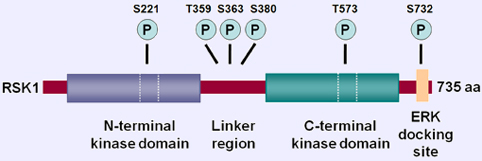
The RSK1 protein contains two kinase domains separated by a linker region of about 100 aa. While the N-terminal kinase domain (NTKD) belongs to the AGC family of kinases, the C-terminal kinase domain (CTKD) belongs to the CaMK family. RSK1 activation requires its interaction with ERK1 and ERK2 through its C-terminal ERK docking region, which initiates an ordered phosphorylation sequence leading to the phosphorylation of six serine or threonine residues (S221, T359, S363, S380, T573 and S732).
Description
The RSK1 protein consists of 735 amino acids, with an apparent molecular weight of about 85-90 kDa.
Expression
Northern analyses and RNase protection assays revealed that RSK1 is expressed in many tissues, with higher levels in skeletal muscle, kidney, lung, liver, pancreas, spleen, thymus, and brain. Although other RSK isoforms are expressed ubiquitously in the brain, RSK1 is most abundant in the cerebellum. In situ hybridization of mouse embryonic tissues revealed that RSK1 is strongly expressed in regions harbouring highly proliferating cells. These include liver, lung, and thymus, as well as olfactory, respiratory, and gut epithelia.
Localisation
RSK1 is normally present in the cytoplasm, but upon mitogenic stimulation it moves into the nucleus, where it phosphorylates several substrates involved in gene transcription. Within minutes of stimulation, RSK1 was shown to accumulate transiently at the plasma membrane, where it presumably receives additional inputs necessary for activation before nuclear translocation.
Function
Mitogenic stimulation of the Ras/ERK pathway leads to the activation of RSK1. RSK1 seems to be a multifunctional ERK effector because it participates in various cellular processes, including nuclear signalling. RSK1 was found to regulate several transcription factors, including SRF, c-Fos, and Nur77. Additional nuclear factors have been shown to be regulated by RSK1, including MITF, estrogen receptor-a nuclear factor (NF)-ATc4 and ER81. RSK1 was shown to interact with the transcriptional coactivator CREB-binding protein (CBP), which, interestingly, binds many transcription factors known to be regulated by RSK1. On the basis of the nature of its substrates, RSK1 seems to have important functions in cellular growth control and proliferation. RSK1 may stimulate cell cycle progression through the regulation of immediate early gene products, such as c-Fos, which promotes the expression of cyclin D1 during the G0/G1 transition to S phase. Other proteins through which RSK1 may stimulate proliferation include the cyclin-dependent kinase (CDK) inhibitor p27kip1, the Na+/H+ exchanger NHE-1 and the kinase GSK3. RSK1 has been shown to phosphorylate and inhibit neuronal NO synthase in response to mitogenic signaling. RSK1 may also promote proliferation by regulating cell-growth-related protein synthesis. Indeed, RSK1 was shown to phosphorylate the tumour suppressor proteins TSC2 and LKB1, thereby resulting in increased mTOR signalling and mRNA translation.
Homology
The RSK family contains four human isoforms (RSK1, RSK2, RSK3 and RSK4), which share 65-73% aa identity. RSK-related molecules have also been identified in C. elegans (T01H8.1) and D. melanogaster (RPS6-protein kinase-II), which share around 50% aa identity to human RSK1 and also contain the two kinase domains typical to RSK family members. No RSK homologues have been found in yeast or plant.
Mutations
Somatic
The natural variant K335T has been observed.
Implicated in
Entity name
Various cancers
Prognosis
Frequent activation of the Ras/ERK signalling pathway has been reported in a broad range of human cancers including various carcinomas, glioblastomas and hematological malignancies. In some of these tumour types, RSK1 expression has been shown to be increased, such as in cancers of the breast and prostate.
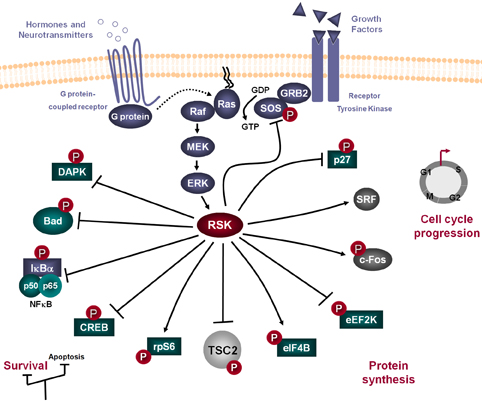
Hyperactivation of RSK has been reported in multiple cancers. Activation of growth factor receptors either by ligand stimulation or receptor overexpression/mutation are common mechanisms that lead to RSK activation. RSK is now known to be a central player in a signalling pathway consisting of many components that have been implicated in tumorigenesis, including upstream Ras GTPases and Raf kinases.
Oncogenesis
RSK1 is an important mediator of survival signals that protect cells from undergoing apoptosis and, thus, is a potentially important therapeutic target. Inhibition of RSK activity using the pharmacological inhibitor SL-0101 was shown to reduce the proliferation rates of breast cancer cells, but not normal breast epithelial cells.
Article Bibliography
| Pubmed ID | Last Year | Title | Authors |
|---|
Other Information
Locus ID:
NCBI: 6195
MIM: 601684
HGNC: 10430
Ensembl: ENSG00000117676
Variants:
dbSNP: 6195
ClinVar: 6195
TCGA: ENSG00000117676
COSMIC: RPS6KA1
RNA/Proteins
Expression (GTEx)
Pathways
Protein levels (Protein atlas)
References
| Pubmed ID | Year | Title | Citations |
|---|---|---|---|
| 37414921 | 2023 | The ribosomal protein S6 kinase alpha-1 (RPS6KA1) induces resistance to venetoclax/azacitidine in acute myeloid leukemia. | 2 |
| 37462338 | 2023 | Comprehensive analysis of the RSK gene family in acute myeloid leukemia determines a prognostic signature for the prediction of clinical prognosis and treatment responses. | 0 |
| 37414921 | 2023 | The ribosomal protein S6 kinase alpha-1 (RPS6KA1) induces resistance to venetoclax/azacitidine in acute myeloid leukemia. | 2 |
| 37462338 | 2023 | Comprehensive analysis of the RSK gene family in acute myeloid leukemia determines a prognostic signature for the prediction of clinical prognosis and treatment responses. | 0 |
| 35417913 | 2022 | Associations of the Methylation Levels of NFAT5, PVT1, RPS6KA1, and MIB1 with Steroid-Resistant Asthma. | 0 |
| 35417913 | 2022 | Associations of the Methylation Levels of NFAT5, PVT1, RPS6KA1, and MIB1 with Steroid-Resistant Asthma. | 0 |
| 34021083 | 2021 | Oncogenic KRAS engages an RSK1/NF1 pathway to inhibit wild-type RAS signaling in pancreatic cancer. | 12 |
| 34638542 | 2021 | The Preeclamptic Environment Promotes the Activation of Transcription Factor Kappa B by P53/RSK1 Complex in a HTR8/SVneo Trophoblastic Cell Line. | 4 |
| 34021083 | 2021 | Oncogenic KRAS engages an RSK1/NF1 pathway to inhibit wild-type RAS signaling in pancreatic cancer. | 12 |
| 34638542 | 2021 | The Preeclamptic Environment Promotes the Activation of Transcription Factor Kappa B by P53/RSK1 Complex in a HTR8/SVneo Trophoblastic Cell Line. | 4 |
| 31678930 | 2020 | Proteomic Analysis Reveals a Role for RSK in p120-catenin Phosphorylation and Melanoma Cell-Cell Adhesion. | 8 |
| 31701625 | 2020 | Aberrant expression of RSK1 characterizes high-grade gliomas with immune infiltration. | 7 |
| 32649858 | 2020 | MAP Kinase-Mediated Activation of RSK1 and MK2 Substrate Kinases. | 6 |
| 32711446 | 2020 | Pathway-Affecting Single Nucleotide Polymorphisms (SNPs) in RPS6KA1 and MBIP Genes are Associated with Breast Cancer Risk. | 2 |
| 33228180 | 2020 | Oxidative Stress Orchestrates MAPK and Nitric-Oxide Synthase Signal. | 25 |
Citation
Philippe P Roux
RPS6KA1 (ribosomal protein S6 kinase, 90kDa, polypeptide 1)
Atlas Genet Cytogenet Oncol Haematol. 2008-03-01
Online version: http://atlasgeneticsoncology.org/gene/43477/rps6ka1
