SIRT1 (sirtuin (silent mating type information regulation 2 homolog) 1 (S. cerevisiae))
2014-12-01 WenYong Chen AffiliationIdentity
Abstract
SIRT1 is a member of the mammalian sirtuin genes that encode for seven protein lysine modifiers with deacetylase, ADP-ribosyltransferase and other deacylase activities. SIRT1 plays diverse roles in regulating cell proliferation, differentiation, stress response, metabolism, energy homeostasis, aging and cancer. Besides deacetylating histone substrates, SIRT1 regulates functions of an array of non-histone proteins including transcriptional factors for gene regulation, DNA repair machinery elements for reducing catastrophic genome lesions, epigenetic factors for chromatin and gene regulation, nuclear receptors and circadian clock as well as related factors for metabolism, and other cell signaling molecules. SIRT1 is involved in many types of human cancer.
DNA/RNA
Description
Transcription
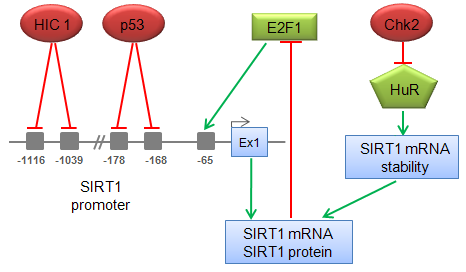
SIRT1 expression is also regulated at the posttranscriptional level by HuR. It has been demonstrated that HuR, a ubiquitously expressed RNA binding protein, associates with the 3 UTR of the SIRT1 mRNA under physiological conditions and helps to stabilize the transcript. This interaction results in increased SIRT1 mRNA stability and thus in elevated protein levels. Conversely, the HuR-SIRT1 mRNA complex is being disrupted upon oxidative stress, which finally leads to decreased mRNA stability and therefore decreased SIRT protein levels. In addition, several microRNA (miR) species negatively regulate SIRT1 mRNA by targeting its 3 UTR, including miR-34a and miR-200a (reviewed in Roth and Chen, 2014).
Pseudogene
Proteins
Description
Expression
Localisation
Function
(1) Lysines 9 and 14 in the amino-terminal tail of histone H3 and lysine 16 of histone H4 are deacetylated by yeast Sir2 and mammalian SIRT1 (Sir2alpha).
(2) Metabolic homeostasis is controlled by SIRT1-mediated deacetylation and thus activation of the peroxisome proliferation activating receptor (PPAR)-gamma co-activator-1a (PGC-1a), which stimulates mitochondrial activity and subsequently increases glucose metabolism, which in turn improves insulin sensitivity. SIRT1 represses PPAR-gamma, a key regulator of adipogenesis, by docking with its cofactors NCoR (nuclear receptor co-repressor) and SMRT (silencing mediator of retinoid and thyroid hormone receptors). The upregulation of SIRT1 triggers lipolysis and loss of fat.
(3) The activation of SIRT1 appears to be neuroprotective in animal models for Alzheimers disease and amyotrophic lateral sclerosis as well as optic neuritis mainly due to decreased deacetylation of the tumor suppressor p53 and PGC-1a.
(4) SIRT1 represses p53-dependent apoptosis in response to DNA damage and oxidative stress and promotes cell survival under cellular stress induced by etoposide treatment or irradiation.
(5) SIRT1 activates FOXO1 and FOXO4, which promote cell-cycle arrest by inducing p27kip1; SIRT1 also induces cellular resistance to oxidative stress by increasing the levels of manganese superoxide dismutase and GADD45 (growth arrest and DNA damage-inducible protein 45).
(6) SIRT1 inhibits the transcriptional activity of NF-kappaB by deacetylating NF-kappaBs subunit, RelA/p65, at lysine 310. Thus, although SIRT1 is capable of protecting cells from p53-induced apoptosis, it may augment apoptosis by repressing NF-kappaB. SIRT1 is reported to bind CTIP2 (BCL11B B-cell CLL/lymphoma 11B) and accelerate the transcriptional repression by this molecule. CTIP2 represses the transcription of its target genes and is implicated in hematopoietic cell development.
(7) SIRT1 deacetylates and activates functions of several DNA repair factors, including KU70, NBS1, APE1, XPA/C and WRN for multiple DNA damage repair pathways to cope with genotoxic stress. Stimulated repair may help cells avoid catastrophic genomic events and survive the damage.
(8) SIRT1 is involved in epigenetic regulation of genes and chromatin. SIRT1 deacetylates several histone tail lysines: histone H4 lysine 16 (H4K16), histone H3 K9 and K14, and histone H1 K26. These modifications of histone tails are closely related to gene silencing and heterochromatin formation that may underlie certain biological processes. SIRT1 can deacetylate DNA methyltransferase 1 (DNMT1) and can either enhance or hinder its methyltransferase activity, thus indirectly affecting global or local DNA methylation patterns. SIRT1 is a component of the polycomb repressor complex (PRC) that is involved in silencing genes during normal development. SIRT1 directly complexes with EZH2, a H3K27 methyltransferase within PRC II complex, and is an integral part of the PRCs silencing functions. A SIRT1-containing PRC complex, termed PRC4, is specifically found in transformed cells and embryonic stem cells. In addition, SIRT1 interacts and deacetylates the SUV39H1 methyltransferase, promoting histone H3 methylation and fostering heterochromatin formation, and repressing rRNA transcription to protect cells from energy deprivation-dependent apoptosis (reviewed in Roth and Chen, 2014).
Homology
Mutations
Germinal
Somatic
Implicated in
Article Bibliography
| Pubmed ID | Last Year | Title | Authors |
|---|---|---|---|
| 17317627 | 2007 | Phosphorylation of HuR by Chk2 regulates SIRT1 expression. | Abdelmohsen K et al |
| 19441904 | 2009 | Sirtuin inhibitors. | Alcaín FJ et al |
| 15486319 | 2004 | Silent information regulator 2alpha, a longevity factor and class III histone deacetylase, is an essential endogenous apoptosis inhibitor in cardiac myocytes. | Alcendor RR et al |
| 17003781 | 2006 | Altered sirtuin expression is associated with node-positive breast cancer. | Ashraf N et al |
| 23473037 | 2013 | Identification of a SIRT1 mutation in a family with type 1 diabetes. | Biason-Lauber A et al |
| 11289308 | 2001 | HuR and mRNA stability. | Brennan CM et al |
| 19132007 | 2009 | How does SIRT1 affect metabolism, senescence and cancer? | Brooks CL et al |
| 22249256 | 2012 | SIRT1 induces EMT by cooperating with EMT transcription factors and enhances prostate cancer cell migration and metastasis. | Byles V et al |
| 19166820 | 2009 | Enhanced radiosensitivity and radiation-induced apoptosis in glioma CD133-positive cells by knockdown of SirT1 expression. | Chang CJ et al |
| 16687393 | 2006 | Histone H2A.z is essential for cardiac myocyte hypertrophy but opposed by silent information regulator 2alpha. | Chen IY et al |
| 16269335 | 2005 | Tumor suppressor HIC1 directly regulates SIRT1 to modulate p53-dependent DNA-damage responses. | Chen WY et al |
| 15220471 | 2004 | Silent information regulator 2 potentiates Foxo1-mediated transcription through its deacetylase activity. | Daitoku H et al |
| 21596753 | 2011 | miR-200a regulates SIRT1 expression and epithelial to mesenchymal transition (EMT)-like transformation in mammary epithelial cells. | Eades G et al |
| 10381378 | 1999 | Characterization of five human cDNAs with homology to the yeast SIR2 gene: Sir2-like proteins (sirtuins) metabolize NAD and may have protein ADP-ribosyltransferase activity. | Frye RA et al |
| 19173742 | 2009 | Zyxin is a novel interacting partner for SIRT1. | Fujita Y et al |
| 16998474 | 2006 | Neddylation of a breast cancer-associated protein recruits a class III histone deacetylase that represses NFkappaB-dependent transcription. | Gao F et al |
| 11139331 | 2001 | The human histone deacetylase family. | Gray SG et al |
| 20078221 | 2010 | Mammalian sirtuins: biological insights and disease relevance. | Haigis MC et al |
| 22986535 | 2013 | SIRT1 promotes thyroid carcinogenesis driven by PTEN deficiency. | Herranz D et al |
| 12963026 | 2003 | Proteomics-based identification of differentially expressed genes in human gliomas: down-regulation of SIRT2 gene. | Hiratsuka M et al |
| 16006743 | 2005 | Transcriptional regulation of neuronal genes and its effect on neural functions: NAD-dependent histone deacetylase SIRT1 (Sir2alpha). | Hisahara S et al |
| 23340254 | 2013 | SIRT1 positively regulates breast cancer associated human aromatase (CYP19A1) expression. | Holloway KR et al |
| 23471411 | 2013 | Evidence for a common mechanism of SIRT1 regulation by allosteric activators. | Hubbard BP et al |
| 17638871 | 2007 | SIRT1 is significantly elevated in mouse and human prostate cancer. | Huffman DM et al |
| 10693811 | 2000 | Transcriptional silencing and longevity protein Sir2 is an NAD-dependent histone deacetylase. | Imai S et al |
| 16909107 | 2007 | SIRT2, a tubulin deacetylase, acts to block the entry to chromosome condensation in response to mitotic stress. | Inoue T et al |
| 19404850 | 2009 | Expression and prognostic significance of SIRT1 in ovarian epithelial tumours. | Jang KY et al |
| 10521401 | 1999 | The SIR2/3/4 complex and SIR2 alone promote longevity in Saccharomyces cerevisiae by two different mechanisms. | Kaeberlein M et al |
| 22017869 | 2011 | Peptide switch is essential for Sirt1 deacetylase activity. | Kang H et al |
| 17581637 | 2007 | SIRT1 deacetylase protects against neurodegeneration in models for Alzheimer's disease and amyotrophic lateral sclerosis. | Kim D et al |
| 17964266 | 2007 | Active regulator of SIRT1 cooperates with SIRT1 and facilitates suppression of p53 activity. | Kim EJ et al |
| 18235501 | 2008 | DBC1 is a negative regulator of SIRT1. | Kim JE et al |
| 16012755 | 2005 | SIRT1 is critical regulator of FOXO-mediated transcription in response to oxidative stress. | Kobayashi Y et al |
| 17098745 | 2007 | SIRT1 inhibits transforming growth factor beta-induced apoptosis in glomerular mesangial cells via Smad7 deacetylation. | Kume S et al |
| 25280219 | 2014 | SIRT1 activation by a c-MYC oncogenic network promotes the maintenance and drug resistance of human FLT3-ITD acute myeloid leukemia stem cells. | Li L et al |
| 22340598 | 2012 | Activation of p53 by SIRT1 inhibition enhances elimination of CML leukemia stem cells in combination with imatinib. | Li L et al |
| 19244112 | 2009 | The critical role of the class III histone deacetylase SIRT1 in cancer. | Liu T et al |
| 11672522 | 2001 | Negative control of p53 by Sir2alpha promotes cell survival under stress. | Luo J et al |
| 21698133 | 2011 | SIRT1 promotes N-Myc oncogenesis through a positive feedback loop involving the effects of MKP3 and ERK on N-Myc protein stability. | Marshall GM et al |
| 22190494 | 2012 | The c-MYC oncoprotein, the NAMPT enzyme, the SIRT1-inhibitor DBC1, and the SIRT1 deacetylase form a positive feedback loop. | Menssen A et al |
| 17447894 | 2007 | Sirtuins in mammals: insights into their biological function. | Michan S et al |
| 18485871 | 2008 | Epigenetic control of rDNA loci in response to intracellular energy status. | Murayama A et al |
| 22055503 | 2011 | PPARα-Sirt1 complex mediates cardiac hypertrophy and failure through suppression of the ERR transcriptional pathway. | Oka S et al |
| 21947282 | 2011 | SIRT1 deacetylates the DNA methyltransferase 1 (DNMT1) protein and alters its activities. | Peng L et al |
| 15175761 | 2004 | Sirt1 promotes fat mobilization in white adipocytes by repressing PPAR-gamma. | Picard F et al |
| 16207712 | 2005 | Poly(ADP-ribose) polymerase-1-dependent cardiac myocyte cell death during heart failure is mediated by NAD+ depletion and reduced Sir2alpha deacetylase activity. | Pillai JB et al |
| 15744310 | 2005 | Nutrient control of glucose homeostasis through a complex of PGC-1alpha and SIRT1. | Rodgers JT et al |
| 23604120 | 2014 | Sorting out functions of sirtuins in cancer. | Roth M et al |
| 24855208 | 2014 | SIRT1 prevents genotoxic stress-induced p53 activation in acute myeloid leukemia. | Sasca D et al |
| 16756498 | 2006 | The biochemistry of sirtuins. | Sauve AA et al |
| 12930829 | 2003 | Involvement of the histone deacetylase SIRT1 in chicken ovalbumin upstream promoter transcription factor (COUP-TF)-interacting protein 2-mediated transcriptional repression. | Senawong T et al |
| 17652729 | 2007 | SIRT1 activation confers neuroprotection in experimental optic neuritis. | Shindler KS et al |
| 17283066 | 2007 | An acetylation/deacetylation-SUMOylation switch through a phylogenetically conserved psiKXEP motif in the tumor suppressor HIC1 regulates transcriptional repression activity. | Stankovic-Valentin N et al |
| 21775285 | 2011 | The deacetylase SIRT1 promotes membrane localization and activation of Akt and PDK1 during tumorigenesis and cardiac hypertrophy. | Sundaresan NR et al |
| 17197703 | 2007 | Nucleocytoplasmic shuttling of the NAD+-dependent histone deacetylase SIRT1. | Tanno M et al |
| 19649206 | 2009 | Distinct HIC1-SIRT1-p53 loop deregulation in lung squamous carcinoma and adenocarcinoma patients. | Tseng RC et al |
| 18004385 | 2007 | SIRT1 regulates the histone methyl-transferase SUV39H1 during heterochromatin formation. | Vaquero A et al |
| 11672523 | 2001 | hSIR2(SIRT1) functions as an NAD-dependent p53 deacetylase. | Vaziri H et al |
| 16328012 | 2006 | Cloning, chromosomal characterization and mapping of the NAD-dependent histone deacetylases gene sirtuin 1. | Voelter-Mahlknecht S et al |
| 20956937 | 2011 | NAMPT overexpression in prostate cancer and its contribution to tumor cell survival and stress response. | Wang B et al |
| 16892051 | 2006 | Interactions between E2F1 and SirT1 regulate apoptotic response to DNA damage. | Wang C et al |
| 24019998 | 2013 | Emerging Roles of SIRT1 in Cancer Drug Resistance. | Wang Z et al |
| 22410779 | 2013 | SIRT1 deacetylase promotes acquisition of genetic mutations for drug resistance in CML cells. | Wang Z et al |
| 18755897 | 2008 | miR-34a repression of SIRT1 regulates apoptosis. | Yamakuchi M et al |
| 17934453 | 2007 | SIRT1 sumoylation regulates its deacetylase activity and cellular response to genotoxic stress. | Yang Y et al |
| 15152190 | 2004 | Modulation of NF-kappaB-dependent transcription and cell survival by the SIRT1 deacetylase. | Yeung F et al |
| 24133372 | 2013 | The emerging and diverse roles of sirtuins in cancer: a clinical perspective. | Yuan H et al |
| 22207735 | 2012 | Activation of stress response gene SIRT1 by BCR-ABL promotes leukemogenesis. | Yuan H et al |
| 18235502 | 2008 | Negative regulation of the deacetylase SIRT1 by DBC1. | Zhao W et al |
| 23778143 | 2013 | Sirtuin 1 inhibition delays cyst formation in autosomal-dominant polycystic kidney disease. | Zhou X et al |
| 18774777 | 2008 | SIRTUIN 1: regulating the regulator. | Zschoernig B et al |
| 15126506 | 2004 | FOXO4 is acetylated upon peroxide stress and deacetylated by the longevity protein hSir2(SIRT1). | van der Horst A et al |
Other Information
Locus ID:
NCBI: 23411
MIM: 604479
HGNC: 14929
Ensembl: ENSG00000096717
Variants:
dbSNP: 23411
ClinVar: 23411
TCGA: ENSG00000096717
COSMIC: SIRT1
RNA/Proteins
Expression (GTEx)
Pathways
Protein levels (Protein atlas)
PharmGKB
| Entity ID | Name | Type | Evidence | Association | PK | PD | PMIDs |
|---|---|---|---|---|---|---|---|
| PA142672073 | CRTC2 | Gene | Pathway | associated | 22722338 | ||
| PA335 | SREBF1 | Gene | Pathway | associated | 22722338 | ||
| PA33558 | PPARGC1A | Gene | Pathway | associated | 22722338 | ||
| PA33744 | PRKAA1 | Gene | Pathway | associated | 22722338 | ||
| PA33745 | PRKAA2 | Gene | Pathway | associated | 22722338 | ||
| PA33746 | PRKAB1 | Gene | Pathway | associated | 22722338 | ||
| PA33747 | PRKAB2 | Gene | Pathway | associated | 22722338 | ||
| PA33751 | PRKAG1 | Gene | Pathway | associated | 22722338 | ||
| PA33752 | PRKAG2 | Gene | Pathway | associated | 22722338 | ||
| PA33753 | PRKAG3 | Gene | Pathway | associated | 22722338 |
References
| Pubmed ID | Year | Title | Citations |
|---|---|---|---|
| 37311988 | 2024 | Delivery of SIRT1 by cancer-associated adipocyte-derived extracellular vesicles regulates immune response and tumorigenesis of ovarian cancer cells. | 2 |
| 37665721 | 2024 | Sirtuin 1 overexpression contributes to the expansion of follicular helper T cells in systemic lupus erythematosus and may serve as an accessible therapeutic target. | 1 |
| 37695462 | 2024 | Effect of SIRT1 gene single-nucleotide polymorphisms on susceptibility to type 1 diabetes in a Han Chinese population. | 0 |
| 37697693 | 2024 | Effects of Schumann resonance on the proliferation and migration of normal human epidermal keratinocytes and the expression of DEFB1 and SIRT1. | 0 |
| 37728850 | 2024 | Neuronal Stem Cells from Late-Onset Alzheimer Patients Show Altered Regulation of Sirtuin 1 Depending on Apolipoprotein E Indicating Disturbed Stem Cell Plasticity. | 1 |
| 37758217 | 2024 | SIRT1 and miR-34a-5p Expression in PBMCs as Potential Biomarkers for Patients With Type 2 Diabetes With Cognitive Impairments. | 0 |
| 37776468 | 2024 | miR-29a-SIRT1-Wnt/β-Catenin Axis Regulates Tumor Progression and Survival in Hepatocellular Carcinoma. | 0 |
| 37866664 | 2024 | circ_SIRT1 upregulates ATG12 to facilitate Imatinib resistance in CML through interacting with EIF4A3. | 0 |
| 38149816 | 2024 | Up-regulation of TNF-alpha/NFkB/SIRT1 axis drives aggressiveness and cancer stem cells accumulation in chemoresistant oral squamous cell carcinoma. | 1 |
| 38176954 | 2024 | Inhibition of glycolysis and SIRT1/GLUT1 signaling ameliorates the apoptotic effect of Leptosidin in prostate cancer cells. | 0 |
| 38195017 | 2024 | Heterogeneous nuclear ribonucleoprotein F deficiency in mouse podocyte promotes podocytopathy mediated by methyltransferase-like 14 nuclear translocation resulting in Sirtuin 1 gene inhibition. | 0 |
| 38237370 | 2024 | SIRT1 regulates endoplasmic reticulum stress-related organ damage. | 0 |
| 38255792 | 2024 | Reduced SIRT1 and SIRT3 and Lower Antioxidant Capacity of Seminal Plasma Is Associated with Shorter Sperm Telomere Length in Oligospermic Men. | 1 |
| 38270305 | 2024 | Metformin inhibits high glucose-induced apoptosis of renal podocyte through regulating miR-34a/SIRT1 axis. | 0 |
| 38293991 | 2024 | [LncRNA SOX2OT enhances 5-fluorouracil resistance of cholangiocarcinoma cells by promoting autophagy via up-regulating SIRT1 expression]. | 0 |
Citation
WenYong Chen
SIRT1 (sirtuin (silent mating type information regulation 2 homolog) 1 (S. cerevisiae))
Atlas Genet Cytogenet Oncol Haematol. 2014-12-01
Online version: http://atlasgeneticsoncology.org/gene/44006/sirt1
Historical Card
2010-03-01 SIRT1 (sirtuin (silent mating type information regulation 2 homolog) 1 (S. cerevisiae)) by Ruo-Chia Tseng,Yi-Ching Wan Affiliation
