SPP1 (secreted phosphoprotein 1)
2008-11-01 Lígia R Rodrigues AffiliationIBB - Institute for Biotechnology, Bioengineering, Centre of Biological Engineering, Universidade do Minho, 4710-057 Braga, Portugal
Identity
HGNC
LOCATION
4q22.1
LOCUSID
ALIAS
BNSP,BSPI,ETA-1,OPN
FUSION GENES
DNA/RNA
Note
Genes encompassed within a 600 kb region on human chromosome 4 encode several noncollageneous bone and dentin proteins. They include osteopontin, bone sialoprotein, dentin matrix protein I, and dentin sialophosphoprotein, all of which have been categorized as members of the small integring-binding ligand N-linked glycoprotein (SIBLING) family-related proteins. The 4 proteins are somewhat similar being secreted, sialylated, phosphorylated, and acidic in nature.
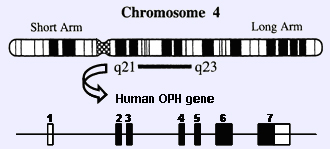
The gene structure of human osteopontin. Exons are boxed, filled boxes are coding regions and open boxes are untranslated regions.
Description
- Osteopontin is encoded by a single copy gene located on the human chromosome 4; 7 exons.
- Codon triplets are not interrupted by introns, and consequently, exon skipping will not affect the codon triplets in the remaining exons.
- The human gene sequence spans ~9 kb and the open reading frame consists of 942 nucleotides from the start codon (in exon 2) to the stop codon (in exon 7).
- Codon triplets are not interrupted by introns, and consequently, exon skipping will not affect the codon triplets in the remaining exons.
- The human gene sequence spans ~9 kb and the open reading frame consists of 942 nucleotides from the start codon (in exon 2) to the stop codon (in exon 7).
Transcription
- The 5-untranslated region includes exon 1, which starts a transcription initiation site (AGC).
- The 3-untranslated region consists of the last part of exon 7, which includes three potential polyadenylation attachment signals (AATAA).
- Exon 2 encodes the signal peptide and the first two amino acids in the mature protein.
- Exon 3 and 5, the two characteristic Ser-Ser-Glu-Glu phosphorylation sequences.
- Exon 4, the two transglutaminase-reactive glutamine residues.
- Exon 6, the aspartic-rich sequence.
- Exon 7 is the largest exon encoding approzimately half of the proteins including the RGD motif and the central thrombin cleavage site.
- There are 3 transcripts for osteopontin splice variants that are OPN-a, OPN-b and OPN-c. Alternative splicing occurs in a region of the molecule that is upstream of the central integrin binding domain and the C-terminal CD44 binding domain. OPN-b lacks exon 5 and OPN-c lacks exon 4.
- Transcriptional regulation is complex and involves multiple pathways including AP-1, Myc, v-Src, RunX/CBF, TGF-B/BMPS/Smad/Hox and Wnt/b-catenin/APC/GSK-3b/Tcf-4.
- The 3-untranslated region consists of the last part of exon 7, which includes three potential polyadenylation attachment signals (AATAA).
- Exon 2 encodes the signal peptide and the first two amino acids in the mature protein.
- Exon 3 and 5, the two characteristic Ser-Ser-Glu-Glu phosphorylation sequences.
- Exon 4, the two transglutaminase-reactive glutamine residues.
- Exon 6, the aspartic-rich sequence.
- Exon 7 is the largest exon encoding approzimately half of the proteins including the RGD motif and the central thrombin cleavage site.
- There are 3 transcripts for osteopontin splice variants that are OPN-a, OPN-b and OPN-c. Alternative splicing occurs in a region of the molecule that is upstream of the central integrin binding domain and the C-terminal CD44 binding domain. OPN-b lacks exon 5 and OPN-c lacks exon 4.
- Transcriptional regulation is complex and involves multiple pathways including AP-1, Myc, v-Src, RunX/CBF, TGF-B/BMPS/Smad/Hox and Wnt/b-catenin/APC/GSK-3b/Tcf-4.
Proteins
Note
Osteopontin serves as a substrate for thrombin and matrix metalloproteinases (MMP2, MMP3, MMP7, MMP9 and MMP12), can bind to the extracellular matrix proteins fibronectin and collagen, and interacts with integrins alphaV (beta1, beta2 or beta5) and (alpha4, alpha5, alpha8 or alpha9) beta1 surface receptors through an Arg-Gly-Asp (RGD) sequence.
Secreted phosphoprotein 1 (or osteopontin) was identified with 7 protein interactions: ITGAV, IGFBP5, PDLIM7, CD44, ITGA5, CTNNBL1, SGTA.
Secreted phosphoprotein 1 (or osteopontin) was identified with 7 protein interactions: ITGAV, IGFBP5, PDLIM7, CD44, ITGA5, CTNNBL1, SGTA.

Structure of human osteopontin protein indicating selected structural domains.
Description
- Recommended name: osteopontin.
- Osteopontin is 314 amino acids in length.
- The molecular weight of osteopontin and associated isoforms are measured between 41 and 75 kDa. Post-translational modifications leading to cell-type and condition-specific variations may account for this variability in molecular weight.
- Osteopontin is extremely hydrophilic with a low isoelectric point (3.5).
- It displays an unusual amino acid composition with 42 serine, 48 aspartic acid and 27 glutaminc acid residues. It is important to notice that 27 out of the 42 serine serine residues are phosphorylated.
- The predicted secondary structure of osteopontin consists of eight alpha-helices and six beta-sheet segments.
- Strutural domains:
Aspartate domain - amino acid sequence Asp86-Asp89 - binds hydroxyapatite,
RGD sequence - amino acid sequence Arg159-Asp159 - binds alphaVbeta3, alphaVbeta1, alphaVbeta5 and alpha5beta1 integrins,
SVVYGLR sequence - amino acid sequence Ser162-Arg168 - binds alpha9beta1 and alpha1beta1 integrins,
Thrombin cleavage site - amino acid sequence Arg168-Ser169 - displays RGD sequence,
Calcium binding domain - amino acid sequence Asp216-Ser228 - calcium binding,
Heparin binding domain - amino acid sequence Asp290-Ile305 - mediates CD44v3 binding.
- Post-translational modifications:
Extensively phosphorylated on clustered serine residues,
N- and O-glycosylated.
- Osteopontin is 314 amino acids in length.
- The molecular weight of osteopontin and associated isoforms are measured between 41 and 75 kDa. Post-translational modifications leading to cell-type and condition-specific variations may account for this variability in molecular weight.
- Osteopontin is extremely hydrophilic with a low isoelectric point (3.5).
- It displays an unusual amino acid composition with 42 serine, 48 aspartic acid and 27 glutaminc acid residues. It is important to notice that 27 out of the 42 serine serine residues are phosphorylated.
- The predicted secondary structure of osteopontin consists of eight alpha-helices and six beta-sheet segments.
- Strutural domains:
- Post-translational modifications:
Expression
Osteopontin is expressed by cells in a variety of tissues, including bone, dentin, cementum, hypertrophic cartilage, kidney, brain, bone-marrow-derived metrial gland cells, vascular tissues and cytotrophoblasts of the chorionic villus in the uterus and decidua, ganglia of the inner ear, brain cells and specialized epithelia found in mammary, salivary, and sweat glands, in bile and pancreatic ducts, and in distal renal tubules and in the gut, as well as in activated macrophages and lymphocytes.
Cell types which express osteopontin: osteoclasts, osteoblasts, kidney, breast and skin epithelial cells, nerve cells, vascular smooth muscle cells and endothelial cells. Activated immune cells (T-cells, NK cells, macrophages and Kupfter cells) also express osteopontin.
Cell types which express osteopontin: osteoclasts, osteoblasts, kidney, breast and skin epithelial cells, nerve cells, vascular smooth muscle cells and endothelial cells. Activated immune cells (T-cells, NK cells, macrophages and Kupfter cells) also express osteopontin.
Localisation
It is predominantly secreted but its intracellular form has also been described.
Function
- Binds tightly to hydroxyapatite. Appears to form an integral part of the mineralized matrix. Probably important to cell-matrix interaction.
- Acts as a cytokine involved in enhancing production of interferon-gamma and interleukin-12 and reducing production of interleukin-10 and is essential in the pathway that leads to type I immunity.
- Participates in bone remodelling, inflammation, cancer and immunity to infection disease.
- Regulates the formation and growth of calcium phosphate and oxalate crystals.
- Is involved in cell attachment and signalling through integrins.
- Is involved in cell attachment and signalling through CD44.
- Acts as a cytokine involved in enhancing production of interferon-gamma and interleukin-12 and reducing production of interleukin-10 and is essential in the pathway that leads to type I immunity.
- Participates in bone remodelling, inflammation, cancer and immunity to infection disease.
- Regulates the formation and growth of calcium phosphate and oxalate crystals.
- Is involved in cell attachment and signalling through integrins.
- Is involved in cell attachment and signalling through CD44.
Homology
The amino acid sequence of osteopontin is nowadays available for several species, such as rat, mouse, human, pig, rabbit and cow. The referenced mammalian osteopontin sequences are identical in ~33% of the residues, and in addition, many similar amino acids are conserved between the sequences. Identical residues are scattered in clusters. More specifically, the larger clusters are located in the hydrophobic leader sequence (the first 16 residues), in a potential site for N-linked glycosylation, and in several sites for O-linked glycosylation and phosphorylation. A stretch of consecutive aspartic acid residues was also found in all species, as well as a cell attachment RGD motif almost immediately followed by a thrombin cleavage site.
Implicated in
Entity name
Multiple cancers
Note
The ability of osteopontin to interact with a diverse range of factors including cell surface receptors (integrins, CD44), secreted proteases (matrix metalloproteinases, urokinase plasminogen activator) and growth factor/receptor pathways (TGFalpha/EGFR, HGF/MET) is central to its role in malignancy.
Changes in gene expression implies alterations in cell properties involved in malignancy such as adhesion, migration, invasion, enhanced tumour survival, tumour angiogenesis, and metastasis.
Changes in gene expression implies alterations in cell properties involved in malignancy such as adhesion, migration, invasion, enhanced tumour survival, tumour angiogenesis, and metastasis.
Disease
Multiple cancers such as breast, thyroid, cervical, prostate, lung, gastric, liver and colon.
At present, it is fully accepted that osteopontin expressed by tumour cells alters their malignant properties, specifically by affecting their ability to grow, invade, and metastatize. However, it is important to notice that osteopontin is expressed both in normal and malignant tissues. Recent studies suggest that osteopontin levels in the blood or tumours of patients with cancer may provide useful clinical information on patient prognoses.
At present, it is fully accepted that osteopontin expressed by tumour cells alters their malignant properties, specifically by affecting their ability to grow, invade, and metastatize. However, it is important to notice that osteopontin is expressed both in normal and malignant tissues. Recent studies suggest that osteopontin levels in the blood or tumours of patients with cancer may provide useful clinical information on patient prognoses.
Prognosis
Elevated osteopontin expression correlate with tumour invasion, progression or metastasis in multiple cancers (thyroid, cervical, breast, prostate, lung, gastric, liver and colon). Osteopontin expression is associated with disease progression in patients, with higher levels of osteopontin produced by cancer cells associated with a poorer patient survival.
Oncogenesis
Osteopontin is believed to be an effector of activated oncogenes functioning to facilitate tumour growth and metastasis.
Article Bibliography
| Pubmed ID | Last Year | Title | Authors |
|---|---|---|---|
| 15099946 | 2004 | Utility of osteopontin as a biomarker in recurrent epithelial ovarian cancer. | Brakora KA et al |
| 1421573 | 1992 | Expression and distribution of osteopontin in human tissues: widespread association with luminal epithelial surfaces. | Brown LF et al |
| 8080043 | 1994 | Osteopontin expression and distribution in human carcinomas. | Brown LF et al |
| 2698313 | 1989 | The nature and significance of osteopontin. | Butler WT et al |
| 18172307 | 2008 | Osteopontin promotes vascular endothelial growth factor-dependent breast tumor growth and angiogenesis via autocrine and paracrine mechanisms. | Chakraborty G et al |
| 15869464 | 2005 | Post-translationally modified residues of native human osteopontin are located in clusters: identification of 36 phosphorylation and five O-glycosylation sites and their biological implications. | Christensen B et al |
| 8262332 | 1993 | Osteopontin: a protein with diverse functions. | Denhardt DT et al |
| 11899236 | 2001 | The functional and clinical roles of osteopontin in cancer and metastasis. | Furger KA et al |
| 18470911 | 2008 | Downregulation of osteopontin contributes to metastasis suppression by breast cancer metastasis suppressor 1. | Hedley BD et al |
| 7945249 | 1994 | Cloning and characterization of the human osteopontin gene and its promoter. | Hijiya N et al |
| 2726470 | 1989 | The cDNA and derived amino acid sequence for human osteopontin. | Kiefer MC et al |
| 11926891 | 2002 | Osteopontin as a potential diagnostic biomarker for ovarian cancer. | Kim JH et al |
| 11834767 | 2002 | Osteopontin--a molecule for all seasons. | Mazzali M et al |
| 17960616 | 2008 | Osteopontin-c is a selective marker of breast cancer. | Mirza M et al |
| 9425320 | 1997 | The role of osteopontin in tumorigenesis and metastasis. | Oates AJ et al |
| 18378437 | 2008 | Genetic networks of cooperative redox regulation of osteopontin. | Partridge CR et al |
| 9342184 | 1997 | Osteopontin expression in mammary gland development and tumorigenesis. | Rittling SR et al |
| 17548669 | 2007 | The role of osteopontin in tumor progression and metastasis in breast cancer. | Rodrigues LR et al |
| 11021631 | 2000 | Osteopontin. | Sodek J et al |
| 17721886 | 2007 | Osteopontin overexpression in breast cancer: knowledge gained and possible implications for clinical management. | Tuck AB et al |
| 18049863 | 2008 | Osteopontin: regulation in tumor metastasis. | Wai PY et al |
| 11825687 | 2001 | The metastasis gene osteopontin: a candidate target for cancer therapy. | Weber GF et al |
Other Information
Locus ID:
NCBI: 6696
MIM: 166490
HGNC: 11255
Ensembl: ENSG00000118785
Variants:
dbSNP: 6696
ClinVar: 6696
TCGA: ENSG00000118785
COSMIC: SPP1
RNA/Proteins
Expression (GTEx)
Pathways
Protein levels (Protein atlas)
PharmGKB
| Entity ID | Name | Type | Evidence | Association | PK | PD | PMIDs |
|---|---|---|---|---|---|---|---|
| PA443434 | Arthritis, Rheumatoid | Disease | MultilinkAnnotation | associated | 24448344 |
References
| Pubmed ID | Year | Title | Citations |
|---|---|---|---|
| 37878112 | 2024 | Osteopontin: an essential regulatory protein in idiopathic pulmonary fibrosis. | 0 |
| 37976180 | 2024 | Crosstalk of platelets with macrophages and fibroblasts aggravates inflammation, aortic wall stiffening, and osteopontin release in abdominal aortic aneurysm. | 3 |
| 38058256 | 2024 | Expression pattern of osteopontin isoforms in malignant melanoma cell lines. | 2 |
| 38167532 | 2024 | Proteomic profiling identifies SPP1 associated with rapidly progressive interstitial lung disease in anti-MDA5-positive dermatomyositis. | 0 |
| 38217023 | 2024 | Deciphering tumor microenvironment: CXCL9 and SPP1 as crucial determinants of tumor-associated macrophage polarity and prognostic indicators. | 2 |
| 38256074 | 2024 | Association of the rs1126616 and rs9138 Variants in the SPP1 Gene among Mexican Patients with Systemic Lupus Erythematosus and Lupus Nephritis. | 1 |
| 38264915 | 2024 | Osteopontin is associated with neutrophil extracellular trap formation in elderly patients with severe sepsis. | 0 |
| 38279773 | 2024 | Osteopontin interacts with dendritic cells and macrophages in pulp inflammation: Comprehensive transcriptomic analysis and laboratory investigations. | 0 |
| 38280808 | 2024 | Osteopontin in cancer. | 0 |
| 38310994 | 2024 | METTL3/16-mediated m(6)A modification of ZNNT1 promotes hepatocellular carcinoma progression by activating ZNNT1/osteopontin/S100A9 positive feedback loop-mediated crosstalk between macrophages and tumour cells. | 0 |
| 38329443 | 2024 | Overexpression of SPP1 is a prognostic indicator of immune infiltration in lung adenocarcinoma. | 0 |
| 38426091 | 2024 | Serum secreted phosphoprotein 1 level is associated with plaque vulnerability in patients with coronary artery disease. | 0 |
| 38443806 | 2024 | Osteopontin, osteoprotegerin and musculoskeletal ultrasound findings in first-degree relatives of rheumatoid arthritis: potential markers of preclinical disease. | 1 |
| 38511216 | 2024 | Targeting osteopontin alleviates endometriosis and inflammation by inhibiting the RhoA/ROS axis and achieves non-invasive in vitro detection via menstrual blood. | 0 |
| 38566328 | 2024 | Integrated bioinformatics analysis identified leucine rich repeat containing 15 and secreted phosphoprotein 1 as hub genes for calcific aortic valve disease and osteoarthritis. | 2 |
Citation
Lígia R Rodrigues
SPP1 (secreted phosphoprotein 1)
Atlas Genet Cytogenet Oncol Haematol. 2008-11-01
Online version: http://atlasgeneticsoncology.org/gene/42379/spp1
