TNFRSF6B (tumor necrosis factor receptor superfamily, member 6b, decoy)
2007-12-01 Jiangping Wu , Bing Han AffiliationCHUM Research Center, University of Montreal, Canada
DNA/RNA

Description
DNA sequence is located on chromosome 20. Transcription consists of 7 exons and 6 introns, spanning 3.6kb.
A shorter transcription variance (M68E) has been identified, and is transcribed from 3 exons and 2 introns spanning 1.9kb as illustrated above. The difference occurs at the 5 untranslated region, but the two transcripts encode the same isoform. Mice do not have a gene orthologue to human TNFRSF6B.
TNFRSF68B mRNA in Northen blot presents as a 1.2-knt band.
A shorter transcription variance (M68E) has been identified, and is transcribed from 3 exons and 2 introns spanning 1.9kb as illustrated above. The difference occurs at the 5 untranslated region, but the two transcripts encode the same isoform. Mice do not have a gene orthologue to human TNFRSF6B.
TNFRSF68B mRNA in Northen blot presents as a 1.2-knt band.
Proteins
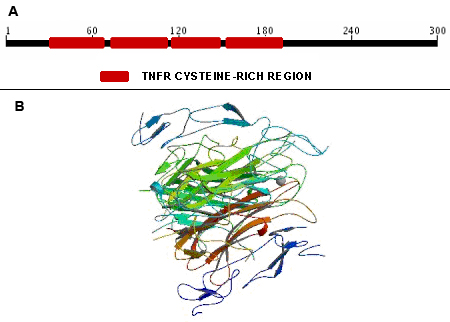
A) Domains and Motifs. B) TNFRSF6B X-ray crystography
Description
TNFRSF6B protein is 300-amino acid long, and has a molecular weight of 35 kD. Although TNFRSF6B belongs to the TNFR superfamily, it lacks the transmembrane and cytosolic domains in its sequence, and is a secreted protein. It contains 4 TNFR cystein-rich regions, as illustrated above.
TNFRSF6B can be easily cleaved between Arg218 and Ala219 in biological fluids and solutions. It has thus a very short (about 20 min) half-life in serum and in vivo. Mutation of arginine residue at position 218 to glutamine makes TNFRSF6B resistant to proteolysis, and significantly prolongs its half-life.
TNFRSF6B can bind to the TNF family members FasL, LIGHT and TL1A. It does not bind to other known TNF family members. Human TNFRSF6B can bind to mouse FasL, LIGHT and TL1A. This allows human DcR3/TNFRSF6B to function in mouse models both in vitro and in vivo.
The role of TNFRSF6B in apoptosis is obvious. FasL is a well-known molecule involved in apoptosis. LIGHT is a ligand for HVEM and LTbetaR, in addition to being a ligand for TNFRSF6B. LIGHT can induce apoptosis in cells expressing both HVEM and LTbetaR, or LTbetaR alone. TL1A, a member of the TNF family, can evoke apoptosis via its receptor, DR3. Consequently, the interaction of TNFRSF6B with FasL, LIGHT, and TL1A blocks apoptosis mediated by Fas, HVEM, LTbetaR and DR3.
TNFRSF6B can be easily cleaved between Arg218 and Ala219 in biological fluids and solutions. It has thus a very short (about 20 min) half-life in serum and in vivo. Mutation of arginine residue at position 218 to glutamine makes TNFRSF6B resistant to proteolysis, and significantly prolongs its half-life.
TNFRSF6B can bind to the TNF family members FasL, LIGHT and TL1A. It does not bind to other known TNF family members. Human TNFRSF6B can bind to mouse FasL, LIGHT and TL1A. This allows human DcR3/TNFRSF6B to function in mouse models both in vitro and in vivo.
The role of TNFRSF6B in apoptosis is obvious. FasL is a well-known molecule involved in apoptosis. LIGHT is a ligand for HVEM and LTbetaR, in addition to being a ligand for TNFRSF6B. LIGHT can induce apoptosis in cells expressing both HVEM and LTbetaR, or LTbetaR alone. TL1A, a member of the TNF family, can evoke apoptosis via its receptor, DR3. Consequently, the interaction of TNFRSF6B with FasL, LIGHT, and TL1A blocks apoptosis mediated by Fas, HVEM, LTbetaR and DR3.
Expression
Normal tissue and cells express low-level TNFRSF6B, and healthy individuals have near-background serum TNFRSF6B levels. About 60% of malignant tumors of various tissue origins overexpress TNFRSF6B, and these patients have elevated serum TNFRSF6B levels. Serum TNFRSF6B levels of tumor patients are positively correlated to the degree of tumor malignancy and status of metastasis. It is hypothesized that malignant tumor cells secrete TNFRSF6B as a way to achieve survival advantage by blocking multiple apoptosis pathways.
Hepatocytes in liver cirrhosis have augmented TNFRSF6B expression and patients with liver cirrhosis have increased serum TNFRSF6B levels.
TNFRSF6B expression is low in resting T cells but is augmented in activated T cells, which probably represents a fine-tuning mechanism to balance the need for clonal expansion and subsequent massive activation-induced T cell death. About 40% of systemic lupus erythematosus patients have elevated serum TNFRSF6B levels.
TNFRSF6B expression in rheumatoid arthritis fibroblast-like synoviocytes is increased by TNFalpha
Hepatocytes in liver cirrhosis have augmented TNFRSF6B expression and patients with liver cirrhosis have increased serum TNFRSF6B levels.
TNFRSF6B expression is low in resting T cells but is augmented in activated T cells, which probably represents a fine-tuning mechanism to balance the need for clonal expansion and subsequent massive activation-induced T cell death. About 40% of systemic lupus erythematosus patients have elevated serum TNFRSF6B levels.
TNFRSF6B expression in rheumatoid arthritis fibroblast-like synoviocytes is increased by TNFalpha
Localisation
TNFRSF6B is a secreted protein, and is thus detected in body fluids. However, it can also be detected in cytoplasm before it is secreted.
Function
As TNFRSF6B can block ligands from interacting with Fas, HVEM, LTbetaR, and DR3, all of which mediate apoptosis, it is thus can effectively inhibit apoptosis in many cell types. It is believed that many types of malignant tumors gain survival advantage by secreting TNFRSF6B which blocks tumor cell apoptosis.
Syngeneic islets transplanted to diabetes recipients survive better in the presence of administered exogenous human TNFRSF6B, due to the blockage of FasL-, LIGHT- and TL1A-triggered islets apoptosis. Transgenic expression of human TNFRSF6B in NOD mouse islets reduces diabetes pathogenesis, again, due to anti-apoptotic effect of TNFRSF6B.
The forward signaling from FasL to Fas, and from LIGHT to HVEM can provide costimulation signals to resting T cells. Blocking of these two signaling pathways reduces T cell responses to antigens. As LIGHT and FasL, although being ligands, are also transmembrane proteins, and are capable of reversely transducing costimulating signals into T cells, TNFRSF6B can also block such reverse signaling. The end result is that TNFRSF6B can reduce several costimulation pathways in T cells and inhibit T cell immune responses, such as cytokine secretion and proliferation in vitro, and cardiac allograft rejection in vivo in mouse models.
When human TNFRSF6B is linked to a transmembrane domain and is expressed on the mouse tumor cell surface, it can effectively trigger T cell costimulation via LIGHT and FasL reverse signaling, and cause effective tumor vaccination in mouse models.
When human TNFRSF6B is transgenically expressed in mice, it causes a systemic lupus erythrematosus-like syndrome. The expression of TNFRSF6B in bone marrow-derived cells is sufficient to induce this phenotype.
Recombinant human TNFRSF6B ameliorates an autoimmune crescentic glomerulonephritis model in mice.
TNFRSF6B can influence dendritic cells which in turn drive T cells to differentiate into Th2 cells.
TNFRSF6B can inhibit actin polymerization of T cells upon mitogen stimulation, and repress T-cell pseudopodium formation, which is known to be important for cell-cell interaction. As a consequence, T-cell aggregation after activation is suppressed by either soluble or solid phase TNFRSF6B.
Human T cells pretreated with soluble or solid-phase TNFRSF6B are compromised in migration in vitro and in vivo toward CXCL12. Mechanistically, a small GTPase Cdc42 fails to be activated after TNFRSF6B pretreatment of human T cells, and further downstream, p38 mitogen-activated protein kinase activation, actin polymerization, and pseudopodium formation are all down-regulated in the treated T cells.
Phagocytic activity toward immune complexes and apoptotic bodies as well as the production of free radicals and proinflammatory cytokines in response to lipopolysaccharide are impaired in TNFRSF6B-treated macrophages.
Syngeneic islets transplanted to diabetes recipients survive better in the presence of administered exogenous human TNFRSF6B, due to the blockage of FasL-, LIGHT- and TL1A-triggered islets apoptosis. Transgenic expression of human TNFRSF6B in NOD mouse islets reduces diabetes pathogenesis, again, due to anti-apoptotic effect of TNFRSF6B.
The forward signaling from FasL to Fas, and from LIGHT to HVEM can provide costimulation signals to resting T cells. Blocking of these two signaling pathways reduces T cell responses to antigens. As LIGHT and FasL, although being ligands, are also transmembrane proteins, and are capable of reversely transducing costimulating signals into T cells, TNFRSF6B can also block such reverse signaling. The end result is that TNFRSF6B can reduce several costimulation pathways in T cells and inhibit T cell immune responses, such as cytokine secretion and proliferation in vitro, and cardiac allograft rejection in vivo in mouse models.
When human TNFRSF6B is linked to a transmembrane domain and is expressed on the mouse tumor cell surface, it can effectively trigger T cell costimulation via LIGHT and FasL reverse signaling, and cause effective tumor vaccination in mouse models.
When human TNFRSF6B is transgenically expressed in mice, it causes a systemic lupus erythrematosus-like syndrome. The expression of TNFRSF6B in bone marrow-derived cells is sufficient to induce this phenotype.
Recombinant human TNFRSF6B ameliorates an autoimmune crescentic glomerulonephritis model in mice.
TNFRSF6B can influence dendritic cells which in turn drive T cells to differentiate into Th2 cells.
TNFRSF6B can inhibit actin polymerization of T cells upon mitogen stimulation, and repress T-cell pseudopodium formation, which is known to be important for cell-cell interaction. As a consequence, T-cell aggregation after activation is suppressed by either soluble or solid phase TNFRSF6B.
Human T cells pretreated with soluble or solid-phase TNFRSF6B are compromised in migration in vitro and in vivo toward CXCL12. Mechanistically, a small GTPase Cdc42 fails to be activated after TNFRSF6B pretreatment of human T cells, and further downstream, p38 mitogen-activated protein kinase activation, actin polymerization, and pseudopodium formation are all down-regulated in the treated T cells.
Phagocytic activity toward immune complexes and apoptotic bodies as well as the production of free radicals and proinflammatory cytokines in response to lipopolysaccharide are impaired in TNFRSF6B-treated macrophages.
Mutations
Note
Not reported yet.
Implicated in
Entity name
Malignant tumors
Disease
Oncogenesis
TNFRSF6B is overexpressed in about 60% of various malignant tumors. Its anti-apoptotic effect provides the tumors a survival advantage, and its role in reducing T cell costimulation favors tumor evasion from the immune surveillance. No TNFRSF6B gene amplification in tumors has been identified.
Diagnosis and prognosis
TNFRSF6B in sera or tumor can be used as a parameter for tumor diagnosis and prognosis. The degree of tumor malignancy is correlated to TNFRSF6B levels. When a TNFRSF6B-expressing tumor is resected, serum TNFRSF6B levels will decrease to near-zero level. The re-arising of serum TNFRSF6B in such patients will indicate tumor reoccurrence.
Therapeutics
When TNFRSF6B is anchored on tumor cell surface, it can increase the antigenicity of the tumor, and such TNFRSF6B-expressing tumors can be used as tumor vaccine.
TNFRSF6B is overexpressed in about 60% of various malignant tumors. Its anti-apoptotic effect provides the tumors a survival advantage, and its role in reducing T cell costimulation favors tumor evasion from the immune surveillance. No TNFRSF6B gene amplification in tumors has been identified.
Diagnosis and prognosis
TNFRSF6B in sera or tumor can be used as a parameter for tumor diagnosis and prognosis. The degree of tumor malignancy is correlated to TNFRSF6B levels. When a TNFRSF6B-expressing tumor is resected, serum TNFRSF6B levels will decrease to near-zero level. The re-arising of serum TNFRSF6B in such patients will indicate tumor reoccurrence.
Therapeutics
When TNFRSF6B is anchored on tumor cell surface, it can increase the antigenicity of the tumor, and such TNFRSF6B-expressing tumors can be used as tumor vaccine.
Entity name
Systemic lupus erythematosus (SLE)
Disease
Pathogenesis
About 50% of SLE patients have elevated serum TNFRSF6B levels, and the levels augment during SLE flare-up. In animal models, human TNFRSF6B overexpression in mouse cells of hematopoietic origin leads to a SLE-like syndrome, suggesting a pathogenic role of TNFRSF6B in SLE.
Therapeutics
Serum TNFRSF6B can be used as a diagnostic parameter for SLE and SLE disease activity.
Due to the pathogenic effect of TNFRSF6B on SLE, it is speculated that neutralizing TNFRSF6B might have therapeutic effect on a subpopulation of SLE patients, who are serum TNFSF6B positive.
About 50% of SLE patients have elevated serum TNFRSF6B levels, and the levels augment during SLE flare-up. In animal models, human TNFRSF6B overexpression in mouse cells of hematopoietic origin leads to a SLE-like syndrome, suggesting a pathogenic role of TNFRSF6B in SLE.
Therapeutics
Serum TNFRSF6B can be used as a diagnostic parameter for SLE and SLE disease activity.
Due to the pathogenic effect of TNFRSF6B on SLE, it is speculated that neutralizing TNFRSF6B might have therapeutic effect on a subpopulation of SLE patients, who are serum TNFSF6B positive.
Entity name
Islet primary nonfunction during islet transplantation
Disease
Therapeutics
Due to the anti-apoptotic effect of TNFRSF6B, it can effectively protect islets from apoptosis during their isolation, transportation, and primary non-function after transplantation.
Due to the anti-apoptotic effect of TNFRSF6B, it can effectively protect islets from apoptosis during their isolation, transportation, and primary non-function after transplantation.
Article Bibliography
| Pubmed ID | Last Year | Title | Authors |
|---|---|---|---|
| 15627206 | 2005 | Frequent gene amplification and overexpression of decoy receptor 3 in glioblastoma. | Arakawa Y et al |
| 10655513 | 2000 | Overexpression of M68/DcR3 in human gastrointestinal tract tumors independent of gene amplification and its location in a four-gene cluster. | Bai C et al |
| 12878204 | 2003 | Characterization of chicken TNFR superfamily decoy receptors, DcR3 and osteoprotegerin. | Bridgham JT et al |
| 16365408 | 2006 | The glycosaminoglycan-binding domain of decoy receptor 3 is essential for induction of monocyte adhesion. | Chang YC et al |
| 14657214 | 2004 | Modulation of macrophage differentiation and activation by decoy receptor 3. | Chang YC et al |
| 14871535 | 2004 | Quantification and detection of DcR3, a decoy receptor in TNFR family. | Chen J et al |
| 16856205 | 2006 | Apoptosis resistance in ulcerative colitis: high expression of decoy receptors by lamina propria T cells. | Fayad R et al |
| 15215185 | 2004 | Soluble receptor (DcR3) and cellular inhibitor of apoptosis-2 (cIAP-2) protect human cytotrophoblast cells against LIGHT-mediated apoptosis. | Gill RM et al |
| 17968950 | 2007 | Overexpression of human decoy receptor 3 in mice results in a systemic lupus erythematosus-like syndrome. | Han B et al |
| 17393415 | 2007 | Decoy receptor 3 expressed in rheumatoid synovial fibroblasts protects the cells against Fas-induced apoptosis. | Hayashi S et al |
| 17301127 | 2007 | Epstein-Barr virus transcription activator Rta upregulates decoy receptor 3 expression by binding to its promoter. | Ho CH et al |
| 14697332 | 2004 | Enhanced adhesion of monocytes via reverse signaling triggered by decoy receptor 3. | Hsu MJ et al |
| 11994433 | 2002 | Modulation of dendritic cell differentiation and maturation by decoy receptor 3. | Hsu TL et al |
| 16210617 | 2005 | Attenuation of Th1 response in decoy receptor 3 transgenic mice. | Hsu TL et al |
| 15124896 | 2004 | Serum concentration of soluble decoy receptor 3 in glioma patients before and after surgery. | Hwang SL et al |
| 17687076 | 2007 | Decoy receptor 3 ameliorates an autoimmune crescentic glomerulonephritis model in mice. | Ka SM et al |
| 15893696 | 2005 | Increased expression of soluble decoy receptor 3 in acutely inflamed intestinal epithelia. | Kim S et al |
| 14688085 | 2004 | Selective induction of tumor necrosis receptor factor 6/decoy receptor 3 release by bacterial antigens in human monocytes and myeloid dendritic cells. | Kim S et al |
| 16040301 | 2005 | Overexpression of decoy receptor 3 in precancerous lesions and adenocarcinoma of the esophagus. | Li H et al |
| 11907838 | 2001 | Ultraviolet light (UV) regulation of the TNF family decoy receptors DcR2 and DcR3 in human keratinocytes. | Maeda T et al |
| 12397645 | 2002 | DCR3 locus is a predictive marker for 5-fluorouracil-based adjuvant chemotherapy in colorectal cancer. | Mild G et al |
| 11098089 | 2000 | Amplification and expression of a decoy receptor for fas ligand (DcR3) in virus (EBV or HTLV-I) associated lymphomas. | Ohshima K et al |
| 16636300 | 2006 | Alterations of Fas and Fas-related molecules in patients with silicosis. | Otsuki T et al |
| 10632670 | 2000 | Over-expression of the decoy receptor 3 (DcR3) gene in peripheral blood mononuclear cells (PBMC) derived from silicosis patients. | Otsuki T et al |
| 9872321 | 1998 | Genomic amplification of a decoy receptor for Fas ligand in lung and colon cancer. | Pitti RM et al |
| 11289159 | 2001 | Soluble decoy receptor 3 is expressed by malignant gliomas and suppresses CD95 ligand-induced apoptosis and chemotaxis. | Roth W et al |
| 16273601 | 2005 | Overexpression of decoy receptor 3 in hepatocellular carcinoma and its association with resistance to Fas ligand-mediated apoptosis. | Shen HW et al |
| 15814697 | 2005 | Tumor vaccine based on cell surface expression of DcR3/TR6. | Shi G et al |
| 14500635 | 2003 | Death decoy receptor TR6/DcR3 inhibits T cell chemotaxis in vitro and in vivo. | Shi G et al |
| 17490732 | 2007 | Evaluation of the novel serum markers B7-H4, Spondin 2, and DcR3 for diagnosis and early detection of ovarian cancer. | Simon I et al |
| 15078896 | 2004 | Transgenic expression of decoy receptor 3 protects islets from spontaneous and chemical-induced autoimmune destruction in nonobese diabetic mice. | Sung HH et al |
| 12111580 | 2002 | The prognostic significance of overexpression of the decoy receptor for Fas ligand (DcR3) in patients with gastric carcinomas. | Takahama Y et al |
| 17099218 | 2007 | Attenuation of bone mass and increase of osteoclast formation in decoy receptor 3 transgenic mice. | Tang CH et al |
| 12794752 | 2003 | Endogenous decoy receptor 3 blocks the growth inhibition signals mediated by Fas ligand in human pancreatic adenocarcinoma. | Tsuji S et al |
| 12761893 | 2003 | DcR3/TR6 modulates immune cell interactions. | Wan X et al |
| 12471113 | 2002 | A TNF family member LIGHT transduces costimulatory signals into human T cells. | Wan X et al |
| 14511236 | 2003 | Fas ligand-induced murine pulmonary inflammation is reduced by a stable decoy receptor 3 analogue. | Wortinger MA et al |
| 12566095 | 2003 | Decoy receptor 3 (DcR3) is proteolytically processed to a metabolic fragment having differential activities against Fas ligand and LIGHT. | Wroblewski VJ et al |
| 14634066 | 2004 | Immunomodulatory effect of decoy receptor 3 on the differentiation and function of bone marrow-derived dendritic cells in nonobese diabetic mice: from regulatory mechanism to clinical implication. | Wu SF et al |
| 12740925 | 2003 | Clinical significance of detecting elevated serum DcR3/TR6/M68 in malignant tumor patients. | Wu Y et al |
| 15475369 | 2004 | Sensitization of cells to TRAIL-induced apoptosis by decoy receptor 3. | Wu YY et al |
| 15661928 | 2005 | Decoy receptor 3 increases monocyte adhesion to endothelial cells via NF-kappa B-dependent up-regulation of intercellular adhesion molecule-1, VCAM-1, and IL-8 expression. | Yang CR et al |
| 15002040 | 2004 | Decoy receptor 3 (DcR3) induces osteoclast formation from monocyte/macrophage lineage precursor cells. | Yang CR et al |
| 18006694 | 2008 | Apoptosis of dendritic cells induced by decoy receptor 3 (DcR3). | You RI et al |
| 10318773 | 1999 | A newly identified member of tumor necrosis factor receptor superfamily (TR6) suppresses LIGHT-mediated apoptosis. | Yu KY et al |
| 11390428 | 2001 | Modulation of T-cell responses to alloantigens by TR6/DcR3. | Zhang J et al |
Other Information
Locus ID:
NCBI: 8771
MIM: 603361
HGNC: 11921
Ensembl: ENSG00000243509
Variants:
dbSNP: 8771
ClinVar: 8771
TCGA: ENSG00000243509
COSMIC: TNFRSF6B
RNA/Proteins
| Gene ID | Transcript ID | Uniprot |
|---|---|---|
| ENSG00000243509 | ENST00000369996 | O95407 |
Expression (GTEx)
Pathways
Protein levels (Protein atlas)
References
| Pubmed ID | Year | Title | Citations |
|---|---|---|---|
| 38458034 | 2024 | HIF-1α regulates DcR3 to promote the development of endometriosis. | 0 |
| 38458034 | 2024 | HIF-1α regulates DcR3 to promote the development of endometriosis. | 0 |
| 37574317 | 2023 | [miR-148b inhibits M2 polarization of LPS-stimulated macrophages by targeting DcR3]. | 0 |
| 37574317 | 2023 | [miR-148b inhibits M2 polarization of LPS-stimulated macrophages by targeting DcR3]. | 0 |
| 35478210 | 2022 | Decoy receptor 3 is involved in epidermal keratinocyte commitment to terminal differentiation via EGFR and PKC activation. | 3 |
| 35478210 | 2022 | Decoy receptor 3 is involved in epidermal keratinocyte commitment to terminal differentiation via EGFR and PKC activation. | 3 |
| 31077284 | 2019 | Decoy Receptor 3 Expression Is Associated With Wild-Type EGFR Status, Poor Differentiation of Tumor, and Unfavorable Patient Outcome. | 0 |
| 31122523 | 2019 | Low plasma levels of decoy receptor 3 (DcR3) in the third trimester of pregnancy with preeclampsia. | 2 |
| 31229617 | 2019 | Hepatitis B X protein upregulates decoy receptor 3 expression via the PI3K/NF-κB pathway. | 8 |
| 31255916 | 2019 | TNFSF/TNFRSF cytokine gene expression in sickle cell anemia: Up-regulated TNF-like cytokine 1A (TL1A) and its decoy receptor (DcR3) in peripheral blood mononuclear cells and plasma. | 6 |
| 31317042 | 2019 | Expression and Clinical Significance of Decoy Receptor 3 in Acute-on-Chronic Liver Failure. | 2 |
| 31332995 | 2019 | Association of Tumor Necrosis Like factor 1 A (TL1A) and its Decoy Receptor (DcR3) with The Disease Activity and Autoantibody Production in Rheumatoid Arthritis Patients. | 2 |
| 31077284 | 2019 | Decoy Receptor 3 Expression Is Associated With Wild-Type EGFR Status, Poor Differentiation of Tumor, and Unfavorable Patient Outcome. | 0 |
| 31122523 | 2019 | Low plasma levels of decoy receptor 3 (DcR3) in the third trimester of pregnancy with preeclampsia. | 2 |
| 31229617 | 2019 | Hepatitis B X protein upregulates decoy receptor 3 expression via the PI3K/NF-κB pathway. | 8 |
Citation
Jiangping Wu ; Bing Han
TNFRSF6B (tumor necrosis factor receptor superfamily, member 6b, decoy)
Atlas Genet Cytogenet Oncol Haematol. 2007-12-01
Online version: http://atlasgeneticsoncology.org/gene/42628/tnfrsf6b
