TNFSF10 (tumor necrosis factor (ligand) superfamily, member 10)
2007-12-01 Maria Grazia Di Iasio , Elisabetta Melloni , Paola Secchiero , Silvano Capitani AffiliationDepartment of Morfology, Embriology, Human Anatomy Section, Ferrara University, Italy
Identity
HGNC
LOCATION
3q26.31
LOCUSID
ALIAS
APO2L,Apo-2L,CD253,TL2,TNLG6A,TRAIL
FUSION GENES
DNA/RNA

Organization of the human TRAIL gene.
Description
5 exons; DNA size 17805 bp.
Transcription
CDS: 846 nt; Krieg A. et al. (BJC 2003) reported two splice variants in neoplastic and non-neoplastic cells.
Pseudogene
No known pseudogenes.
Proteins
Note
281 AA, 32509 Da; TRAIL (TNF-Related Apoptosis-Inducing Ligand) was originally identified by two independent groups and characterized as a member of the TNF (Tumor Necrosis Factor) family of death-inducing ligands. TRAIL can bind to five different receptors found on a variety of cell types: four membrane-bound and one soluble receptor. Two of these membrane receptors, TRAIL-R1/death receptor 4 (DR4) and TRAIL-R2/death receptor 5 (DR5), act as agonistic receptors, containing a cytoplasmic death domain through which TRAIL can transmit an apoptotic signal. The other two membrane receptors, TRAIL-R3/decoy receptor 1 (DcR1) and TRAIL-R4/decoy receptor 2 (DcR2), can also bind TRAIL, but act as antagonistic/regulatory receptors, lacking the death domain. In addition to these four transmembrane receptors, a fifth soluble antagonistic receptor, osteoprotegerin (OPG), has been identified (Diagram 1).
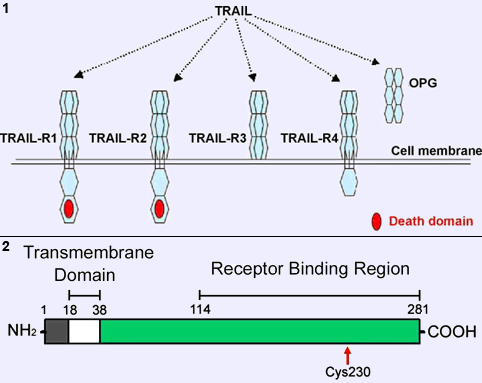
Diagram 1. TRAIL receptor system.
Diagram 2. Schematic representation of the structure of TRAIL protein.
Description
The extra-cellular domain of the membrane-bound TRAIL forms a bell shaped homo-trimer, much like other ligands of the TNF family. However, there is a unique insertion loop of about 16-20 amino acids in soluble TRAIL near its amino-terminal end (Diagram 2). Unlike other members of the TNF superfamily, TRAIL carries a zinc ion at the trimer interface, coordinated by the single unpaired cysteine residue (Cys 230) of each monomer (Diagram 2). This zinc ion is essential for structural integrity of TRAIL, and substituting the Cys 230 with alanine or serine strongly affects the capacity of TRAIL to induce apoptosis. Three molecules of TRAIL assemble with three molecules of the transmembrane receptor as a hexameric complex (3:3).
Expression
Membrane-bound TRAIL is expressed on the surface of activated immune cells, such as natural killer (NK) cells, T cells, macrophages and dendritic cells, whereas soluble TRAIL is present in the sera of normal individuals as well as of patients affected by neoplastic disorders. Soluble TRAIL is also released in the culture supernatant of activated peripheral blood mononuclear cells (PBMC) in response to interferon induction, so that it apparently seems to function as an immune effector molecule, mediating antitumor cytotoxicity and immune regulation. Importantly, this biological role of TRAIL is consistent with its tumor selective properties, since it implies that normal tissues are constitutively protected from circulating immune cells bearing TRAIL. Besides, a significant level of TRAIL transcript has been detected in many human tissues including thymus, spleen, PBMC, prostate, ovary, small intestine, colon and placenta, but not in the brain and it is expressed constitutively in some cell lines.
Localisation
TRAIL is a type II membrane protein of about 33-35 kD, which can be cleaved from the cell surface by the aspartic proteinase cathepsin E to form a soluble ligand of about 21 kD that retains biological activity.
Function
The best-characterized biological activity of TRAIL is to induce apoptotic cell death in a variety of neoplastic cells. Both full-length membrane expressed TRAIL and soluble TRAIL can rapidly induce apoptosis in a wide variety of human cancer cell lines and primary tumors (including hematological malignancies), showing minimal or absent cytotoxicity on normal cells, both in vitro and in vivo; thus TRAIL was identified as a potential tumor-specific cancer therapeutic. The wide expression of TRAIL and TRAIL-Rs in many normal tissues suggests that the physiological role of TRAIL is more complex than the simply induction of apoptosis in cancer cells. In this respect, several studies have demonstrated that the TRAIL-TRAIL receptors system elicit a physiological role in normal hematopoiesis (for example an anti-differentiative effect on erythroid maturation and a pro-maturative effect during megakaryocytopoiesis and in vascular physiology, promoting the survival, migration and proliferation of endothelial cells). It has also been demonstrated that TRAIL significantly counteracts the adhesion of peripheral blood derived monocytes and granulocytes to endothelial cells without inducing apoptosis in response to inflammatory cytokines in vitro, suggesting an anti-inflammatory activity of TRAIL. All these data are reviewed in Secchiero and Zauli, 2008.
Homology
| GENE | IDENTITY (%) | ||
| SPECIES | SYMBOL | PROTEIN | DNA |
| HOMO SAPIENS | TNFSF10 | ||
| VS. PAN TROGLODYTES | TNFSF10 | 98.9 | 99.3 |
| VS. MUS MUSCULUS | TNFSF10 | 67.0 | 75.0 |
| VS. RATTUS NORVEGICUS | TNFSF10 | 70.3 | 74.3 |
| VS. GALLUS GALLUS | TNFSF10 | 59.3 | 64.2 |
| VS. DANIO RERIO | TNFSF10L2 | 46.2 | 54.1 |
| GENE | IDENTITY (%) | |
| SPECIES | SYMBOL | PROTEIN |
| HOMO SAPIENS | TNFSF10 | |
| HOMO SAPIENS | TNF | 23 |
| HOMO SAPIENS | RANKL | 24 |
| HOMO SAPIENS | FASL | 27 |
| HOMO SAPIENS | CD40L | 23 |
| HOMO SAPIENS | CD137L | NOT SIGNIFICANT |
| HOMO SAPIENS | OX40L | NOT SIGNIFICANT |
| HOMO SAPIENS | CD27L | NOT SIGNIFICANT |
| HOMO SAPIENS | CD30L | NOT SIGNIFICANT |
| HOMO SAPIENS | LTA | 22 |
| HOMO SAPIENS | LTB | 21 |
| HOMO SAPIENS | APO3L | NOT SIGNIFICANT |
| HOMO SAPIENS | APRIL | NOT SIGNIFICANT |
| HOMO SAPIENS | TNFSF13B | NOT SIGNIFICANT |
| HOMO SAPIENS | TNFSF14 | 25 |
| HOMO SAPIENS | TNFSF15 | 34 |
| HOMO SAPIENS | TNFSF18 | NOT SIGNIFICANT |
Mutations

6 exonic variations. For details see: http://www.ncbi.nlm.nih.gov/SNP/snp_ref.cgi?locusId=8743
Implicated in
Entity name
Myelodysplastic Syndromes (MDS).
Note
The myelodysplastic syndromes comprise a heterogeneous group of clonal disorders, usually characterized by a normal or hypercellular marrow with dysplastic features leading to peripheral blood cytopenias and a variable incidence of transformation into acute myeloid leukemia (AML). Ineffective erythropoiesis is a common feature of MDS. One mechanism invoked to explain the apparent discrepancy between cellular marrow and peripheral blood cytopenias in patients with MDS is apoptosis, which occurs with increased frequency in MDS marrow.
Disease
The decrease of mature erythrocytes, the major clinical feature of MDS, has been attributed to the increased expression and release at the bone marrow level of TRAIL, that selectively inhibits erythroid development by specifically targeting immature erythroblasts, impairing erythropoiesis and contributing to the degree of anemia.
Entity name
B-Chronic Lymphocytic Leukemia (B-CLL)
Note
B-CLL represents a quintessential example of human malignancies that are caused primarily by defects in apoptosis or programmed cell death.
During the early stages of disease, mature B lymphocytes that constitute most B-CLL are largely quiescent G(0) phase cells, which accumulate not because they are dividing more rapidly than normal cells but because they survive longer than their normal counterparts due to defects in the apoptotic pathways. These noncycling CD5+/CD19+ B lymphocytes accumulate in the peripheral blood, marrow, spleen, and lymph nodes. Defects in apoptotic pathways contribute also to chemoresistance, rendering tumor cells less sensitive to the cytotoxic actions of currently available anticancer drugs, and can also promote resistance to cellular immune responses.
During the early stages of disease, mature B lymphocytes that constitute most B-CLL are largely quiescent G(0) phase cells, which accumulate not because they are dividing more rapidly than normal cells but because they survive longer than their normal counterparts due to defects in the apoptotic pathways. These noncycling CD5+/CD19+ B lymphocytes accumulate in the peripheral blood, marrow, spleen, and lymph nodes. Defects in apoptotic pathways contribute also to chemoresistance, rendering tumor cells less sensitive to the cytotoxic actions of currently available anticancer drugs, and can also promote resistance to cellular immune responses.
Disease
In order to elucidate the expression of TRAIL and its biological potential function in B-CLL, it has been examined the expression of TRAIL in B-CLL PBMC in comparison with PBMC obtained from healthy blood donors as well as the susceptibility of B-CLL cells to soluble recombinant TRAIL and the potential effects of endogenous membrane-bound TRAIL on autologous B-CLL cell survival. It has been shown that TRAIL is overexpressed in B-CLL PBMC in comparison with normal B cells, but B-CLL cells are resistant to TRAIL-mediated apoptosis. Taken together, these findings suggest that an aberrant expression of TRAIL might contribute to the pathogenesis of B-CLL.
Article Bibliography
| Pubmed ID | Last Year | Title | Authors |
|---|---|---|---|
| 9721089 | 1998 | Death receptors: signaling and modulation. | Ashkenazi A et al |
| 8639933 | 1996 | Apoptosis in bone marrow of myelodysplastic syndrome patients. | Bogdanović AD et al |
| 15681838 | 2005 | Evidence for a role of TNF-related apoptosis-inducing ligand (TRAIL) in the anemia of myelodysplastic syndromes. | Campioni D et al |
| 17981533 | 2008 | TRAIL and osteoprotegerin: a role in endothelial physiopathology? | Corallini F et al |
| 8905447 | 1996 | Molecular, structural, and biological characteristics of the tumor necrosis factor ligand superfamily. | Gruss HJ et al |
| 10341278 | 1999 | Myelodysplasia. | Heaney ML et al |
| 10651627 | 2000 | A unique zinc-binding site revealed by a high-resolution X-ray structure of homotrimeric Apo2L/TRAIL. | Hymowitz SG et al |
| 18006832 | 2007 | Cathepsin E prevents tumor growth and metastasis by catalyzing the proteolytic release of soluble TRAIL from tumor cell surface. | Kawakubo T et al |
| 12644830 | 2003 | TRAIL-beta and TRAIL-gamma: two novel splice variants of the human TNF-related apoptosis-inducing ligand (TRAIL) without apoptotic potential. | Krieg A et al |
| 15828026 | 2005 | Functional expression of TRAIL and TRAIL-R2 during human megakaryocytic development. | Melloni E et al |
| 8663110 | 1996 | Induction of apoptosis by Apo-2 ligand, a new member of the tumor necrosis factor cytokine family. | Pitti RM et al |
| 11842384 | 2002 | Modulating apoptosis pathways in low-grade B-cell malignancies using biological response modifiers. | Reed JC et al |
| 18043245 | 2008 | Tumor-necrosis-factor-related apoptosis-inducing ligand and the regulation of hematopoiesis. | Secchiero P et al |
| 17530027 | 2007 | Targeting death-inducing receptors in cancer therapy. | Takeda K et al |
| 8777713 | 1995 | Identification and characterization of a new member of the TNF family that induces apoptosis. | Wiley SR et al |
| 16750931 | 2006 | The role of the TRAIL/TRAIL receptors system in hematopoiesis and endothelial cell biology. | Zauli G et al |
Other Information
Locus ID:
NCBI: 8743
MIM: 603598
HGNC: 11925
Ensembl: ENSG00000121858
Variants:
dbSNP: 8743
ClinVar: 8743
TCGA: ENSG00000121858
COSMIC: TNFSF10
RNA/Proteins
| Gene ID | Transcript ID | Uniprot |
|---|---|---|
| ENSG00000121858 | ENST00000241261 | P50591 |
| ENSG00000121858 | ENST00000241261 | Q6IBA9 |
| ENSG00000121858 | ENST00000420541 | P50591 |
| ENSG00000121858 | ENST00000430881 | H7C246 |
Expression (GTEx)
Pathways
Protein levels (Protein atlas)
References
| Pubmed ID | Year | Title | Citations |
|---|---|---|---|
| 38216558 | 2024 | The E3 ubiquitin ligase Itch regulates death receptor and cholesterol trafficking to affect TRAIL-mediated apoptosis. | 2 |
| 38236186 | 2024 | KCNK5 Regulating Potassium Efflux and Inducing Pyroptosis in Corneal Epithelial Cells Through TNFSF10-Mediated Autophagy in Dry Eye. | 0 |
| 38265424 | 2024 | Heparan sulfate promotes TRAIL-induced tumor cell apoptosis. | 0 |
| 38316367 | 2024 | Significance of TRAIL/Apo-2 ligand and its death receptors in apoptosis and necroptosis signalling: Implications for cancer-targeted therapeutics. | 2 |
| 38562920 | 2024 | Reduced expressions of apoptosis-related proteins TRAIL, Bcl-2, and TNFR1 in NK cells of juvenile-onset systemic lupus erythematosus patients: relations with disease activity, nephritis, and neuropsychiatric involvement. | 0 |
| 38216558 | 2024 | The E3 ubiquitin ligase Itch regulates death receptor and cholesterol trafficking to affect TRAIL-mediated apoptosis. | 2 |
| 38236186 | 2024 | KCNK5 Regulating Potassium Efflux and Inducing Pyroptosis in Corneal Epithelial Cells Through TNFSF10-Mediated Autophagy in Dry Eye. | 0 |
| 38265424 | 2024 | Heparan sulfate promotes TRAIL-induced tumor cell apoptosis. | 0 |
| 38316367 | 2024 | Significance of TRAIL/Apo-2 ligand and its death receptors in apoptosis and necroptosis signalling: Implications for cancer-targeted therapeutics. | 2 |
| 38562920 | 2024 | Reduced expressions of apoptosis-related proteins TRAIL, Bcl-2, and TNFR1 in NK cells of juvenile-onset systemic lupus erythematosus patients: relations with disease activity, nephritis, and neuropsychiatric involvement. | 0 |
| 35930348 | 2023 | An enhancer variant associated with breast cancer susceptibility in Black women regulates TNFSF10 expression and antitumor immunity in triple-negative breast cancer. | 4 |
| 36239572 | 2023 | Regulation of programmed death ligand 1 (PD-L1) expression by TNF-related apoptosis-inducing ligand (TRAIL) in triple-negative breast cancer cells. | 6 |
| 36715448 | 2023 | TSC2 regulates tumor susceptibility to TRAIL-mediated T-cell killing by orchestrating mTOR signaling. | 3 |
| 36822870 | 2023 | [Tumor necrosis factor-related apoptosis-inducing ligand gene polymorphism and its plasma phenotype in relation to Crohn's disease]. | 0 |
| 36888983 | 2023 | TRAIL or TRAIL-R2 as a Predictive Biomarker for Mortality or Cardiovascular Events: A Systematic Review and Meta-analysis. | 2 |
Citation
Maria Grazia Di Iasio ; Elisabetta Melloni ; Paola Secchiero ; Silvano Capitani
TNFSF10 (tumor necrosis factor (ligand) superfamily, member 10)
Atlas Genet Cytogenet Oncol Haematol. 2007-12-01
Online version: http://atlasgeneticsoncology.org/gene/42632/tnfsf10
