TYMP (thymidine phosphorylase)
2010-03-01 Irene V Bijnsdorp , Godefridus J Peters AffiliationDepartment of Medical Oncology, VU University Medical Center, Amsterdam, The Netherlands
Identity
HGNC
LOCATION
22q13.33
LOCUSID
ALIAS
ECGF,ECGF1,MEDPS1,MNGIE,MTDPS1,PDECGF,TP,hPD-ECGF
FUSION GENES
DNA/RNA
Note
The TP gene encodes an angiogenic factor which promotes angiogenesis both in vitro and in vivo and is involved in nucleotide synthesis and thymidine phosphorolysis.
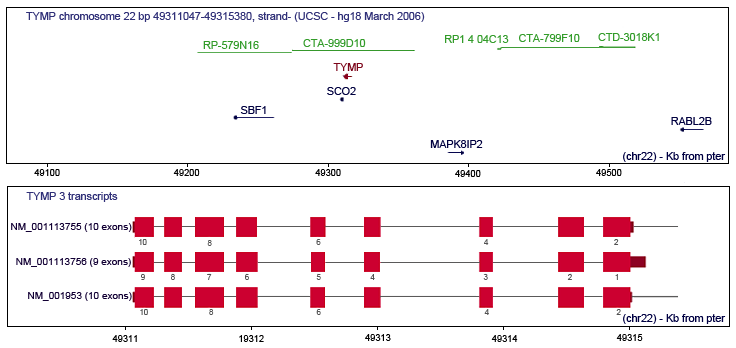
TYMP is located on chromosome 22 of which 3 transcripts have been identified.
Description
Thymidine phosphorylase is located at chromosome 22 in the region of q13.33. cDNA is approximately 1.8 kb long, consisting of 10 exons in a 4.3 kb region (Hagiwara et al., 1991; Stenman et al., 1992). TP was first cloned and sequenced in 1989 (Ishikawa et al., 1989). The nucleic acid sequence of TP is highly conserved, the human TP shares 39% sequence identity with that of E. coli (Barton et al., 1992).
Transcription
The promoter region of the TP gene has no TATA box or CCAAT box, but has a high G-C content and seven copies of the SP-1 binding site upstream from the transcription start site. Exact TP gene regulation is unknown, but has been described to be (indirectly) regulated by NFkB, TNF-alpha and IFN-gamma (Waguri et al., 1997; Zhu et al., 2002; Zhu et al., 2003; Eda et al., 1993; de Bruin et al., 2004).
Proteins
Note
Thymidine phosphorylase was first identified as the platelet-derived endothelial cell growth factor, because it was related to endothelial cell growth (Miyazono et al., 1987; Ishikawa et al., 1989). Later on, it was found that it was identical to thymidine phosphorylase (Furukawa et al., 1992). Thymidine phosphorylase (TP) is the most correct name to refer to this protein, since it catalyzes the phopshorolysis of thymidine to thymine. TP undergoes limited post-translational modification and is not glycosylated. Covalent linkage between serine residues of TP and phosphate groups of nucleotides has been observed, which may facilitate secretion of the protein (Usuki et al., 1991). However, TP does not contain a classical secretion signal (Ishikawa et al., 1989). TP is a dimer, consisting of two identical subunits that are non-covalently associated (Desgranges et al., 1981) with its dimeric molecular mass ranging from 90 kD in Escherichia coli to 110 kD in mammals (Schwartz, 1978; Desgranges et al., 1981).
Description
TP protein does not contain a known receptor binding region or a secretion signal (Ishikawa et al., 1989). It is implicated in nucleotide synthesis and degradation of thymidine. TP is also implicated in angiogenesis (reviewed in de Bruin et al., 2006; Liekens et al., 2007; Bronckaers et al., 2009).
Expression
TP is highly expressed in liver tissues. Furthermore, TP is often overexpressed in tumor sites and is involved in inflammatory diseases, such as rheumatoid arthritis.
Localisation
TP is expressed in the cytoplasm and the nucleus (Fox et al., 1995).
Function
TP catalyzes the phosphorolysis of thymidine (TdR) to thymine and 2-deoxy-alpha-D-ribose 1-phosphate (dR-1-P). TP can also catalyze the formation of thymidine from thymine and dR-1-P. TP also catalyzes the phosphorolysis of deoxyuridine to uracil and dR-1-P. TP also has deoxyribosyl transferase activity by which the deoxyribosyl moiety is transferred from a pyrimidine nucleoside to another pyrimidine base. Subsequently a new pyrimidine nucleoside is formed.
The sugars that are formed by degradation of thymidine are thought to play a role in the induction of angiogenesis. Deoxyribose-1-P can be converted to deoxyribose-5-phosphate or degraded to deoxyribose. Deoxyribose can be secreted, and possibly attract endothelial cells to form new blood vessels (reviewed in de Bruin et al., 2006; Liekens et al., 2007; Bronckaers et al., 2009). TP in some cancer cells can also increase their invasive potential, although the exact mechanism remains unclear.
TP can also activate or inactivate several pyrimidines or pyrimidine nucleoside analogs with antiviral and antitumoral activity, such as inactivation of trifluorothymidine (TFT) (Heidelberger et al., 1964) and 5-fluoro-2-deoxyruidine (van Laar et al., 1998), or activation of 5-fluorouracil (5-FU) (Schwartz et al., 1995) and 5-fluoro-5-deoxyuridine (5DFUR).
The sugars that are formed by degradation of thymidine are thought to play a role in the induction of angiogenesis. Deoxyribose-1-P can be converted to deoxyribose-5-phosphate or degraded to deoxyribose. Deoxyribose can be secreted, and possibly attract endothelial cells to form new blood vessels (reviewed in de Bruin et al., 2006; Liekens et al., 2007; Bronckaers et al., 2009). TP in some cancer cells can also increase their invasive potential, although the exact mechanism remains unclear.
TP can also activate or inactivate several pyrimidines or pyrimidine nucleoside analogs with antiviral and antitumoral activity, such as inactivation of trifluorothymidine (TFT) (Heidelberger et al., 1964) and 5-fluoro-2-deoxyruidine (van Laar et al., 1998), or activation of 5-fluorouracil (5-FU) (Schwartz et al., 1995) and 5-fluoro-5-deoxyuridine (5DFUR).
Homology
The TYMP gene is conserved in chimpanzee, mouse, rat, and zebrafish.
Mutations
Note
Mutations in this gene have been associated with mitochondrial neurogastrointestinal encephalomyopathy (MNGIE). Multiple alternatively spliced variants, encoding the same protein, have been identified.
Implicated in
Entity name
Various cancer
Note
TP in tumor sites can be expressed in the cancer cells, in the most malignant cells, tumor stromal cells (such as macrophages) or in the invasive part of the tumor (van Triest et al., 1999). A high TP expression and activity have been related to a poor outcome and increased angiogenesis. The TP gene is regulated by many other factors that are implicated in cancer, such as NFkB (de Bruin et al., 2004). TP regulates the expression of IL-8, and possibly also that of other genes, although the exact mechanism of this regulation is still unclear (Brown et al., 2000; Bijnsdorp et al., 2008). The high TP activity in the tumor can selectively activate the 5FU prodrug 5-deoxy-5-fluorouridine to 5FU. 5deoxy-5-fluorouridine is an intermediate of the oral 5FU prodrug Capecitabine (Xeloda) (de Bruin et al., 2006). On the other hand TP can inactivate the fluoropyrimidine trifluorothymidine (TFT), which is registered as the antiviral drug Viroptic® (De Clercq, 2004). An inhibitor of TP, TPI, will prevent inactivation of TFT. TAS-102 is a combination of TFT and TPI (in a molar ratio of 1:0.5) which is developed as an anticancer drug (Temmink et al., 2007).
Disease
Gastrointestinal tumors (Fox et al., 1995; Yoshikawa et al., 1999; Kimura et al., 2002; Takebayashi et al., 1996), breast cancer (Moghaddam et al., 1995), bladder cancer (OBrien et al., 1996).
Prognosis
High expression is often related to a poor prognosis, an increased microvessel density and increased metastasis.
Fusion protein
No fusion protein has been described.
Entity name
Rheumatoid arthritis
Note
Elevated levels of (circulating) PD-ECGF (TP) were found in rheumatoid arthritis patients (Asai et al., 1993). In the sera and synovial fluids of patients suffering from rheumatoid arthritis PD-ECGF (TP) was detected at high levels (Asai et al., 1993). In addition, there was a significant positive correlation between PD-ECGF (TP) levels in synovial fluid and in serum (Asai et al., 1993). The elevated PD-ECGF (TP) levels presumably arise through induction of PD-ECGF (TP) in synoviocytes, resulting from aberrant production of cytokines like TNF-alpha and IL-1 (Waguri et al., 1997).
Entity name
Atherosclerosis
Note
TP is expressed in atherosclerosis. Macrophages, foam cells and giant cells from both aortic and coronary plaques expressed TP, suggesting that TP may play a role in the pathogenesis of atherosclerosis (Boyle et al., 2000).
Entity name
Psoriasis
Note
Increased PD-ECGF (TP) mRNA and immunoreactivity were found in lesional psoriasis compared to the non-lesional skin (Creamer et al., 1997). In another study it was reported that the thymidine phosphorylase activity was twenty-fold higher in psoriatic lesions than in normal skin (Hammerberg et al., 1991).
Entity name
Inflammatory bowel disease
Note
In inflammatory bowel disease, TP has been found to be overexpressed, predominantly in macrophages and fibroblasts of the inflamed colonic mucosa. The grade of expression augmented with an increasing grade of inflammation. In addition, TP was found in the endothelial cells of the inflamed colonic mucosa (Giatromanolaki et al., 2003; Saito et al., 2003).
Entity name
Chronic glomerulonephritis
Note
TP is upregulated in chronic glomerulonephritis (a renal disease characterized by inflammation of the glomeruli) where it probably plays a critical role in the progression of interstitial fibrosis (Wang et al., 2006).
Entity name
Mitochondrial neurogastrointestinal encephalomyopathy (MNGIE)
Note
An autosomal recessive disorder involving DNA alterations (Bardosi et al., 1987). Gene mutations in the TP gene include missense, splice sites microdeletions and single nucleotide insertions (Spinazzola et al., 2002; Nishino et al., 2000). These mutations are associated with a severe reduction in TP activity. This leads to increased thymidine plasma levels, and increased deoxyuridine levels (which is also a substrate for TP).
Prognosis
Not determined.
Article Bibliography
| Pubmed ID | Last Year | Title | Authors |
|---|---|---|---|
| 7507805 | 1993 | High concentrations of immunoreactive gliostatin/platelet-derived endothelial cell growth factor in synovial fluid and serum of rheumatoid arthritis. | Asai K et al |
| 2823522 | 1987 | Myo-, neuro-, gastrointestinal encephalopathy (MNGIE syndrome) due to partial deficiency of cytochrome-c-oxidase. A new mitochondrial multisystem disorder. | Bardosi A et al |
| 1304367 | 1992 | Human platelet-derived endothelial cell growth factor is homologous to Escherichia coli thymidine phosphorylase. | Barton GJ et al |
| 18600526 | 2008 | The role of platelet-derived endothelial cell growth factor/thymidine phosphorylase in tumor behavior. | Bijnsdorp IV et al |
| 11004701 | 2000 | Expression of angiogenic factor thymidine phosphorylase and angiogenesis in human atherosclerosis. | Boyle JJ et al |
| 19434693 | 2009 | The dual role of thymidine phosphorylase in cancer development and chemotherapy. | Bronckaers A et al |
| 11103787 | 2000 | Thymidine phosphorylase induces carcinoma cell oxidative stress and promotes secretion of angiogenic factors. | Brown NS et al |
| 9470899 | 1997 | Overexpression of the angiogenic factor platelet-derived endothelial cell growth factor/thymidine phosphorylase in psoriatic epidermis. | Creamer D et al |
| 15125867 | 2004 | Antiviral drugs in current clinical use. | De Clercq E et al |
| 7284378 | 1981 | Catabolism of thymidine in human blood platelets: purification and properties of thymidine phosphorylase. | Desgranges C et al |
| 8339382 | 1993 | Cytokines induce thymidine phosphorylase expression in tumor cells and make them more susceptible to 5'-deoxy-5-fluorouridine. | Eda H et al |
| 7636628 | 1995 | Platelet-derived endothelial cell growth factor/thymidine phosphorylase expression in normal tissues: an immunohistochemical study. | Fox SB et al |
| 1570012 | 1992 | Angiogenic factor. | Furukawa T et al |
| 12610101 | 2003 | Hypoxia inducible factor 1alpha and 2alpha overexpression in inflammatory bowel disease. | Giatromanolaki A et al |
| 14247510 | 1964 | FLUORINATED PYRIMIDINES. XXI. THE TUMOR-INHIBITORY ACTIVITY OF 5-TRIFLUOROMETHYL-2'-DEOXYURIDINE. | HEIDELBERGER C et al |
| 2005900 | 1991 | Organization and chromosomal localization of the human platelet-derived endothelial cell growth factor gene. | Hagiwara K et al |
| 2071939 | 1991 | Elevated thymidine phosphorylase activity in psoriatic lesions accounts for the apparent presence of an epidermal "growth inhibitor," but is not in itself growth inhibitory. | Hammerberg C et al |
| 2467210 | 1989 | Identification of angiogenic activity and the cloning and expression of platelet-derived endothelial cell growth factor. | Ishikawa F et al |
| 12064013 | 2002 | Correlation between expression levels of thymidine phosphorylase (dThdPase) and clinical features in human gastric carcinoma. | Kimura H et al |
| 17572389 | 2007 | Targeting platelet-derived endothelial cell growth factor/thymidine phosphorylase for cancer therapy. | Liekens S et al |
| 3549724 | 1987 | Purification and properties of an endothelial cell growth factor from human platelets. | Miyazono K et al |
| 7532308 | 1995 | Thymidine phosphorylase is angiogenic and promotes tumor growth. | Moghaddam A et al |
| 10852545 | 2000 | Mitochondrial neurogastrointestinal encephalomyopathy: an autosomal recessive disorder due to thymidine phosphorylase mutations. | Nishino I et al |
| 8841001 | 1996 | Expression of the angiogenic factor thymidine phosphorylase/platelet-derived endothelial cell growth factor in primary bladder cancers. | O'Brien TS et al |
| 12673445 | 2003 | Expression of platelet-derived endothelial cell growth factor in inflammatory bowel disease. | Saito S et al |
| 7642571 | 1995 | Thymidine phosphorylase mediates the sensitivity of human colon carcinoma cells to 5-fluorouracil. | Schwartz EL et al |
| 357904 | 1978 | Thymidine phosphorylase from Escherichia coli. | Schwartz M et al |
| 11733540 | 2002 | Altered thymidine metabolism due to defects of thymidine phosphorylase. | Spinazzola A et al |
| 1733667 | 1992 | Regional localization of the human platelet-derived endothelial cell growth factor (ECGF1) gene to chromosome 22q13. | Stenman G et al |
| 8758258 | 1996 | The activity and expression of thymidine phosphorylase in human solid tumours. | Takebayashi Y et al |
| 8185693 | 1994 | Aberrant production of gliostatin/platelet-derived endothelial cell growth factor in rheumatoid synovium. | Takeuchi M et al |
| 17441963 | 2007 | Therapeutic potential of the dual-targeted TAS-102 formulation in the treatment of gastrointestinal malignancies. | Temmink OH et al |
| 1939103 | 1991 | Covalent linkage between nucleotides and platelet-derived endothelial cell growth factor. | Usuki K et al |
| 9133962 | 1997 | Gliostatin/platelet-derived endothelial cell growth factor as a clinical marker of rheumatoid arthritis and its regulation in fibroblast-like synoviocytes. | Waguri Y et al |
| 16282698 | 2006 | Upregulation of thymidine phosphorylase in chronic glomerulonephritis and its role in tubulointerstitial injury. | Wang EH et al |
| 10098749 | 1999 | Thymidine phosphorylase/platelet-derived endothelial cell growth factor is upregulated in advanced solid types of gastric cancer. | Yoshikawa T et al |
| 12466967 | 2002 | The Sp1 transcription factor contributes to the tumor necrosis factor-induced expression of the angiogenic factor thymidine phosphorylase in human colon carcinoma cells. | Zhu GH et al |
| 14573775 | 2003 | Expression of the angiogenic factor thymidine phosphorylase in THP-1 monocytes: induction by autocrine tumor necrosis factor-alpha and inhibition by aspirin. | Zhu GH et al |
| 9640213 | 1998 | Comparison of 5-fluoro-2'-deoxyuridine with 5-fluorouracil and their role in the treatment of colorectal cancer. | van Laar JA et al |
| 10741735 | 2000 | Prognostic role of thymidylate synthase, thymidine phosphorylase/platelet-derived endothelial cell growth factor, and proliferation markers in colorectal cancer. | van Triest B et al |
Other Information
Locus ID:
NCBI: 1890
MIM: 131222
HGNC: 3148
Ensembl: ENSG00000025708
Variants:
dbSNP: 1890
ClinVar: 1890
TCGA: ENSG00000025708
COSMIC: TYMP
RNA/Proteins
Expression (GTEx)
Pathways
Protein levels (Protein atlas)
PharmGKB
| Entity ID | Name | Type | Evidence | Association | PK | PD | PMIDs |
|---|---|---|---|---|---|---|---|
| PA128406956 | fluorouracil | Chemical | ClinicalAnnotation | associated | PD | 24167597 | |
| PA445062 | Neoplasms | Disease | ClinicalAnnotation | associated | PD | 24167597 | |
| PA448771 | capecitabine | Chemical | ClinicalAnnotation | associated | PD | 24167597 |
References
| Pubmed ID | Year | Title | Citations |
|---|---|---|---|
| 37603049 | 2023 | Distinctive metabolic remodeling in TYMP deficiency beyond mitochondrial dysfunction. | 1 |
| 38043946 | 2023 | Identifying TYMP as an Immune Prognostic Marker in Clear Cell Renal Cell Carcinoma. | 0 |
| 37603049 | 2023 | Distinctive metabolic remodeling in TYMP deficiency beyond mitochondrial dysfunction. | 1 |
| 38043946 | 2023 | Identifying TYMP as an Immune Prognostic Marker in Clear Cell Renal Cell Carcinoma. | 0 |
| 35341481 | 2022 | Loss of thymidine phosphorylase activity disrupts adipocyte differentiation and induces insulin-resistant lipoatrophic diabetes. | 3 |
| 35567733 | 2022 | Impact of thymidine phosphorylase and CD163 expression on prognosis in stage II colorectal cancer. | 1 |
| 35341481 | 2022 | Loss of thymidine phosphorylase activity disrupts adipocyte differentiation and induces insulin-resistant lipoatrophic diabetes. | 3 |
| 35567733 | 2022 | Impact of thymidine phosphorylase and CD163 expression on prognosis in stage II colorectal cancer. | 1 |
| 33825174 | 2021 | Novel Mutations of the TYMP Gene in Mitochondrial Neurogastrointestinal Encephalomyopathy: Case Series and Literature Review. | 1 |
| 33825174 | 2021 | Novel Mutations of the TYMP Gene in Mitochondrial Neurogastrointestinal Encephalomyopathy: Case Series and Literature Review. | 1 |
| 32476180 | 2020 | Thymidine phosphorylase promotes angiogenesis and tumour growth in intrahepatic cholangiocarcinoma. | 3 |
| 32476180 | 2020 | Thymidine phosphorylase promotes angiogenesis and tumour growth in intrahepatic cholangiocarcinoma. | 3 |
| 30642883 | 2019 | Antimalarial Drug Pyrimethamine Plays a Dual Role in Antitumor Proliferation and Metastasis through Targeting DHFR and TP. | 20 |
| 30849523 | 2019 | Kinetics mechanism and regulation of native human hepatic thymidine phosphorylase. | 0 |
| 31366497 | 2019 | 5-Aza-2-deoxycytidine Enhances the Sensitivity of 5-Fluorouracil by Demethylation of the Thymidine Phosphorylase Promoter. | 3 |
Citation
Irene V Bijnsdorp ; Godefridus J Peters
TYMP (thymidine phosphorylase)
Atlas Genet Cytogenet Oncol Haematol. 2010-03-01
Online version: http://atlasgeneticsoncology.org/gene/40397/tymp
