VAV3 (vav 3 guanine nucleotide exchange factor)
2010-08-01 Leah Lyons , Kerry L Burnstein AffiliationNova Southeastern University, College of Medical Sciences, Department of Physiology, Florida, USA (LL); University of Miami, Miller School of Medicine, Department of Molecular, Cellular Pharmacology, Miami, Florida, USA (KLB)
DNA/RNA
Description
Transcription
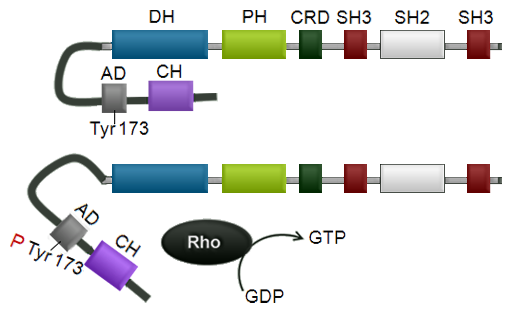
Vav3 can be modified posttranslationally by phosphorylation. Phosphorylation site prediction identifies phosphorylation sites at T131, S134, Y141, Y173, S511, T606 and Y797. Sites residing in the N terminal region have been shown to regulate activation of Vav3 GEF function (Movilla and Bustelo, 1999). In the unphosphorylated state, the GEF domain is prevented from physical association with Rho proteins by the Vav3 N terminal domains. These domains (calponin homology and acidic domains) form an autoinhibitory loop via intramolecular interactions. Vav3 is recruited via its SH2 domain to phosphotyrosine residues on interacting proteins, including activated growth factor receptors. Once bound to active growth factor receptors, or other molecules containing intrinsic tyrosine kinase activity, Vav3 becomes tyrosine phosphorylated (Movilla and Bustelo, 1999; Bustelo, 2002; Zugaza et al., 2002). Tyrosine phosphorylation of Vav3 results in a conformational change that relieves the autoinhibition, thus activating the GEF function by allowing access of Rho proteins to the GEF domain (Movilla and Bustelo, 1999; Yu et al., 2010). Tyrosine 173 in particular is a critical residue in this process (Llorca et al., 2005; Yu et al., 2010). Consistent with an autoinhibitory role of the N terminal regions, removal of both the calponin homology and the acidic domains results in constitutive activation of Vav3 GEF function (Movilla and Bustelo, 1999; Zeng et al., 2000; Zugaza et al., 2002).
Proteins

Description
Expression
Localisation
Function
Vav3 is implicated in B cell induced antigen presentation to T cells (Malhotra et al., 2009) and mediates both B and T cell signaling events and alteration of macrophage morphology (Sindrilaru et al., 2009). Additionally, protein interactions with the C terminal SH3 SH2, SH3 cassette have revealed roles in scaffolding through adaptor like actions (Bustelo, 2001; Yabana and Shibuya, 2002).
Additional functions of Vav3 in distinct tissues are listed below.
Nervous system: NGF-induced neurite outgrowth in PC12 cells requires Vav3-mediated activation of Rac. This process involves P13K activation which occurs upstream of Vav3 (Aoki et al., 2005). Vav3 is also important for neuronal migration during development (Khodosevich et al., 2009). Additionally, Vav3 knockout mice show defects in Purkinje cell dendrite branching, granule cell migration and survival. Functionally the animals show deficiencies in motor coordination and gaiting consistent with a role for Vav3 in neuronal guidance, cerebellar development and function (Quevedo et al., 2010).
Skeletal system: Studies in osteoclasts support a role for Vav3 in mediating proper bone deposition. Specifically, Vav3 deficient osteoclasts exhibit abnormalities in actin cytoskeletal rearrangements, cell spreading, and resorptive activities. Consistent with the actions of Vav3 on integrin signaling, the osteoclast defects were found to be due to impaired integrin engagement. Further, Vav3 deficient mice have increased bone density and are refractory to PTH-mediated bone resorption (Faccio et al., 2005).
Cardiovascular system: An important role for Vav3 in maintaining proper cardiovascular homeostasis was suggested by experiments performed in Vav3 null mice. These mice exhibited many symptoms of cardiovascular dysfunction including tachycardia, hypertension and cardiovascular remodeling. Consistent with these symptoms, the mice also exhibited a high degree of sympathetic tone including elevated circulating levels of catecholamines and renin-angiotensin-aldosterone hyperactivity, resulting in progressive loss of both cardiovascular and renal homeostasis (Sauzeau et al., 2006).
Vascular smooth muscle: Vav3 is both necessary and sufficient for rat vascular smooth muscle cell proliferation. These effects occur through a Rac-1 dependent mechanism, involving the effector Pak 1 (Toumaniantz et al., 2010).
Platelets: Consistent with a role for Vav3 in mediating integrin-based responses, Vav3 and Vav1 together are required for collagen exposure-mediated PLC activation in platelets. This signaling pathway occurs through the major platelet integrin alphaIIbbetaIII (Pearce et al., 2004).
Angiogenesis: Mice deficient in both Vav3 and Vav2 show reduced endothelial migration in response to the presence of tumor cells. Additionally Vav2 and Vav3 were found to be necessary and sufficient for Eph A receptor-mediated angiogenesis both in vitro and in vivo (Hunter et al., 2006).
Homology
Mutations
Note
Implicated in
Additionally, Vav3 mRNA is up-regulated in androgen independent tumors in the Nkx3.1; Pten mouse model of prostate cancer (Banach-Petrosky et al., 2007; Ouyang et al., 2008) and targeted expression of a constitutively active form of Vav3 in prostate epithelium of transgenic mice leads to overactivity of the androgen receptor signaling axis and adenocarcinoma (Liu et al., 2008). Mechanistic studies show that Vav3 stimulates ligand independent androgen receptor activation by a GEF-dependent mechanism that requires the Rho GTPase, Rac 1 in prostate cancer cells (Lyons et al., 2008). Additionally, Vav3 enhances androgen receptor transcriptional activity in the presence of low concentrations of androgen through a GEF independent pathway that requires the Vav3 PH domain (Lyons and Burnstein, 2006).
Article Bibliography
| Pubmed ID | Last Year | Title | Authors |
|---|---|---|---|
| 15728722 | 2005 | Local phosphatidylinositol 3,4,5-trisphosphate accumulation recruits Vav2 and Vav3 to activate Rac1/Cdc42 and initiate neurite outgrowth in nerve growth factor-stimulated PC12 cells. | Aoki K et al |
| 17909013 | 2007 | Prolonged exposure to reduced levels of androgen accelerates prostate cancer progression in Nkx3.1; Pten mutant mice. | Banach-Petrosky W et al |
| 16203770 | 2005 | Molecular alterations in primary prostate cancer after androgen ablation therapy. | Best CJ et al |
| 19435813 | 2009 | Host deficiency in Vav2/3 guanine nucleotide exchange factors impairs tumor growth, survival, and angiogenesis in vivo. | Brantley-Sieders DM et al |
| 11607839 | 2001 | Vav proteins, adaptors and cell signaling. | Bustelo XR et al |
| 15950967 | 2005 | Phylogenetic conservation of the regulatory and functional properties of the Vav oncoprotein family. | Couceiro JR et al |
| 16762975 | 2006 | Vav3 oncogene is overexpressed and regulates cell growth and androgen receptor activity in human prostate cancer. | Dong Z et al |
| 15711558 | 2005 | Vav3 regulates osteoclast function and bone mass. | Faccio R et al |
| 18387945 | 2008 | Identification and functional analysis of phosphorylated tyrosine residues within EphA2 receptor tyrosine kinase. | Fang WB et al |
| 20363978 | 2010 | Nonobese diabetic congenic strain analysis of autoimmune diabetes reveals genetic complexity of the Idd18 locus and identifies Vav3 as a candidate gene. | Fraser HI et al |
| 15249579 | 2004 | Vav GEFs are required for beta2 integrin-dependent functions of neutrophils. | Gakidis MA et al |
| 14695335 | 2004 | Gene expression analysis of human prostate carcinoma during hormonal therapy identifies androgen-responsive genes and mechanisms of therapy resistance. | Holzbeierlein J et al |
| 16782872 | 2006 | Essential role of Vav family guanine nucleotide exchange factors in EphA receptor-mediated angiogenesis. | Hunter SG et al |
| 19668709 | 2009 | Major signaling pathways in migrating neuroblasts. | Khodosevich K et al |
| 18518979 | 2008 | Vav3 oncogene activates estrogen receptor and its overexpression may be involved in human breast cancer. | Lee K et al |
| 18676865 | 2008 | Targeted overexpression of vav3 oncogene in prostatic epithelium induces nonbacterial prostatitis and prostate cancer. | Liu Y et al |
| 15775967 | 2005 | Global conformational rearrangements during the activation of the GDP/GTP exchange factor Vav3. | Llorca O et al |
| 16384856 | 2006 | Vav3, a Rho GTPase guanine nucleotide exchange factor, increases during progression to androgen independence in prostate cancer cells and potentiates androgen receptor transcriptional activity. | Lyons LS et al |
| 18079321 | 2008 | Ligand-independent activation of androgen receptors by Rho GTPase signaling in prostate cancer. | Lyons LS et al |
| 15720714 | 2005 | Construction and analysis of tag single nucleotide polymorphism maps for six human-mouse orthologous candidate genes in type 1 diabetes. | Maier LM et al |
| 19586920 | 2009 | B cell antigen receptor endocytosis and antigen presentation to T cells require Vav and dynamin. | Malhotra S et al |
| 10938113 | 2000 | Vav family proteins couple to diverse cell surface receptors. | Moores SL et al |
| 10523675 | 1999 | Biological and regulatory properties of Vav-3, a new member of the Vav family of oncoproteins. | Movilla N et al |
| 18381418 | 2008 | Activator protein-1 transcription factors are associated with progression and recurrence of prostate cancer. | Ouyang X et al |
| 17054426 | 2007 | Vav family proteins are required for optimal regulation of PLCgamma2 by integrin alphaIIbbeta3. | Pearce AC et al |
| 15456756 | 2004 | Vav1 and vav3 have critical but redundant roles in mediating platelet activation by collagen. | Pearce AC et al |
| 20089829 | 2010 | Vav3-deficient mice exhibit a transient delay in cerebellar development. | Quevedo C et al |
| 11884391 | 2002 | Distinct role of phosphatidylinositol 3-kinase and Rho family GTPases in Vav3-induced cell transformation, cell motility, and morphological changes. | Sachdev P et al |
| 16166423 | 2005 | Possible involvement of RUNX3 silencing in the peritoneal metastases of gastric cancers. | Sakakura C et al |
| 19008376 | 2008 | The guanine nucleotide exchange factors trio, Ect2, and Vav3 mediate the invasive behavior of glioblastoma. | Salhia B et al |
| 16767097 | 2006 | Vav3 proto-oncogene deficiency leads to sympathetic hyperactivity and cardiovascular dysfunction. | Sauzeau V et al |
| 10920889 | 1997 | [Correlation between hypomethylation of c-myc and c-N-ras oncogenes and pathological changes in human hepatocellular carcinoma]. | Shen L et al |
| 19147786 | 2009 | Wound healing defect of Vav3-/- mice due to impaired {beta}2-integrin-dependent macrophage phagocytosis of apoptotic neutrophils. | Sindrilaru A et al |
| 16925834 | 2006 | AceView: a comprehensive cDNA-supported gene and transcripts annotation. | Thierry-Mieg D et al |
| 19969623 | 2010 | The Rho protein exchange factor Vav3 regulates vascular smooth muscle cell proliferation and migration. | Toumaniantz G et al |
| 10713454 | 2000 | Major transcript variants of VAV3, a new member of the VAV family of guanine nucleotide exchange factors. | Trenkle T et al |
| 12400014 | 2002 | Adaptor protein APS binds the NH2-terminal autoinhibitory domain of guanine nucleotide exchange factor Vav3 and augments its activity. | Yabana N et al |
| 20141838 | 2010 | Structural and energetic mechanisms of cooperative autoinhibition and activation of Vav1. | Yu B et al |
| 11094073 | 2000 | Vav3 mediates receptor protein tyrosine kinase signaling, regulates GTPase activity, modulates cell morphology, and induces cell transformation. | Zeng L et al |
| 12228230 | 2002 | Structural determinants for the biological activity of Vav proteins. | Zugaza JL et al |
Other Information
Locus ID:
NCBI: 10451
MIM: 605541
HGNC: 12659
Ensembl: ENSG00000134215
Variants:
dbSNP: 10451
ClinVar: 10451
TCGA: ENSG00000134215
COSMIC: VAV3
RNA/Proteins
Expression (GTEx)
Pathways
Protein levels (Protein atlas)
References
| Pubmed ID | Year | Title | Citations |
|---|---|---|---|
| 36602863 | 2023 | Targeting HuR-Vav3 mRNA interaction prevents Pseudomonas aeruginosa adhesion to the cystic fibrosis airway epithelium. | 2 |
| 36960857 | 2023 | VAV3 regulates glioblastoma cell proliferation, migration, invasion and cancer stem‑like cell self‑renewal. | 3 |
| 37085264 | 2023 | CARD9, VAV3, and infection risk in IgA nephropathy. | 1 |
| 37467637 | 2023 | VAV3 in human cancers: Mechanism and clinical implication. | 0 |
| 37783052 | 2023 | Serum exosome-derived miR-146a-3p promotes macrophage M2 polarization in allergic rhinitis by targeting VAV3 via PI3K/AKT/mTOR pathway. | 0 |
| 36602863 | 2023 | Targeting HuR-Vav3 mRNA interaction prevents Pseudomonas aeruginosa adhesion to the cystic fibrosis airway epithelium. | 2 |
| 36960857 | 2023 | VAV3 regulates glioblastoma cell proliferation, migration, invasion and cancer stem‑like cell self‑renewal. | 3 |
| 37085264 | 2023 | CARD9, VAV3, and infection risk in IgA nephropathy. | 1 |
| 37467637 | 2023 | VAV3 in human cancers: Mechanism and clinical implication. | 0 |
| 37783052 | 2023 | Serum exosome-derived miR-146a-3p promotes macrophage M2 polarization in allergic rhinitis by targeting VAV3 via PI3K/AKT/mTOR pathway. | 0 |
| 34292486 | 2022 | The effect of VAV3 polymorphisms on thyroid cancer. | 0 |
| 35650206 | 2022 | Nuclear Vav3 is required for polycomb repression complex-1 activity in B-cell lymphoblastic leukemogenesis. | 2 |
| 37092056 | 2022 | Rs7537605 polymorphism in VAV3 gene and rs28665122 polymorphism in SEPS gene are not associated with Hashimoto's thyroiditis in North-East Algerian population. | 1 |
| 34292486 | 2022 | The effect of VAV3 polymorphisms on thyroid cancer. | 0 |
| 35650206 | 2022 | Nuclear Vav3 is required for polycomb repression complex-1 activity in B-cell lymphoblastic leukemogenesis. | 2 |
Citation
Leah Lyons ; Kerry L Burnstein
VAV3 (vav 3 guanine nucleotide exchange factor)
Atlas Genet Cytogenet Oncol Haematol. 2010-08-01
Online version: http://atlasgeneticsoncology.org/gene/42782/vav3
