NSD2 (nuclear receptor binding SET domain protein 2 )
2012-05-01 Eva Martinez-Garcia , Jonathan D Licht AffiliationFeinberg School of Medicine, Northwestern University, Hematology\\\/Oncology Division, 303 East Chicago Avenue, Chicago, IL 60611-3008, USA
Identity
HGNC
LOCATION
4p16.3
LOCUSID
ALIAS
KMT3F,KMT3G,MMSET,REIIBP,TRX5,WHS,WHSC1
FUSION GENES
DNA/RNA
Description
Spans 120 Kb of genomic DNA and consists of 24 exons transcribed into a mRNA that undergoes alternative splicing (Marango et al., 2007).
Transcription
Undergoes complex alternative splicing. Most primary trancripts splice directly to exon 3, which contains the proper translation initiation site, though small fraction of transcripts retain upstream sequence including exons 1 and 2 (Keats et al., 2005).
Proteins
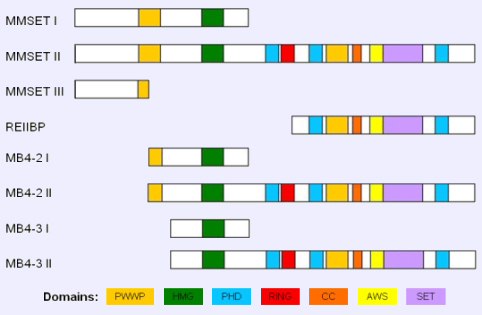
Conserved domains present in MMSET variants (adapted from Keats et al., 2005).
Description
Alternative splicing of exon 4 to 4a instead of 5 generates de MMSET III protein (273 amino acids, 32 kDa), due to the presence of an in-frame stop codon in exon 4a. Alternative splicing of exon 10 to 11 or 12 generates MMSET I (647 amino acids, 75 kDa) or the full-length MMSET II (1365 amino acids, 155 kDa) respectively, due to the presence of an in-frame stop codon in exon 11. A third transcript initiated within a middle intron of MMSET, encoding a mRNA comprising the 3half of MMSET gene was identified and encodes a protein named RE-IIBP.
The long transcript, MMSET II, contains: 2 PWWP (proline-tryptophan-tryptophan-proline) domain, a HMG box (high mobility group), 4 PHD (plant-home domain)- type zinc finger motifs and a SET domain. MMSET I contains only a PWWP and a HMG domain and REIIBP, 2 PHD, a PWWP and a SET domain (Keats et al., 2005).
The long transcript, MMSET II, contains: 2 PWWP (proline-tryptophan-tryptophan-proline) domain, a HMG box (high mobility group), 4 PHD (plant-home domain)- type zinc finger motifs and a SET domain. MMSET I contains only a PWWP and a HMG domain and REIIBP, 2 PHD, a PWWP and a SET domain (Keats et al., 2005).
Expression
Widely expressed.
It is expressed preferentially in rapidly growing embryonic tissues, in a pattern corresponding to affected organs in WHS patients (Stec et al., 1998). Recently it has been shown that MMSET is highly expressed in different tumor types such as carcinomas of the gastrointestinal tract (stomach, colon, anal canal), small cell lung carcinoma, bladder, female genitals and skin (Hudlebusch et al., 2011). It is also highly expressed and associated with aggressive neuroblastoma (Hudlebusch et al., 2011).
It is expressed preferentially in rapidly growing embryonic tissues, in a pattern corresponding to affected organs in WHS patients (Stec et al., 1998). Recently it has been shown that MMSET is highly expressed in different tumor types such as carcinomas of the gastrointestinal tract (stomach, colon, anal canal), small cell lung carcinoma, bladder, female genitals and skin (Hudlebusch et al., 2011). It is also highly expressed and associated with aggressive neuroblastoma (Hudlebusch et al., 2011).
Localisation
Homogenous pattern within the nucleus, excluded from the nucleolus.
Function
Histone methyltransferase that leads to dimethylation of histone 3 lysine 36 (H3K36) (Marango et al., 2008; Martinez-Garcia et al., 2011; Kuo et al., 2011). WHSC1 is involved in the cellular response to DNA damage through its activity on H4K20 residue (Hajdu et al., 2011; Pei et al., 2011).
Implicated in
Entity name
Note
WHSC1 was identified as a gene involved in the t(4;14)(p16;q32) translocation present in approximately 15% to 20% of MM (Chesi et al., 1998). This subtype of myeloma with t(4;14)(p16;q32) has a poor prognosis with frequent relapse after autologous stem-cell transplantation (Moreau et al., 2002; Chang et al., 2004).
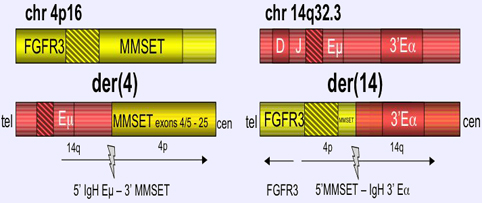
The t(4;14) Translocation Identifies MMSET as an oncogene in Multiple Myeloma. The gene rearrangement links the Eµ enhancer 5 to MMSET, driving transcription of MMSET from the telomeric-centromeric direction. The reciprocal translocation links an Ig enhancer 3 to the FGFR3 locus stimulating transcription in the centromeric-telomeric direction.
Entity name
Glioblastoma
Note
WHSC1 expression level is correlated with glioma grade, and it appears to be directly involved in the proliferative capacity of GBM cells in vitro (Li et al., 2008).
Entity name
Neuroblastoma
Note
MMSET is highly expressed in 75% neuroblastomas and is associated with aggressiveness. MMSET is associated with poor prognostic markers, poor survival, and progression; and is required for proliferation of neuroblastoma cells (Hudlebusch et al., 2011).
Entity name
Urinary bladder cancer
Note
In urinary bladder cancer, MMSET protein was detected in 40% of the cases and was associated with aggressiveness: expression levels correlated with poor prognostic markers (stage, grade, age, and type of tumor growth), and progression (Hudlebusch et al., 2011).
Entity name
Prostate cancer
Note
Analysis of microarray databases indicates that MMSET expression rises in the progression from benign prostatic epithelium to localized and metastatic PCa. Overexpression of MMSET in RWPE-1 cells is accompanied by an epithelial to mesenchymal transition (EMT), characterized by a change in cell morphology and increased expression of mesenchymal markers vimentin and N-cadherin. Twist1, an EMT promoting gene, was strongly regulated by MMSET (Ezponda-Itoiz et al., 2012).
Entity name
Wolf-Hirschhorn syndrome (WHS)
Note
Wolf-Hirshhorn syndrome is caused by a partial deletion of chromosome 4p, particularly in the region of WHSC1 and WHSC2. About 87% of cases represent a de novo deletion, while about 13% are inherited from a parent with a chromosome translocation.
Article Bibliography
| Pubmed ID | Last Year | Title | Authors |
|---|---|---|---|
| 15015970 | 2004 | The t(4;14) is associated with poor prognosis in myeloma patients undergoing autologous stem cell transplant. | Chang H et al |
| 9787135 | 1998 | The t(4;14) translocation in myeloma dysregulates both FGFR3 and a novel gene, MMSET, resulting in IgH/MMSET hybrid transcripts. | Chesi M et al |
| 22797064 | 2013 | The histone methyltransferase MMSET/WHSC1 activates TWIST1 to promote an epithelial-mesenchymal transition and invasive properties of prostate cancer. | Ezponda T et al |
| 21788515 | 2011 | Wolf-Hirschhorn syndrome candidate 1 is involved in the cellular response to DNA damage. | Hajdu I et al |
| 21527557 | 2011 | MMSET is highly expressed and associated with aggressiveness in neuroblastoma. | Hudlebusch HR et al |
| 15677557 | 2005 | Overexpression of transcripts originating from the MMSET locus characterizes all t(4;14)(p16;q32)-positive multiple myeloma patients. | Keats JJ et al |
| 22099308 | 2011 | NSD2 links dimethylation of histone H3 at lysine 36 to oncogenic programming. | Kuo AJ et al |
| 18182627 | 2008 | Identification of a novel proliferation-related protein, WHSC1 4a, in human gliomas. | Li J et al |
| 18156491 | 2008 | The MMSET protein is a histone methyltransferase with characteristics of a transcriptional corepressor. | Marango J et al |
| 20974671 | 2011 | The MMSET histone methyl transferase switches global histone methylation and alters gene expression in t(4;14) multiple myeloma cells. | Martinez-Garcia E et al |
| 12176874 | 2002 | Recurrent 14q32 translocations determine the prognosis of multiple myeloma, especially in patients receiving intensive chemotherapy. | Moreau P et al |
| 21293379 | 2011 | MMSET regulates histone H4K20 methylation and 53BP1 accumulation at DNA damage sites. | Pei H et al |
| 9618163 | 1998 | WHSC1, a 90 kb SET domain-containing gene, expressed in early development and homologous to a Drosophila dysmorphy gene maps in the Wolf-Hirschhorn syndrome critical region and is fused to IgH in t(4;14) multiple myeloma. | Stec I et al |
Other Information
Locus ID:
NCBI: 7468
MIM: 602952
HGNC: 12766
Ensembl: ENSG00000109685
Variants:
dbSNP: 7468
ClinVar: 7468
TCGA: ENSG00000109685
COSMIC: NSD2
RNA/Proteins
Expression (GTEx)
Pathways
Protein levels (Protein atlas)
References
| Pubmed ID | Year | Title | Citations |
|---|---|---|---|
| 38236723 | 2024 | Decreased NSD2 impairs stromal cell proliferation in human endometrium via reprogramming H3K36me2. | 0 |
| 38353053 | 2024 | Clinical details of individuals with Rauch-Steindl syndrome due to NSD2 truncating variants. | 1 |
| 38709169 | 2024 | ISWI chromatin remodeling complexes recruit NSD2 and H3K36me2 in pericentromeric heterochromatin. | 1 |
| 38236723 | 2024 | Decreased NSD2 impairs stromal cell proliferation in human endometrium via reprogramming H3K36me2. | 0 |
| 38353053 | 2024 | Clinical details of individuals with Rauch-Steindl syndrome due to NSD2 truncating variants. | 1 |
| 38709169 | 2024 | ISWI chromatin remodeling complexes recruit NSD2 and H3K36me2 in pericentromeric heterochromatin. | 1 |
| 35984902 | 2023 | The location of the t(4;14) translocation breakpoint within the NSD2 gene identifies a subset of patients with high-risk NDMM. | 10 |
| 36189577 | 2023 | The constitutional gain-of-function variant p.Glu1099Lys in NSD2 is associated with a novel syndrome. | 0 |
| 37016431 | 2023 | NSD2 E1099K drives relapse in pediatric acute lymphoblastic leukemia by disrupting 3D chromatin organization. | 4 |
| 37073435 | 2023 | WHSC1 is involved in DNA damage, cellular senescence and immune response in hepatocellular carcinoma progression. | 2 |
| 37150325 | 2023 | The T1150A cancer mutant of the protein lysine dimethyltransferase NSD2 can introduce H3K36 trimethylation. | 2 |
| 37463241 | 2023 | Histone Methyltransferase NSD2 Activates PKCα to Drive Metabolic Reprogramming and Lenalidomide Resistance in Multiple Myeloma. | 0 |
| 35984902 | 2023 | The location of the t(4;14) translocation breakpoint within the NSD2 gene identifies a subset of patients with high-risk NDMM. | 10 |
| 36189577 | 2023 | The constitutional gain-of-function variant p.Glu1099Lys in NSD2 is associated with a novel syndrome. | 0 |
| 37016431 | 2023 | NSD2 E1099K drives relapse in pediatric acute lymphoblastic leukemia by disrupting 3D chromatin organization. | 4 |
Citation
Eva Martinez-Garcia ; Jonathan D Licht
NSD2 (nuclear receptor binding SET domain protein 2 )
Atlas Genet Cytogenet Oncol Haematol. 2012-05-01
Online version: http://atlasgeneticsoncology.org/gene/42809/nsd2
Historical Card
2008-11-01 NSD2 (nuclear receptor binding SET domain protein 2 ) by Eva Martinez-Garcia,Jonathan D Licht Affiliation
Feinberg School of Medicine, Northwestern University, Hematology\\\/Oncology Division, 303 East Chicago Avenue, Chicago, IL 60611-3008, USA
