Atlas of Genetics and Cytogenetics in Oncology and Haematology


Home   Genes   Leukemias   Solid Tumours   Cancer-Prone   Deep Insight   Case Reports   Journals  Portal   Teaching   

X Y 1 2 3 4 5 6 7 8 9 10 11 12 13 14 15 16 17 18 19 20 21 22 NA

WISP2 (Wnt-1-inducible signaling parthway protein-2)

Identity

Other namesCCN5
rCop-1
CT58
CTGF-L
HGNC (Hugo) WISP2
Location 20q12-13
Location_base_pair Starts at 42777299 and ends at 42789866 bp from pter ( according to hg18-Mar_2006)  [Mapping]
Note WISP-2 is a member of the connective tissue growth factor/cysteine-rich 61/nephroblastoma overexpressed (nov) (CCN) family and is upregulated in the mouse mammary epithelial cell line C57MG transformed by Wnt-1 and in several non-invasive human breast tumor cell lines. WISP-2 is a serum and PMA (phorbol 12-myristate 13-acetate)-induced early responsive gene. Blocking the expression of this gene by WISP-2 antisense oligos or siRNA drastically reduce serum or PMA-induced cell proliferation in MCF-7 cells. Therefore, these studies suggest that WISP-2 signaling may be essential for mitogen-induced breast tumor cell proliferation.

WISP-2 expression is enhanced by important modulators of human breast cancer cell proliferation such as estrogen, progesterone and epidermal growth factor ( EGF) in MCF-7 cells. These effects, inhibited by appropriate antagonists, indicate that steroids and growth factor-induced upregulation of WISP-2 may be mediated through receptors.

The expression profile of WISP-2 gene in breast tumor biopsy tissue specimens are similar with that of in vitro studies and suggest that WISP-2 mRNA and protein levels are significantly higher in tumor samples as compared to the normal breast samples, and this expression is significantly correlated with the expression of estrogen receptor protein. However, within the tumor specimens, expression was predominant in the non-invasive carcinoma lesions as well as benign hyperplastic areas adjacent to the invasive tumors. Together, these findings suggest that bi-phasic regulation of WISP-2 signaling may be critical for initial events of growth, survivability and invasion of breast tumor cells.

WISP-2 also acts as a negative regulator in some cells including vascular smooth muscle cells.

DNA/RNA

Note Until now, three genes have been identified and isolated as members of WISP sub-family. WISP-1/CCN4, WISP-2/CCN5 and WISP-3/CCN6 genes were localized in human chromosomes 8q24.1-q24.3, 20q12-q13 and 6q22-23, respectively and exhibit tissue specific patterns of expression. Nucleotide and protein sequence alignment studies have demonstrated a 30-40% sequence homology within WISP genes and their modular architecture is similar except in their C-terminal domains, which is absent in the WISP-2 gene.
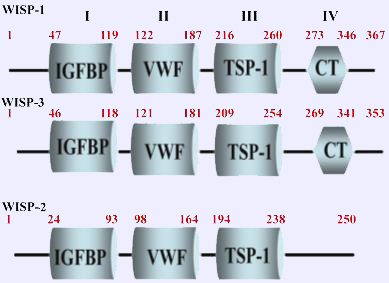
 
  Modular structure of individual genes of WISP sub-family of CCN family. Module shown with color boxes are the predicted primary translational.

Protein

Description The translation products of most of the CCN family members are secreted proteins of 35-40 kDa and have been shown to contain four distinct structural modules: 1) an IGF-binding protein type (IGFBP) domain, 2) a Von Willebrand type C (VWC) domain; 3) a Thrombospondin-1 (TSP-1) domain and 4) a C-terminal Cysteine-knot (CT) domain (10). Although the functional roles of these multiple modules are unclear, they raise interesting questions as to the contribution of each individual module to the biological properties of the full-length proteins.
Expression Epithelial cells and vascular smooth muscle cells
Localisation Adrenal gland, breast, colon, pancreas, uterus and ovary.
Function Positive regulator of epithelial cells and negative regulator of vascular smooth muscle cells.

Mutations

Somatic Amplified in breast tumor cells.

Implicated in

Disease Breast cancer
  
Disease Colon cancer
  
Disease Macronodular adrenal hyperplasia
  

External links

Nomenclature
HGNC (Hugo)WISP2   12770
Entrez_Gene (NCBI)WISP2  8839  WNT1 inducible signaling pathway protein 2
Cards
AtlasWISP2ID42814ch20q12
GeneCards (Weizmann)WISP2
Ensembl (Hinxton)ENSG00000064205 [Gene_View]  WISP2 [Vega]
AceView (NCBI)WISP2
Genatlas (Paris)WISP2
euGene (Indiana)8839
SOURCE (Stanford)NM_003881
Genomic and cartography
GoldenPath (UCSC)WISP2  -     chr20:42777299-42789866 +  20q13.12   [Description]    (hg18-Mar_2006)
EnsemblWISP2 - 20q13.12 [CytoView]
Mapping of homologs : NCBIWISP2 [Mapview]
OMIM603399   
Gene and transcription
Gene : Genbank (Entrez)AF074604 AF083500 AF100780 AK129660 AK313853
Reference sequence (RefSeq transcript) :SRSNM_003881
Reference transcript : EntrezNM_003881
RefSeq genomic : SRSAC_000063 AC_000152 NC_000020 NT_011362 NW_001838666 NW_927339
RefSeq genomic : EntrezAC_000063 AC_000152 NC_000020 NT_011362 NW_001838666 NW_927339
Consensus coding sequences : CCDS NCBIWISP2
Cluster EST : UnigeneHs.592145 [ SRS ] Hs.592145 [ NCBI ]
Alternative Splicing : Fast-db (Paris)11888
Protein : pattern, domain, 3D structure
Protein : UniProt/SwissProtO76076 (SRS) O76076 (Expasy) O76076 (Uniprot)
With graphics : InterProO76076
Splice isoforms : VarSplice FASTAO76076(VarSplice FASTA)
Domaine pattern : Prosite (SRS)IGFBP_N_1 (PS00222)    IGFBP_N_2 (PS51323)    TSP1 (PS50092)    VWFC_1 (PS01208)    VWFC_2 (PS50184)   
Domain pattern : Prosite (Expaxy)IGFBP_N_1 (PS00222)    IGFBP_N_2 (PS51323)    TSP1 (PS50092)    VWFC_1 (PS01208)    VWFC_2 (PS50184)   
Domains : Interpro (SRS)IGFBP_like    TSP1    VWF_C   
Domains : Interpro (EBI)IGFBP_like    TSP1    VWF_C   
Related proteins : CluSTrO76076
Domain families : Pfam SRSIGFBP (PF00219)    TSP_1 (PF00090)    VWC (PF00093)   
Domain families : Pfam SangerIGFBP (PF00219)    TSP_1 (PF00090)    VWC (PF00093)   
Domain families : Pfam NCBIpfam00219    pfam00090    pfam00093   
Domain families : Smart EMBLIB (SM00121)TSP1 (SM00209)VWC (SM00214)
Blocks (Seattle)O76076
Crystal structure of protein : PDB SRS
Crystal structure of protein : PDBSum
Crystal structure of protein : IMB
Crystal structure of protein : PDB RSDB
HPRD16020
Protein Interaction databases
DIP (DOE-UCLA)O76076
IntAct (EBI)O76076
Polymorphism : SNP, mutations, diseases
Single Nucleotide Polymorphism (SNP) : dbSNP NCBIWISP2
SNP : GeneSNP UtahWISP2
SNP : HGBaseWISP2
Genetic variants : HAPMAPWISP2
Somatic Mutations in Cancer : COSMICWISP2 
Mutations and Diseases : HGMDWISP2
Hereditary diseases : OMIM603399   
Hereditary diseases : GENETests603399   
Diseases : Genetic AssociationWISP2
General knowledge
Homologs : HomoloGeneWISP2
Homology/Alignments : Family Browser UCSCWISP2
Phylogenetic Trees/Animal Genes : TreeFamWISP2
Chemical/Protein Interactions : CTD8839
Keywords Ontology : AmiGOregulation of cell growth  protein binding  insulin-like growth factor binding  extracellular region  soluble fraction  cell adhesion  signal transduction  cell-cell signaling  
Keywords Ontology : EGO-EBIregulation of cell growth  protein binding  insulin-like growth factor binding  extracellular region  soluble fraction  cell adhesion  signal transduction  cell-cell signaling  
Pathways : BIOCARTA
Pathways : KEGG
Other databases
Probes
Probes : ImagenesWISP2 Related clones (RZPD - Berlin)
Literature
PubMed21 Pubmed reference(s) in Entrez
PubGeneWISP2

Bibliography

WISP genes are members of the connective tissue growth factor family that are up-regulated in wnt-1-transformed cells and aberrantly expressed in human colon tumors.
Pennica D, Swanson TA, Welsh JW, Roy MA, Lawrence DA, Lee J, Brush J, Taneyhill LA, Deuel B, Lew M, Watanabe C, Cohen RL, Melhem MF, Finley GG, Quirke P, Goddard AD, Hillan KJ, Gurney AL, Botstein D, Levine AJ
Proceedings of the National Academy of Sciences of the United States of America. 1998 ; 95 (25) : 14717-14722.
PMID 9843955
 
Identification and cloning of a connective tissue growth factor-like cDNA from human osteoblasts encoding a novel regulator of osteoblast functions.
Kumar S, Hand AT, Connor JR, Dodds RA, Ryan PJ, Trill JJ, Fisher SM, Nuttall ME, Lipshutz DB, Zou C, Hwang SM, Votta BJ, James IE, Rieman DJ, Gowen M, Lee JC
The Journal of biological chemistry. 1999 ; 274 (24) : 17123-17131.
PMID 10358067
 
Differential expression of WISP-1 and WISP-2 genes in normal and transformed human breast cell lines.
Saxena N, Banerjee S, Sengupta K, Zoubine MN, Banerjee SK
Molecular and cellular biochemistry. 2001 ; 228 (1-2) : 99-104.
PMID 11855747
 
WISP-2 gene in human breast cancer: estrogen and progesterone inducible expression and regulation of tumor cell proliferation.
Banerjee S, Saxena N, Sengupta K, Tawfik O, Mayo MS, Banerjee SK
Neoplasia (New York, N.Y.). 2003 ; 5 (1) : 63-73.
PMID 12659671
 
Estrogen-induced genes, WISP-2 and pS2, respond divergently to protein kinase pathway.
Inadera H
Biochemical and biophysical research communications. 2003 ; 309 (2) : 272-278.
PMID 12951045
 
Gene array analysis of macronodular adrenal hyperplasia confirms clinical heterogeneity and identifies several candidate genes as molecular mediators.
Bourdeau I, Antonini SR, Lacroix A, Kirschner LS, Matyakhina L, Lorang D, Libutti SK, Stratakis CA
Oncogene. 2004 ; 23 (8) : 1575-1585.
PMID 14767469
 
The growth arrest-specific gene CCN5 is deficient in human leiomyomas and inhibits the proliferation and motility of cultured human uterine smooth muscle cells.
Mason HR, Lake AC, Wubben JE, Nowak RA, Castellot JJ Jr
Molecular human reproduction. 2004 ; 10 (3) : 181-187.
PMID 14981145
 
REVIEW articlesautomatic search in PubMed
Last year publicationsautomatic search in PubMed

Search in all EBI   NCBI

Contributor(s)

Written12-2004Sushanta K. Banerjee, Snigdha Banerjee
Division of Hematology/Oncology, Depatment of Medicine, and Department of Anatomy and Cell Biology University of Kansas Medical Center and Research Director, Cancer Research Unit, VA Medical Center, Kansas City, MO 64128, USA

Citation

This paper should be referenced as such :
Banerjee SK, Banerjee S . WISP2 (Wnt-1-inducible signaling parthway protein-2). Atlas Genet Cytogenet Oncol Haematol. December 2004 .
URL : http://AtlasGeneticsOncology.org/Genes/WISP2ID42814ch20q12.html

© Atlas of Genetics and Cytogenetics in Oncology and Haematology
indexed on : Sat Jun 27 16:38:56 CEST 2009

Home   Genes   Leukemias   Solid Tumours   Cancer-Prone   Deep Insight   Case Reports   Journals  Portal   Teaching   

For comments and suggestions or contributions, please contact us

jlhuret@AtlasGeneticsOncology.org.
