WISP3 (WNT-1 inducible signaling pathway protein 3)
2005-03-01 Celina G Kleer , Lei Ding AffiliationDepartment of Pathology, 2G332 University Hospital, 1500 E. Medical Center Drive, Ann Arbor, MI 48109-0054, USA
DNA/RNA
Description
5 exons spanning 967kb of genomic
Transcription
Alternative splicing generates at least three transcript variants, their sizes are 1212bp, 1307 bp and 1068 bp
Proteins
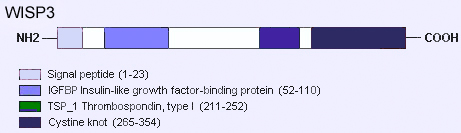
Description
WISP3 contains four conserved cysteine-rich domains: insulin-like growth factor-binding domain, von Willebrand factor type C module, thrombospondin domain and C-terminal cystine knot-like domain. It has three isoforms: 1) variant 1, 354 aa, 39292 Da; 2) variant 2, 331 aa, This variant differs from variant 1 in two regions. It has an alternate 5 end which results in a different N-terminus. It also uses two alternative donor and acceptor sites in the middle coding region which result in a few internal aa differences between variant 1 and 2. 3) variant 3, 372 aa, This variant differs in the 5 UTR and CDS, compared to variant 1. The resulting protein is longer and has a distinct N-terminus, compared to variant 1.
Expression
Predominant expression in adult kidney and testis and fetal kidney. Weaker expression found in placenta, ovary, prostate and small intestine. Also expressed in skeletally-derived cells such as synoviocytes and articular cartilage chondrocytes.
Localisation
Secreted (Probable).
Function
It is a member of the WNT1 inducible signaling pathway (WISP) protein subfamily, which belongs to the connective tissue growth factor (CTGF) family and may be downstream in the WNT1 signaling pathway that is relevant to malignant transformation. It is over-expressed in colon tumors. It is essential for normal postnatal skeletal growth and cartilage homeostasis. It acts as a putative growth regulator contributing to the inflammatory breast cancer by regulating tumor cell growth, invasion and angiogenesis.
Homology
Wnt1-inducible signaling proteins
Mutations
Germinal
Various types of mutations have been described, dispersed throughout the gene, including nucleotide substitutions, small deletions and small insertions. There are patients who are compound heterozygous, heterozygous or homozygous. The mutations cause progressive pseudorheumatoid dysplasia.
Somatic
Somatic mutations that cause reading frameshifts at a polyadenosine tract within the WISP3 coding sequence have been observed at higher-than-expected rates in gastrointestinal tumors from patients with mutations in the mismatch repair pathway.
Implicated in
Entity name
Arthropathy, progressive pseudorheumatoid, of childhood
Disease
Mutations in the WISP3 gene result in an arthropathy of childhood beginning at about age 3-8. Usually several joints were affected with pain and soft tissue swelling. The proximal interphalangeal joints of the hand were most commonly affected and the hips and elbows next most often involved.
Entity name
Inflammatory breast cancer
Oncogenesis
Loss of WISP3 is one of the key genetic alterations in the development of IBC.
Entity name
Rheumatoid arthritis
Entity name
Colon cancer
Oncogenesis
Frameshifts, non-sense mutations and non-synonymous changes involving cysteines or affect a splice-donor site.
Article Bibliography
| Pubmed ID | Last Year | Title | Authors |
|---|
Citation
Celina G Kleer ; Lei Ding
WISP3 (WNT-1 inducible signaling pathway protein 3)
Atlas Genet Cytogenet Oncol Haematol. 2005-03-01
Online version: http://atlasgeneticsoncology.org/gene/469/wisp3
