XRCC6 (X-ray repair complementing defective repair in Chinese hamster cells 6)
2010-06-01 Sabina Pucci , Maria Josç Zonetti AffiliationLab of Molecular Pathology, Dept of Biopathology, University of Rome Tor Vergata, Via Montpellier, 00133 Rome, Italy
Identity
HGNC
LOCATION
22q13.2
LOCUSID
ALIAS
CTC75,CTCBF,G22P1,KU70,ML8,TLAA
FUSION GENES
DNA/RNA
Description
The KU70 gene is composed of 13 exons.
Transcription
2156 bp mRNA.
Proteins
Description
The Ku70 protein is 609 amino acid long and its molecular weight is 69.8 kDa. It is composed of 3 domains: an amino (N) amino-terminal alpha/beta domain, a central beta-barrel domain and a helical C-terminal arm (Rivera-Calzada et al., 2007). The C-terminal region consists of a 5 kDa SAP domain (Ku70-SAP) which involved in DNA binding during NHEJ reaction.

Expression
Ku70 is ubiquitously expressed. Changes in Ku70 expression correlated to a pathological state.
Localisation
Ku was originally reported to be a nuclear protein, consistent with its functions as a subunit of DNA-PK involved in DNA double strand breaks repair. However, several studies have revealed the cytoplasmic or cell surface localization of Ku proteins in various cell types (Prabhakar et al., 1990). Recently, it has been demonstrated that the shift from the nucleus to the cytoplasm of the Ku70/Ku80 proteins in tumor cells could represents a mechanism to inhibit cell death through the Ku70-Bax-sCLU interactions, giving rise to a new chemoresistant clone with a more aggressive phenotype.
Function
Ku is a heterodimeric protein composed of two subunits with molecular weight of 70 and 86 kDa. Ku forms a complex with the DNA-dependent protein kinase catalytic subunit (DNA-PKcs) to form the full DNA-dependent protein kinase, DNA-PK, consisting of 470 kDa and required for the non-homologous end joining (NHEJ) pathway of DNA repair. The Ku heterodimer binds the ends of various types of DNA discontinuity, and is involved in the repair of DNA breaks caused by an incorrect DNA replication, V(D)J recombination, physiological oxidations, ionizing irradiation, and some chemotherapeutic drug effects (Featherstone and Jackson, 1999). The principal role of Ku proteins is to take care of the homeostasis of the genome being involved in telomere maintenance, specific gene transcription, DNA replication, cell-cycle regulation and regulation of apoptosis induction. Ku70 has been shown to bind to the pro-apoptotic protein BAX in the cytoplasm in normal, undamaged cell. After DNA damage inducing DNA double-strand breaks repair (UV treatment, ionizing radiation, etc.) Ku70 allows the translocation of Bax to the mitochondria leading to the release of death-promoting factors, such as cytochrome c, in the cytoplasmic compartment. In normal cells, after an irreversible cell damage, nCLU cooperates with Ku70 to induce apoptotic death, activating the translocation of Bax to mitochondria whereas the sCLU protein stabilizes the Ku70-Bax interaction in the cytoplasm acting as cytoprotectant. The Ku70-Bax-sCLU interaction in the cytoplasm seems to play an important role in cell survival pathways and in cell death escape, that in pathological condition could lead to the survival of the aberrant cell clone. Overall, the dynamic interactions among CLU, Ku70, and Bax seems to have an important role in both tumor insurgence and its progression (Pucci et al., 2009a; Pucci et al., 2009b).
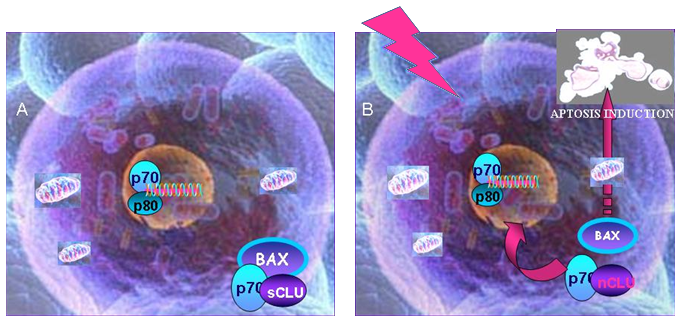
Ku70/80-CLU-Bax interactions. (A) Bax is localized inactive in the cytoplasm in normal, undamaged cell interacting with the Ku70 protein C-terminus. sCLU stabilizes the Ku70-Bax interaction in the cytoplasm acting as cytoprotectant. (B) After DNA damage inducing DNA double-strand breaks repair (UV treatment, ionizing radiation, etc.) Ku70 allows the translocation of Bax to the mitochondria inducing apoptosis (Mazzarelli et al., 2009).
Implicated in
Entity name
Colon cancer
Note
The colon cancer expression and the localization of Ku70 and Ku80 are related to tumor progression in colon cancer. DNA repair is inhibited in high infiltrative colon carcinoma by Ku80 loss and Ku70 cell compartment shift (from the nucleus to the cytoplasm).
Moreover in colorectal carcinoma was demonstrated a very important role of Ku70 expression, localization, and physical interaction with CLU and Bax. In fact the Ku70-CLU-Bax colocalization in the cytoplasm and an increase in Ku70-CLU-Bax binding were observed in highly aggressive human colon cancer (Pucci et al., 2004; Pucci et al., 2009c), confirming that these interactions regulate the Bax-dependent cell death.
Moreover in colorectal carcinoma was demonstrated a very important role of Ku70 expression, localization, and physical interaction with CLU and Bax. In fact the Ku70-CLU-Bax colocalization in the cytoplasm and an increase in Ku70-CLU-Bax binding were observed in highly aggressive human colon cancer (Pucci et al., 2004; Pucci et al., 2009c), confirming that these interactions regulate the Bax-dependent cell death.
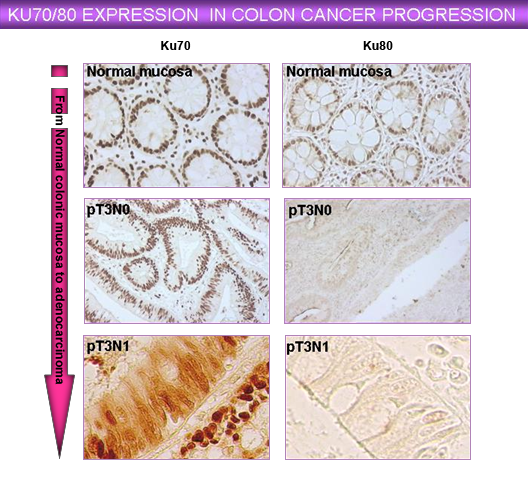
Tumor-specific modulation of Ku70/80 in human colon cancer. Ku70 staining was strongly positive in the nuclei of normal mucosa. In node-negative carcinomas (pT3N0) Ku70 expression slightly decreased and it localized mainly in the nucleus. In node-positive carcinomas (pT3N1) Ku70 staining was distributed mainly in cytoplasm. The expression of Ku86 was positive in the nuclei of control tissues (normal mucosa). Nuclear Ku86 expression was strongly decreased in node-negative tumors (pT3N0). No staining for Ku86 was found in the nucleus or in the cytoplasm of node-positive carcinomas (pT3N1).
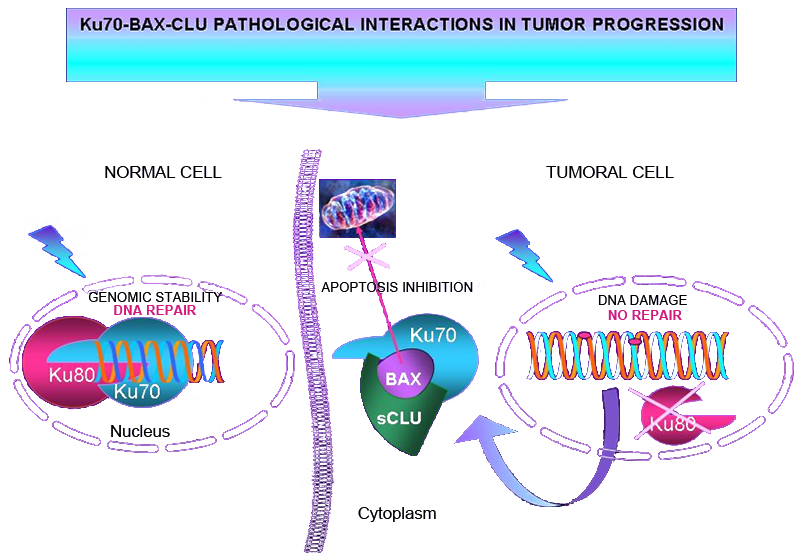
Ku70-Bax-CLU pathological interaction. Apoptosis escaping. The shift of clusterin forms production, the loss of Ku80, and the cytoplasmic relocalization of Ku70 are related to cell death inhibition and cancer progression.
Entity name
Breast cancer
Note
Experimental data further reported an inactivation of Ku DNA-binding activity, essential for genomic stability in breast and in bladder carcinomas. A dysfunction of this protective activity let the aberrant cell clone growing. In highly infiltrative and metastatic tumors of the breast and bladder, the impaired DNA-repair activity is due to the loss of Ku86 (Pucci et al., 2001) and to the Ku70 shifting from the nucleus to the cytoplasm. The shift from the nucleus to the cytoplasm of the Ku70/80 proteins in tumor cells could represents a mechanism to inhibit cell death through the cooperative interaction with sCLU, giving rise to a new chemoresistant clone with a more aggressive phenotype.
Article Bibliography
| Pubmed ID | Last Year | Title | Authors |
|---|---|---|---|
| 10377944 | 1999 | Ku, a DNA repair protein with multiple cellular functions? | Featherstone C et al |
| 19879422 | 2009 | CLU and colon cancer. The dual face of CLU: from normal to malignant phenotype. | Mazzarelli P et al |
| 2212014 | 1990 | Cell surface expression of the 70-kD component of Ku, a DNA-binding nuclear autoantigen. | Prabhakar BS et al |
| 19623170 | 2009 | Clusterin in stool: a new biomarker for colon cancer screening? | Pucci S et al |
| 19177010 | 2009 | Interleukin-6 affects cell death escaping mechanisms acting on Bax-Ku70-Clusterin interactions in human colon cancer progression. | Pucci S et al |
| 17159921 | 2007 | Structural model of full-length human Ku70-Ku80 heterodimer and its recognition of DNA and DNA-PKcs. | Rivera-Calzada A et al |
Other Information
Locus ID:
NCBI: 2547
MIM: 152690
HGNC: 4055
Ensembl: ENSG00000196419
Variants:
dbSNP: 2547
ClinVar: 2547
TCGA: ENSG00000196419
COSMIC: XRCC6
RNA/Proteins
Expression (GTEx)
Pathways
Protein levels (Protein atlas)
References
| Pubmed ID | Year | Title | Citations |
|---|---|---|---|
| 38277448 | 2024 | Ku70 senses cytosolic DNA and assembles a tumor-suppressive signalosome. | 0 |
| 38277448 | 2024 | Ku70 senses cytosolic DNA and assembles a tumor-suppressive signalosome. | 0 |
| 37108203 | 2023 | Analysis of Ku70 S155 Phospho-Specific BioID2 Interactome Identifies Ku Association with TRIP12 in Response to DNA Damage. | 0 |
| 37728466 | 2023 | Nuclear expression of Ku70/80 is associated with CHEK2 germline mutations in breast cancer. | 0 |
| 37108203 | 2023 | Analysis of Ku70 S155 Phospho-Specific BioID2 Interactome Identifies Ku Association with TRIP12 in Response to DNA Damage. | 0 |
| 37728466 | 2023 | Nuclear expression of Ku70/80 is associated with CHEK2 germline mutations in breast cancer. | 0 |
| 34878919 | 2022 | The Large Nonstructural Protein (NS1) of Human Bocavirus 1 Directly Interacts with Ku70, Which Plays an Important Role in Virus Replication in Human Airway Epithelia. | 4 |
| 34878919 | 2022 | The Large Nonstructural Protein (NS1) of Human Bocavirus 1 Directly Interacts with Ku70, Which Plays an Important Role in Virus Replication in Human Airway Epithelia. | 4 |
| 33529758 | 2021 | Down-regulation of GP130 signaling sensitizes bladder cancer to cisplatin by impairing Ku70 DNA repair signaling and promoting apoptosis. | 5 |
| 33734613 | 2021 | XRCC5/6 polymorphisms and their interactions with smoking, alcohol consumption, and sleep satisfaction in breast cancer risk: A Chinese multi-center study. | 3 |
| 34006647 | 2021 | Ku70 suppresses alternative end joining in G1-arrested progenitor B cells. | 18 |
| 34718776 | 2021 | Phospho-Ku70 induced by DNA damage interacts with RNA Pol II and promotes the formation of phospho-53BP1 foci to ensure optimal cNHEJ. | 6 |
| 34746031 | 2021 | The Role of Ku70 as a Cytosolic DNA Sensor in Innate Immunity and Beyond. | 15 |
| 34966825 | 2021 | TEX10 Promotes the Tumorigenesis and Radiotherapy Resistance of Urinary Bladder Carcinoma by Stabilizing XRCC6. | 4 |
| 33529758 | 2021 | Down-regulation of GP130 signaling sensitizes bladder cancer to cisplatin by impairing Ku70 DNA repair signaling and promoting apoptosis. | 5 |
Citation
Sabina Pucci ; Maria Josç Zonetti
XRCC6 (X-ray repair complementing defective repair in Chinese hamster cells 6)
Atlas Genet Cytogenet Oncol Haematol. 2010-06-01
Online version: http://atlasgeneticsoncology.org/gene/246/xrcc6
