ZNF217 (zinc finger protein 217)
2005-09-01 Paul Yaswen , Colin Collins AffiliationLife Sciences Division, Lawrence Berkeley National Laboratory, 1 Cyclotron Road, Bldg 977-225A, Berkeley, CA 94720-8174, USA
DNA/RNA
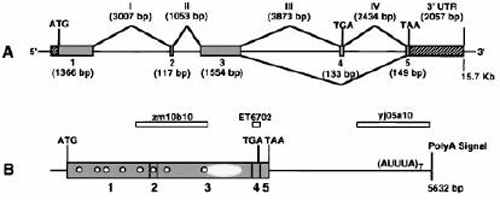
Genomic organization of ZNF217. (A) The genomic organization of the five exons with encoded initiation and termination codons that make up ZNF217. Hatched boxes represent known 59- and 39-untranslated regions (UTR) in the cDNA. The sizes of exons and introns appear below and above the map, respectively. (B) The map of the 5632-bp ZNF217 cDNA. Vertical bars represent exon boundaries. The relative positions of the predicted eight C2H2 Kruppel-like zinc finger motifs are indicated by white circles. The position of the proline-rich putative transcription activator domain is shown as a hatched oval. AUUUA motifs are indicated in the 39-untranslated region. The relative locations of three ESTs are shown in boxes.
Description
5 exons
Transcription
Exon 4 encodes a TGA termination codon and is alternatively processed.
Pseudogene
None
Proteins

Eight C2H2 zinc fingers and a proline-rich domain. Conserved linker sequence, TGEKP, reported to bind DNA with high affinity
Description
Full-length ZNF217 cDNAs encode two open reading frames of 1,062 and 1,108 amino acids, due to alternative splicing of exon 4. Each predicted protein has eight C2H2 zinc fingers and a proline-rich domain. Sequence analysis of ZNF217 indicates a strong resemblance to members of the Kruppel-like family of zinc finger proteins. The eight zinc finger domains in ZNF217 are interspersed throughout the ZNF217 sequence and their pattern does not appear to fall into one of the three classes of C2H2 zinc finger proteins; triple-C2H2, multiple adjacent, and separated-paired fingers. The sixth and seventh zinc fingers in ZNF217 are separated by the conserved linker sequence, TGEKP, reported to bind DNA with high affinity. Database analysis indicates that this paired zinc finger region aligns with those in several members of the Delta-EF1/ZFH-1 family of two-handed zinc-finger homeodomain proteins, including Smad-Interacting Protein 1 (SIP-1).
Expression
ZNF217 is expressed at low levels in normal tissues.
Localisation
Nuclear
Function
ZNF217 protein localizes to the nucleus and co-immunoprecipitates with complexes containing the transcriptional corepressors CoREST and CtBP, histone deacetylases HDAC1 and HDAC2, and histone methyltransferases G9a and Eu-HMTase1. This strongly suggests that ZNF217 may function as part of a transcriptional repressor complex.
Implicated in
Entity
Breast cancer
Note
The findings that ZNF217 can immortalize human mammary epithelial cells, and that its amplification is associated with poor prognosis, suggest that it may play roles in both early and late stage breast cancer. ZNF217 can attenuate apoptotic signals resulting from telomere dysfunction as well as from doxorubicin-induced DNA damage, while silencing ZNF217 with siRNA restores sensitivity to doxorubicin. Moreover, elevated ZNF217 leads to increased phosphorylation of Akt, whereas inhibition of the phosphatidylinositol 3 kinase pathway and Akt phosphorylation decreases ZNF217 protein levels and increases sensitivity to doxorubicin. These results suggest that ZNF217 may promote neoplastic transformation by increasing cell survival during telomeric crisis, and may promote later stages of malignancy by increasing cell survival during chemotherapy.
Article Bibliography
| Pubmed ID | Last Year | Title | Authors |
|---|---|---|---|
| 15300252 | 2004 | In situ analyses of genome instability in breast cancer. | Chin K et al |
| 9671742 | 1998 | Positional cloning of ZNF217 and NABC1: genes amplified at 20q13.2 and overexpressed in breast carcinoma. | Collins C et al |
| 11245413 | 2001 | The ZNF217 gene amplified in breast cancers promotes immortalization of human mammary epithelial cells. | Nonet GH et al |
| 15476264 | 2004 | The candidate oncogene ZNF217 is frequently amplified in colon cancer. | Rooney PH et al |
| 15756435 | 2005 | Detection of Her2/neu, c-MYC and ZNF217 gene amplification during breast cancer progression using fluorescence in situ hybridization. | Shimada M et al |
Other Information
Locus ID:
NCBI: 7764
MIM: 602967
HGNC: 13009
Ensembl: ENSG00000171940
Variants:
dbSNP: 7764
ClinVar: 7764
TCGA: ENSG00000171940
COSMIC: ZNF217
RNA/Proteins
| Gene ID | Transcript ID | Uniprot |
|---|---|---|
| ENSG00000171940 | ENST00000302342 | O75362 |
| ENSG00000171940 | ENST00000371471 | O75362 |
| ENSG00000171940 | ENST00000431687 | A2A326 |
| ENSG00000171940 | ENST00000437222 | Q9BZ31 |
Expression (GTEx)
Protein levels (Protein atlas)
References
| Pubmed ID | Year | Title | Citations |
|---|---|---|---|
| 37080415 | 2023 | FTO-stabilized miR-139-5p targets ZNF217 to suppress prostate cancer cell malignancies by inactivating the PI3K/Akt/mTOR signal pathway. | 5 |
| 37648814 | 2023 | Frequent ZNF217 mutations lead to transcriptional deregulation of interferon signal transduction via altered chromatin accessibility in B cell lymphoma. | 1 |
| 37080415 | 2023 | FTO-stabilized miR-139-5p targets ZNF217 to suppress prostate cancer cell malignancies by inactivating the PI3K/Akt/mTOR signal pathway. | 5 |
| 37648814 | 2023 | Frequent ZNF217 mutations lead to transcriptional deregulation of interferon signal transduction via altered chromatin accessibility in B cell lymphoma. | 1 |
| 35121826 | 2022 | MicroRNA-135 inhibits initiation of epithelial-mesenchymal transition in breast cancer by targeting ZNF217 and promoting m6A modification of NANOG. | 11 |
| 35362545 | 2022 | Interferon regulatory factor 5‑induced upregulation of zinc‑finger protein 217 promotes pancreatic carcinoma progression. | 2 |
| 36356557 | 2022 | Hsa_circ_0069094 positively regulates the expression of oncogenic ZNF217 by competitively targeting miR-758-3p to promote the development of breast cancer. | 3 |
| 35121826 | 2022 | MicroRNA-135 inhibits initiation of epithelial-mesenchymal transition in breast cancer by targeting ZNF217 and promoting m6A modification of NANOG. | 11 |
| 35362545 | 2022 | Interferon regulatory factor 5‑induced upregulation of zinc‑finger protein 217 promotes pancreatic carcinoma progression. | 2 |
| 36356557 | 2022 | Hsa_circ_0069094 positively regulates the expression of oncogenic ZNF217 by competitively targeting miR-758-3p to promote the development of breast cancer. | 3 |
| 31454071 | 2020 | A candidate pathogenic gene, zinc finger gene 217 (ZNF217), may contribute to polycystic ovary syndrome through prostaglandin E2. | 6 |
| 32721948 | 2020 | Stiff stroma increases breast cancer risk by inducing the oncogene ZNF217. | 53 |
| 32741808 | 2020 | lncRNA SNHG1 Knockdown Alleviates Amyloid-β-Induced Neuronal Injury by Regulating ZNF217 via Sponging miR-361-3p in Alzheimer's Disease. | 22 |
| 32999043 | 2020 | Implication of ZNF217 in Accelerating Tumor Development and Therapeutically Targeting ZNF217-Induced PI3K-AKT Signaling for the Treatment of Metastatic Osteosarcoma. | 5 |
| 31454071 | 2020 | A candidate pathogenic gene, zinc finger gene 217 (ZNF217), may contribute to polycystic ovary syndrome through prostaglandin E2. | 6 |
Citation
Paul Yaswen ; Colin Collins
ZNF217 (zinc finger protein 217)
Atlas Genet Cytogenet Oncol Haematol. 2005-09-01
Online version: http://atlasgeneticsoncology.org/gene/42875/znf217
