Beckwith-Wiedemann syndrome
2000-11-01 Marcel Mannens AffiliationDNA-diagnostics laboratory, University of Amsterdam, Academic Medical Center Department of Clinical Genetics PO Box 22700 1100 DE Amsterdam, the Netherlands
Identity
Name
Beckwith-Wiedemann syndrome
Alias
Exomphalos-macroglossia-gigantism triad
Inheritance
incidence of 7\/105; given the variable expression of the symptoms, the actual frequency is likely to be higher; generally there is sporadic occurrence of the syndrome (85%); inheritance is mostly maternal (imprinting) with a more severe phenotype after maternal transmission
Omim
130650
Mesh
D001506
Orphanet
116 Beckwith-Wiedemann syndrome
Umls
C0004903
Clinics
Phenotype and clinics
multiple features that occur variably; most prominent is the EMG triad (exomphalos-macroglossia-gigantism): apart from the abdominal wall defects and pre- and postnatal growth abnormalities, earlobe pits or creases, facial nevus flammeus, hypoglycemia, renal abnormalities and hemihypertrophy (unilateral overgrowth) are frequently seen
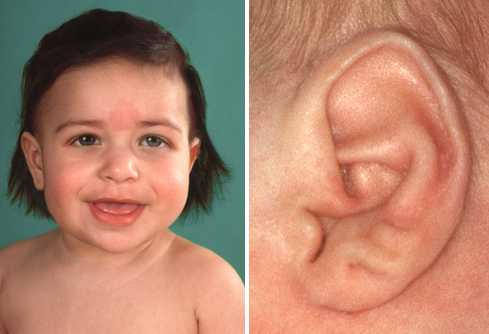
Patient with Beckwith-Wiedemann syndrome. The face shows the enlarged tongue (macroglossia), the ear the typical earlobe creases - Marcel Mannens
Neoplastic risk
the increased risk for childhood solid tumours is 7.5% (thousand fold increase); tumours most frequently seen are nephroblastoma (Wilms tumour), adrenocortical carcinoma, rhabdomyosarcoma and hepatoblastoma; clinical risk factors are hemihypertrophy and nephromegaly; genetic risk factors are uniparental disomy (UPD) and H19\/IGF2 imprinting defects
Treatment
in general surgical correction of the abdominal wall defects and macroglossia; monitoring the glycemia during the first 3 days and early treatment of hypoglycemia (deleterious for central nervous system) is of importance to avoid further complications; frequent screening for tumour development
Prognosis
clinical features tend to become less with ageing; tumour risk decreases strongly after the 4-7th year of birth
Cytogenetics
Inborn condition
paternal duplications of chromosome region 11p15, maternal translocations involving chromosome region 11p15.3-p15.5
Cancer cytog
apart from chromosome 11 aberrations, multiple chromosomes are involved in tumour development; promising prognostic indicators in Wilms tumour might be chromosome 1p and 16q aberrations; tther molecular abnormalities associated with an adverse outcome in Wilms tumour are 22q allele loss or P53 aberrations
Other Findings
Note
in 10-20% of BWS cases, uniparental disomy of chromosome region 11p15 is seen, mostly in a mosaic form
Genes involved and Proteins
Alias
D11S813E, D11S878E, ASM, ASM1
Note
imprinted, maternally expressed, untranslated mRNA
Description
the human H19 gene is 2.7 kb long and includes 4 small introns; maternally expressed, paternal imprint
Expression
highly expressed in endodermal and mesodermal embryonic tissues; in adult brain, only in the pons and globus pallidus; in adult tissues, expression is primarily confined to skeletal and cardiac muscle; other tissues are down-regulated postnatal but re-expressed in tumours that express the gene during embryogenesis
Function
putative tumour suppressor; proposed regulatory function for IGF2 expression (under debate)
Germinal
hypermethylated in 10-20% of sporadic BWS cases; familial transmission unclear yet; loss of imprinting (LOI) can be induced in deletion mouse models
Somatic
hypermethylated in 10-20% of sporadic BWS cases mostly somatic events due to UPD in mosaic form; LOI in tumours
Alias
IGF-II, somatomedin A, Hs.75963
Transcription
1356 bp mRNA, paternally expressed, maternal imprint
Description
180 amino acids, 20,14 kDa (unprocessed)
Expression
IGF2 has the highest levels of expression in tissues that are affected by prenatal overgrowth in BWS; the main source of expression is liver; expression depends on promoter usage; P1 is exclusively active in adult liver, whereas P3 and P4 exert their action in liver prenatal; P2 is only active in certain tumour cell lines
Localisation
secreted
Function
embryonal growth factor, mitogen
Homology
belongs to the insulin\/IGF\/relaxin family
Germinal
hypomethylated; LOI in sporadic BWS cases; familial transmission unclear yet; BWS phenotype can be induced in igf2 overexpressing mouse models
Somatic
hypomethylated, LOI in sporadic BWS cases; mostly somatic events due to UPD in mosaic form; LOI in tumours
Alias
KIP2, P57KIP2, P57, CDKN5
Description
1511 bp messenger, preferentially maternally expressed (paternal imprint)
Expression
It is expressed in the heart, brain, lung, skeletal muscle, kidney, pancreas and testis; high levels are seen in the placenta, low levels in liver
Localisation
nuclear
Function
Summary: Cyclin-dependent kinase inhibitor 1C is a tight-binding inhibitor of several G1 cyclin\/Cdk complexes and a negative regulator of cell proliferation; mutations of CDKN1C are implicated in sporadic cancers and Beckwith-Wiedemann syndrome suggesting that it is a tumour suppressor candidate; in BWS however, no evidence for tumour association was found
Homology
p21CIP1 CdK inhibitor gene family
Germinal
mostly maternal, nucleotide substitutions, small deletions
Somatic
CDKN1C mutations are described in tumour formation; mouse mutation-models reveal part of the BWS phenotype in particular the abdominal-wall defects
Alias
KCNQ1 overlapping transcript 1, LIT1, KvDMR1, KvLQT1-AS, Long QT intronic transcript 1
Description
maternally imprinted gene, > 80 kb RNA
Transcription
intronic transcript 1, embedded in intron 9 (and 10) of KCNQ1, in opposite orientation; expressed in most human tissues and from the paternal allele, the maternal allele being imprinted through a specific methylation of a CpG island; abnormally expressed in patients with Beckwith-Wiedemann syndrome, independently of IGF2 imprinting; no abnormal imprinting in Wilms tumour
Expression
untranslated
Function
unknown; it is postulated that KCNQ1OT1 might influence the expression of nearby imprinted genes such as CDKN1C or IGF2\/H19
Germinal
aberrant methylation in 50-80% of BWS patients not always 100% (might be due to UPD in some cases); inheritance unclear
Somatic
unclear; there is no association between aberrant methylation and tumour development
Alias
zinc finger protein 215, BAZ2
Description
mRNA of 3480 bp, 9 exons, at least 5 splice variants; exon 9 runs antisense of a second gene: ZNF214
Transcription
imprinted in a tissue specific manner, the maternal allele being preferentially expressed
Description
517 amino acids, 60,048 kDa; KRABA domain; similarities to a KRABB domain; SCAN box; nuclear localisation signal KKKR; 2 x 2 zinc-fingers
Expression
widely expressed at low levels; expression is highest in testis; splice variants of ZNF215 show tissue specific expression
Localisation
nuclear
Function
putative transcription factor; ZNF215 was cloned from a region associated with hemihypertrophy, cardiac abnormalities, Wilms tumour and minor BWS features; as such the gene might be responsible for a distinct phenotype in BWS
Homology
belongs to the Krueppel family of C2H2-type zinc finger proteins
Germinal
various amino acids substitutions found in BWS \/ hemihypertrophy patients; causal relationship with phenotype unclear
Somatic
in tumours no mutations found so far
Article Bibliography
| Pubmed ID | Last Year | Title | Authors |
|---|---|---|---|
| 10762538 | 2000 | Disruption of a novel imprinted zinc-finger gene, ZNF215, in Beckwith-Wiedemann syndrome. | Alders M et al |
| 9544889 | 1998 | Risk of cancer during the first four years of life in children from The Beckwith-Wiedemann Syndrome Registry. | DeBaun MR et al |
| 7820926 | 1994 | Clinical features and natural history of Beckwith-Wiedemann syndrome: presentation of 74 new cases. | Elliott M et al |
| 8618920 | 1995 | Multiple genetic loci within 11p15 defined by Beckwith-Wiedemann syndrome rearrangement breakpoints and subchromosomal transferable fragments. | Hoovers JM et al |
| 10220444 | 1999 | Loss of imprinting of a paternally expressed transcript, with antisense orientation to KVLQT1, occurs frequently in Beckwith-Wiedemann syndrome and is independent of insulin-like growth factor II imprinting. | Lee MP et al |
| 9781904 | 1998 | Molecular genetics of Wiedemann-Beckwith syndrome. | Li M et al |
| 9143384 | 1997 | The Beckwith-Wiedemann syndrome phenotype and the risk of cancer. | Schneid H et al |
| 10738297 | 2000 | Genetics of Beckwith-Wiedemann syndrome-associated tumors: common genetic pathways. | Steenman M et al |
| 14231762 | 1964 | [FAMILIAL MALFORMATION COMPLEX WITH UMBILICAL HERNIA AND MACROGLOSSIA--A "NEW SYNDROME"?]. | WIEDEMANN HR et al |
External Links
Citation
Marcel Mannens
Beckwith-Wiedemann syndrome
Atlas Genet Cytogenet Oncol Haematol. 2000-11-01
Online version: http://atlasgeneticsoncology.org/cancer-prone-disease/10037/beckwith-wiedemann-syndrome
