Chediak-Higashi Syndrome
2012-12-01 Xinjie Xu , Wei Shen AffiliationCytogenetics Laboratory, Center for Human Genetics, Inc, Cambridge, MA, USA (XX); Waisman Center, University of Wisconsin-Madison, Madison, WI, USA (WS)
Identity
Name
Chediak-Higashi Syndrome
Alias
CHS
Note
Chediak-Higashi Syndrome is a rare genetic disease. The clinical features include oculocutaneous albinism, immunodeficiency, neurological manifestations, mild coagulation defects and a predisposition to lymphoma-like cancer.
Inheritance
Autosome Recessive.
Omim
214500
Mesh
D002609
Orphanet
167 Ché syndrome
Umls
C0007965
Clinics
Phenotype and clinics
The symptoms of CHS patients are variable. They have highly variable hypopigmentation of the skin, eye and hair (oculocutaneus albinism). The Neurological manifestations are also variable, including cognitive impairment, peripheral neuropathy, ataxia, and parkinsonism. In addition, the CHS patients have frequent infections, particularly bacterial infections of the skin and respiratory tract. Symptoms can appear anytime from childhood to early adulthood. Generally speaking, CHS patients have mild coagulation defects including epistaxis, gum\/mucosal bleeding, and easy bruising.
The accelerated phase, which occurs in 85% of individuals with CHS, can take place at any age. Clinical manifestations include fever, lymphadenopathy, hepatosplenomegaly, anemia, neutropenia, and sometimes thrombocytopenia. Originally thought to be a malignancy resembling lymphoma, the accelerated phase is now known to be a hemophagocytic lymphohistiocytosis characterized by multiorgan inflammation. The accelerated phase and its complications are the most common causes of mortality in CHS patients.
Most CHS patients present in early childhood and die unless treated by bone marrow transplantation. About 10-15% of patients exhibit a much milder clinical symptoms and survive to adulthood, but develop progressive and often fatal neurological dysfunction. Very rare patients exhibit an intermediate adolescent CHS phenotype, with severe infections in early childhood, but a milder course by adolescence, and no accelerated phase.
The accelerated phase, which occurs in 85% of individuals with CHS, can take place at any age. Clinical manifestations include fever, lymphadenopathy, hepatosplenomegaly, anemia, neutropenia, and sometimes thrombocytopenia. Originally thought to be a malignancy resembling lymphoma, the accelerated phase is now known to be a hemophagocytic lymphohistiocytosis characterized by multiorgan inflammation. The accelerated phase and its complications are the most common causes of mortality in CHS patients.
Most CHS patients present in early childhood and die unless treated by bone marrow transplantation. About 10-15% of patients exhibit a much milder clinical symptoms and survive to adulthood, but develop progressive and often fatal neurological dysfunction. Very rare patients exhibit an intermediate adolescent CHS phenotype, with severe infections in early childhood, but a milder course by adolescence, and no accelerated phase.
Treatment
Infections are treated with antibiotics. Antiviral drugs such as acyclovir and chemotherapy drugs are often used in the accelerated phase of the disease. Surgery may be needed to drain abscesses in some cases.
Patients in the accelerated phase are treated with chemoimmunotherapy followed by transition to continuation therapy. Allogenic HSCT is the only treatment to cure hematologic and immunologic defects. Platelet transfusions are needed for serious bleeding. Corrective lenses help to improve visual acuity. Treatment by rehabilitation specialists are used for neurologic complications.
Patients in the accelerated phase are treated with chemoimmunotherapy followed by transition to continuation therapy. Allogenic HSCT is the only treatment to cure hematologic and immunologic defects. Platelet transfusions are needed for serious bleeding. Corrective lenses help to improve visual acuity. Treatment by rehabilitation specialists are used for neurologic complications.
Prognosis
CHS patients usually die in their first decade of life, from chronic infections or accelerated disease. However, some mildly affected children have survived longer.
Genes involved and Proteins
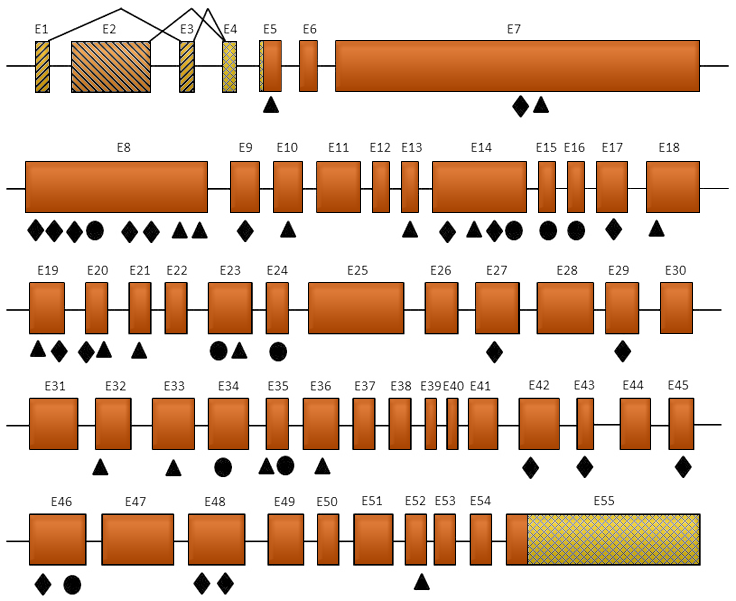
Figure 1. The structure and mutations of the human LYST gene. Filled box indicate coding sequences. Hatched box indicate 5 and 3 untranslated sequences. Left-hatched indicates 5 untranslated sequences in mRNA containing exons 1 and 3, right-hatched indicates 5 untranslated sequences in mRNAs containing exon 2, and double- hatched indicates common 5 and 3 untranslated sequences. E1 and E2 represent mutually exclusive 5 terminal exons, and corresponding alternative promoters are indicated by right-facing arrows. Filled diamonds denote frameshifts, filled triangles denote nonsense mutations, and filled circles denote missense substitutions. (Katrim et al., 2002).
Description
55 exons spanning 205.9 kb of genomic DNA.
Transcription
Two alternative transcriptions. The large transcript (12.0 kb) produces functional protein. The function of the small transcript (5.8 kb) is unknown.

Figure 2. A schematic representation of motifs found in CHS protein. (Ward et al., 2000).
Description
The CHS protein is composed of 3801 amino acids. The molecular weight of the CHS protein is 430 kDa. The N-terminus of the protein has a large stretch of alpha-helices termed HEAT repeats (Figure 2). HEAT repeats are important to mediate membrane associations and are associated with vesicle transport. The C-terminus of the protein has two domains that are conserved between the human and mouse homologues. The first of these domains has been referred to as the BEACH domain. The BEACH domain contains a consensus WIDL amino acid stretch as well as several other conserved amino acids that define members of the CHS protein family. The second domain contains a WD-40 repeat region, indicative of a protein-protein interaction domain.
Expression
LYST is expressed in all cells.
Localisation
Cytosolic.
Function
Lysosome trafficking regulator.
Homology
There are 82% identity and 88% homology between the human and mouse proteins. Similar degrees of identity are seen among human, rat and cow CHS genes.
Note
More than 50 mutations have been identified, most of which are nonsense mutations that result in premature stop codons and thus a truncated protein. Figure 1 shows the distribution of the mutations.
Article Bibliography
| Pubmed ID | Last Year | Title | Authors |
|---|---|---|---|
| 17293882 | 2007 | Hematopoietic cell transplantation for Chediak-Higashi syndrome. | Eapen M et al |
| 11487012 | 2001 | Hermansky-Pudlak syndrome and Chediak-Higashi syndrome: disorders of vesicle formation and trafficking. | Huizing M et al |
| 10527680 | 1999 | Clinical, molecular, and cell biological aspects of Chediak-Higashi syndrome. | Introne W et al |
| 20301751 | 1993 | Chediak-Higashi Syndrome. | Toro C et al |
| 11857544 | 2002 | Apparent genotype-phenotype correlation in childhood, adolescent, and adult Chediak-Higashi syndrome. | Karim MA et al |
| 8896560 | 1996 | Identification and mutation analysis of the complete gene for Chediak-Higashi syndrome. | Nagle DL et al |
| 11208072 | 2000 | Analysis of the lysosomal storage disease Chediak-Higashi syndrome. | Ward DM et al |
External Links
Citation
Xinjie Xu ; Wei Shen
Chediak-Higashi Syndrome
Atlas Genet Cytogenet Oncol Haematol. 2012-12-01
Online version: http://atlasgeneticsoncology.org/cancer-prone-disease/10128/chediak-higashi-syndrome
