Hereditary multiple cutaneous leiomyomatosis
2008-10-01 Sadhanna Badeloe , Jorge Frank AffiliationMaastricht University Center for Molecular Dermatology (MUCMD), Department of Dermatology, University Hospital Maastricht, P. Debyelaan 25, Postbus 5800, 6202 AZ Maastricht, The Netherlands
Identity
Name
Hereditary multiple cutaneous leiomyomatosis
Alias
Multiple cutaneous and uterine leiomyomatosis (MCUL) , Hereditary leiomyomatosis and renal cell cancer (HLRCC)
Note
Multiple cutaneous leiomyomatosis (MCUL) is characterized by multiple leiomyomas of the skin and uterus. When associated with renal cell cancer, this syndrome is referred to as hereditary leiomyomatosis and renal cell cancer (HLRCC).
Inheritance
Autosomal dominant with incomplete penetrance and variable expressivity.
Omim
150800
Mesh
C535516
Orphanet
523 Hereditary leiomyomatosis and renal cell cancer
Umls
-
Clinics
Phenotype and clinics
Hereditary multiple cutaneous leiomyomatosis is a tumor predisposition syndrome characterized by multiple cutaneous and uterine leiomyomas and an increased risk of developing renal cancer.
The penetrance of leiomyoma of the skin is very high. They tend to develop in the second to fourth decade of life as multiple grouped skin colored to brown-red papules. These benign skin lesions are typically painful in response to touch or cold. Leiomyomas gradually increase in size and number and the extent of skin lesions is variable, even within one family. Some patients suffer from extensive disease, with multiple leiomyomas covering large areas of the body, whereas others only have a few inconspicuous papules. Interestingly, multiple cutaneous leiomyomas do not exclusively manifest in a diffuse and symmetric fashion. Rather frequently, a segmental manifestation pattern of these tumors can be observed, most likely reflecting mosaicism.
Uterine leiomyomas occur in more than 90% of females with MCUL\/HLRCC. These patients may have a medical history of menorrhagia and pelvic pressure or pain, frequently requiring a hysterectomy before the age of 30 years.
The penetrance of leiomyoma of the skin is very high. They tend to develop in the second to fourth decade of life as multiple grouped skin colored to brown-red papules. These benign skin lesions are typically painful in response to touch or cold. Leiomyomas gradually increase in size and number and the extent of skin lesions is variable, even within one family. Some patients suffer from extensive disease, with multiple leiomyomas covering large areas of the body, whereas others only have a few inconspicuous papules. Interestingly, multiple cutaneous leiomyomas do not exclusively manifest in a diffuse and symmetric fashion. Rather frequently, a segmental manifestation pattern of these tumors can be observed, most likely reflecting mosaicism.
Uterine leiomyomas occur in more than 90% of females with MCUL\/HLRCC. These patients may have a medical history of menorrhagia and pelvic pressure or pain, frequently requiring a hysterectomy before the age of 30 years.
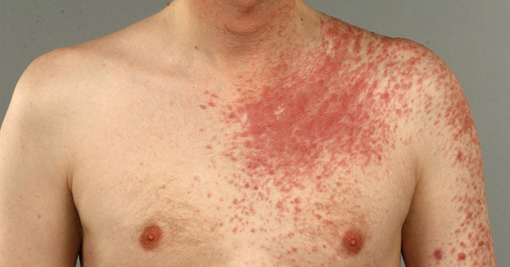
Figure 1. Segementally distributed cutaneous leiomyomas on the left shoulder and chest.
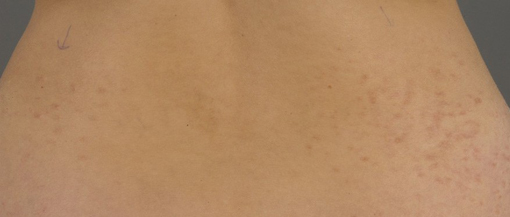
Figure 2. Diffuse and symmetrically distributed cutaneous leiomyomas on the back.
Neoplastic risk
A small percentage (1 -17%) of families with MCUL also cluster renal cell cancer. The age of onset varies from 16 to 90 years. Type II papillary RCC is the predominant type of kidney malignancy in HLRCC. These tumors tend to be very aggressive. Metastases are seen in more than 50% of affected individuals, even in those with relatively small primary tumors. Furthermore, sporadic cases of collecting duct carcinoma, oncocytoma, clear cell carcinoma, and Wilms tumor have been described.
A minority of female patients with MCUL\/HLRCC are apparently predisposed to the development of highly aggressive uterine leiomyosarcoma.
A broad range of other benign and malignant tumors has also been observed in MCUL\/HLRCC families. These mostly anecdotal reports include breast, prostate, and bladder cancer, testis leydig cell tumors, ovarian and kidney cysts, cerebral cavernomas, and adrenal gland adenomas. However, the majority of the aforementioned tumors encountered in these families most probably are not directly associated with either MCUL or HLRCC.
A minority of female patients with MCUL\/HLRCC are apparently predisposed to the development of highly aggressive uterine leiomyosarcoma.
A broad range of other benign and malignant tumors has also been observed in MCUL\/HLRCC families. These mostly anecdotal reports include breast, prostate, and bladder cancer, testis leydig cell tumors, ovarian and kidney cysts, cerebral cavernomas, and adrenal gland adenomas. However, the majority of the aforementioned tumors encountered in these families most probably are not directly associated with either MCUL or HLRCC.
Treatment
While solitary cutaneous leiomyomas can be easily treated by surgical excision, multiple leiomyomas covering large surfaces of the body are difficult to manage. Several different treatment modalities have been described for symptomatic pain relief or tumor destruction in cutaneous leiomyomatosis, including pharmacological agents such as nifedipine, gabapentin, doxazosin, phenoxybenzamine, hyoscine, hydrobromide, and nitroglycerine or invasive therapeutic strategies comprising extensive surgical excision, CO2 laser ablation and cryotherapy, all with variable success.
For symptomatic uterine leiomyomas different surgical approaches can be considered, including myomectomy, hysterectomy or abdominal uterus extirpation. Prior to recommending a specific therapy the patients individual concerns should always be respected though, in particular the specific symptoms and their effect on quality of life and the possible request to preserve fecundancy.
For symptomatic uterine leiomyomas different surgical approaches can be considered, including myomectomy, hysterectomy or abdominal uterus extirpation. Prior to recommending a specific therapy the patients individual concerns should always be respected though, in particular the specific symptoms and their effect on quality of life and the possible request to preserve fecundancy.
Prognosis
Genetic counseling of patients and their relatives should be self-evident. Once the diagnosis of hereditary multiple cutaneous leiomyomatosis is made, affected individuals must be considered at risk for the occurrence of other tumors. Referral of all female patients to a gynecologist for annual evaluation is warranted.
There are no specific screening guidelines for HLRCC, most likely due to the rareness of the disease. We suggest that annual abdominal computational tomography could serve as screening procedure for both the detection of kidney tumors and uterine changes. Magnetic resonance imaging and ultrasound could serve as alternative techniques if contrast-enhanced computational tomography cannot be performed.
There are no specific screening guidelines for HLRCC, most likely due to the rareness of the disease. We suggest that annual abdominal computational tomography could serve as screening procedure for both the detection of kidney tumors and uterine changes. Magnetic resonance imaging and ultrasound could serve as alternative techniques if contrast-enhanced computational tomography cannot be performed.
Genes involved and Proteins
Description
The FH gene spans 22 kb and consists of 10 exons.
Note
FH is an enzyme of the Krebs cycle, which catalyzes the conversion of fumarate to malate.
To be noted
Databases
http:\/\/chromium.liacs.nl\/LOVD2\/SDH\/home.php?select_db=FH The FH Mutation Database
Article Bibliography
| Pubmed ID | Last Year | Title | Authors |
|---|---|---|---|
| 11807464 | 2002 | Gabapentin treatment of multiple piloleiomyoma-related pain. | Alam M et al |
| 15724016 | 2005 | Clinical features of multiple cutaneous and uterine leiomyomatosis: an underdiagnosed tumor syndrome. | Alam NA et al |
| 11283798 | 2001 | Localization of a gene (MCUL1) for multiple cutaneous leiomyomata and uterine fibroids to chromosome 1q42.3-q43. | Alam NA et al |
| 16237213 | 2005 | Missense mutations in fumarate hydratase in multiple cutaneous and uterine leiomyomatosis and renal cell cancer. | Alam NA et al |
| 12761039 | 2003 | Genetic and functional analyses of FH mutations in multiple cutaneous and uterine leiomyomatosis, hereditary leiomyomatosis and renal cancer, and fumarate hydratase deficiency. | Alam NA et al |
| 18514489 | 2008 | Hereditary multiple cutaneous leiomyoma resulting from novel mutations in the fumarate hydratase gene. | Badeloe S et al |
| 17326474 | 2007 | [From gene to disease; cutaneous leiomyomatosis]. | Badeloe S et al |
| 15099382 | 2004 | Successful treatment of pain in two patients with cutaneous leiomyomata with the oral alpha-1 adrenoceptor antagonist, doxazosin. | Batchelor RJ et al |
| 18366737 | 2008 | The FH mutation database: an online database of fumarate hydratase mutations involved in the MCUL (HLRCC) tumor syndrome and congenital fumarase deficiency. | Bayley JP et al |
| 17476294 | 2007 | Cerebral cavernomas in a family with multiple cutaneous and uterine leiomyomas associated with a new mutation in the fumarate hydratase gene. | Campione E et al |
| 15748575 | 2004 | Familial leiomyomatosis cutis et uteri. | Cassetty CT et al |
| 15663510 | 2005 | Familial multiple cutaneous and uterine leiomyomas associated with papillary renal cell cancer. | Chan I et al |
| 10759817 | 2000 | Treatment of multiple cutaneous leiomyomas with CO2 laser ablation. | Christenson LJ et al |
| 16309500 | 2006 | Multiple cutaneous and uterine leiomyomata resulting from missense mutations in the fumarate hydratase gene. | Chuang GS et al |
| 8573925 | 1995 | Familial multiple cutaneous leiomyomas. | Fernández-Pugnaire MA et al |
| 3408259 | 1988 | Familial leiomyomatosis cutis et uteri (Reed's syndrome). | García Muret MP et al |
| 12920381 | 2003 | Familial leiomyomatosis: a review and discussion of pathogenesis. | Garman ME et al |
| 17509289 | 2007 | Hereditary leiomyomatosis and renal cell cancer: a syndrome associated with an aggressive form of inherited renal cancer. | Grubb RL 3rd et al |
| 12484429 | 2002 | Dohi Memorial Lecture. New aspects of cutaneous mosaicism. | Happle R et al |
| 17908262 | 2008 | Evidence for a founder effect of the germline fumarate hydratase gene mutation R58P causing hereditary leiomyomatosis and renal cell cancer (HLRCC). | Heinritz W et al |
| 17613550 | 2007 | Genetic heterogeneity among uterine leiomyomata: insights into malignant progression. | Hodge JC et al |
| 17630610 | 2007 | Genodermatoses with malignant potential. | Holman JD et al |
| 11907496 | 2002 | Cutaneous smooth muscle neoplasms: clinical features, histologic findings, and treatment options. | Holst VA et al |
| 16403393 | 2005 | Multiple cutaneous and uterine leiomyomatosis (Reed's syndrome). | Kim G et al |
| 11549574 | 2001 | Familial cutaneous leiomyomatosis is a two-hit condition associated with renal cell cancer of characteristic histopathology. | Kiuru M et al |
| 12183404 | 2002 | Few FH mutations in sporadic counterparts of tumor types observed in hereditary leiomyomatosis and renal cell cancer families. | Kiuru M et al |
| 11800159 | 2001 | Type 2 segmental cutaneous leiomyomatosis. | König A et al |
| 12472537 | 2002 | Type 1 segmental cutaneous leiomyomatosis. | Lang K et al |
| 11248088 | 2001 | Inherited susceptibility to uterine leiomyomas and renal cell cancer. | Launonen V et al |
| 17270241 | 2007 | Conventional renal cancer in a patient with fumarate hydratase mutation. | Lehtonen HJ et al |
| 14695314 | 2004 | Biallelic inactivation of fumarate hydratase (FH) occurs in nonsyndromic uterine leiomyomas but is rare in other tumors. | Lehtonen R et al |
| 15448018 | 2004 | Genetic basis of cancer of the kidney: disease-specific approaches to therapy. | Linehan WM et al |
| 17960613 | 2008 | A cancer-predisposing "hot spot" mutation of the fumarase gene creates a dominant negative protein. | Lorenzato A et al |
| 17768033 | 2007 | Novel mutation in a fumalate hydratase gene of a Japanese patient with multiple cutaneous and uterine leiomyomatosis. | Makino T et al |
| 17895761 | 2007 | The morphologic spectrum of kidney tumors in hereditary leiomyomatosis and renal cell carcinoma (HLRCC) syndrome. | Merino MJ et al |
| 18476789 | 2008 | Genetic basis for kidney cancer: opportunity for disease-specific approaches to therapy. | Pfaffenroth EC et al |
| 16173977 | 2005 | [Familial occurrence of a type 2 segmental manifestation of cutaneous leiomyomatosis]. | Renner R et al |
| 16319483 | 2006 | Type 2 segmental manifestation of cutaneous leiomyomatosis in four unrelated women with additional uterine leiomyomas (Reed's Syndrome). | Ritzmann S et al |
| 17010749 | 2006 | Multiple painful cutaneous nodules and renal mass. | Rothman A et al |
| 7229147 | 1981 | Familial cutaneous leiomyomatosis. | Thyresson HN et al |
| 11865300 | 2002 | Germline mutations in FH predispose to dominantly inherited uterine fibroids, skin leiomyomata and papillary renal cell cancer. | Tomlinson IP et al |
| 12772087 | 2003 | Mutations in the fumarate hydratase gene cause hereditary leiomyomatosis and renal cell cancer in families in North America. | Toro JR et al |
| 11436362 | 2001 | Cutaneous leiomyomatosis with type 2 segmental involvement. | Tsoitis G et al |
| 17034471 | 2006 | The syndrome of hereditary leiomyomatosis and renal cell cancer (HLRCC): The clinical features of an individual with a fumarate hydratase gene mutation. | Varol A et al |
| 8823555 | 1996 | Familial leiomyomata. | Vellanki LS et al |
| 15937070 | 2006 | Novel mutations in FH and expansion of the spectrum of phenotypes expressed in families with hereditary leiomyomatosis and renal cell cancer. | Wei MH et al |
External Links
Citation
Sadhanna Badeloe ; Jorge Frank
Hereditary multiple cutaneous leiomyomatosis
Atlas Genet Cytogenet Oncol Haematol. 2008-10-01
Online version: http://atlasgeneticsoncology.org/cancer-prone-disease/10127/hereditary-multiple-cutaneous-leiomyomatosis
