Thyroid: Anaplastic (undifferentiated) carcinoma
2012-07-01 Sai-Ching Jim Yeung , Mouhammed Amir Habra Affiliation1.The University of Texas M. D. Anderson Cancer Center, Department of General Internal Medicine, Ambulatory Treatment, Emergency Care, Department of Endocrine Neoplasia, Hormonal Disorders, 1515 Holcombe Boulevard, Unit 437, Houston, Texas 77030, USA (SCJY); The University of Texas M. D. Anderson Cancer Center, Department of Endocrine Neoplasia, Hormonal Disorders, 1515 Holcombe Boulevard, Unit 1416, Houston, Texas 77030, USA (MAH)
2.Anatomia Patologica, Ospedale Bellaria, Via Altura 3, 40139 Bologna, Italy
3.The University of Texas M. D. Anderson Cancer Center, Department of General Internal Medicine, Ambulatory Treatment, Emergency Care, Department of Endocrine Neoplasia, Hormonal Disorders, 1515 Holcombe Boulevard, Unit 437, Houston, Texas 77030, USA
Summary
Note
Clinics and Pathology
Epidemiology
Clinics
Pathology
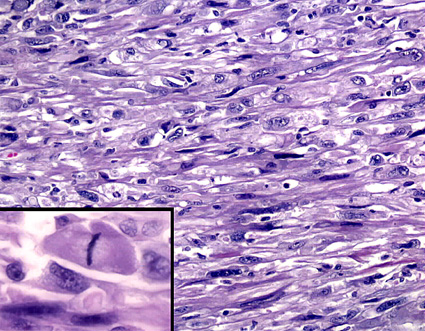
Immunohistochemically, undifferentiated thyroid carcinoma is generally negative for thyroglobulin and calcitonin. Pan-keratin and epithelial membrane antigen (EMA) are positive in about one-half and one-third of cases respectively. Vimentin is positive in about 90%, and epithelial membrane antigen is positive in about 30% of cases. Thyroid transcription factor-1 (TTF-1) staining is present in 0-50% of cases. Although immunostaining is negative for muscle-specific actin, Factor VIII-related antigen, and desmin, these markers can differentiate ATC from some soft tissue sarcomas with which they can be confused.
Treatment
A few patients with resectable disease have been reported to have long-term survival with aggressive multimodal therapy that included surgery, radiation, and chemotherapy. Current clinical practice emphasizes the use of multimodal therapy to achieve local disease control and stabilization of airway patency. Radiotherapy may be hyperfractionated and in combination with chemotherapy. Chemotherapy is usually doxorubicin-based or taxane-based combinations. Preclinical studies using human ATC cell lines show promise that new effective combinations including novel drugs will be found in the future. ATC has high 18 F-fluorodeoxyglucose (FDG) uptake. FDG-PET imaging can complement traditional imaging modalities and detect metastatic foci not readily visible otherwise (Bogsrud et al., 2008).
Prognosis
Factors associated with worse prognosis include distant metastases and large primary tumor size (> 7cm) (Chen et al., 2008).
The 5-year survival rate is around 5%, and the surviving cases are typically small tumors confined to the thyroid amenable to local resection.
Cytogenetics
Cytogenetics morphological
Cytogenetics molecular
CGH: DNA imbalance can be demonstrated at a variety of chromosomal loci in 80% of undifferentiated carcinomas with a median number of chromosomal losses or gains of 10 per case with abnormal CGH profile. Gains were more common than DNA losses. Loss of chromosomal DNA was identified at 1p, 2q, 4q, 5q, 6q, 8p, 13q, 22q. Specific chromosomal DNA alterations (i.e. 3p13-14+, 5q11-31-, 11q13+) may be associated with the transition from more differentiated phenotypes to ATC.
Comparative genome hybridization (CGH) shows frequent gain of 20q, including the UBCH10 gene in 20q13.12, which may also be associated with progression of differentiated thyroid cancers to ATC (Lee et al., 2007).
Using microarray-based CGH with further fluorescence in situ hybridization (FISH) analysis, the MAP kinase phosphatase-8 (DUSP26) gene, which codes for a phosphatase that inhibits p38-mediated apoptosis, is shown to be amplified in ATC (Yu et al., 2007).
Human telomerase reverse transcriptase (hTERT) protein expression is increased in ATC samples and cell lines (Takano et al., 2007). In ATC cell lines, miR-138 was significantly down regulated in comparison to papillary thyroid cancer cell lines. miR-138 was inversely correlated with the human telomerase reverse transcriptase (hTERT) protein expression (Mitomo et al., 2008).
Genes Involved and Proteins
Note
Aberrant Wnt/beta-Catenin signaling appears to be a distinctive feature of ATC since stabilizing mutations and/or aberrant beta-Catenin nuclear localization are present in 80% of ATC. beta-Catenin nuclear localization is accompanied by its cellular redistribution with marked decrease of the beta-Catenin membrane bound fraction.
ATC are characterized by increased cell replication and high Ki67/Mib1 proliferation index, loss of the apoptotic protein bcl-2 and of Fas and its ligand (usually highly expressed in well differentiated thyroid tumors), by an increase in the proapoptotic protein Bax, by Cyclin D1 over-expression and conversely by a fall in the CDK inhibitor p27. Transmembrane protein 34 (TMEM34) is down-regulated in ATC. It is not clear whether these changes represent the cause or (more likely) the effect of dysregulated cell differentiation and growth in ATC.
Immunohistochemical staining of a tissue microarray of 12 cases of ATC showed the following: beta-catenin (positive in 41% of the cases), aurora A (41%), cyclin E (67%), cyclin D1 (77%), and EGFR (84%).
Thyroglobulin, Bcl-2, E-cadherin, vascular endothelial growth factor and beta-catenin are more expressed in differentiated thyroid cancer while topoisomerase II-alpha, MIB-1, and p53 are more expressed in ATC and these changes are expected to occur during progression from differentiated thyroid cancer to ATC (Wiseman et al., 2007).
Article Bibliography
| Pubmed ID | Last Year | Title | Authors |
|---|---|---|---|
| 10958311 | 2000 | Treatment of anaplastic thyroid carcinoma with paclitaxel: phase 2 trial using ninety-six-hour infusion. Collaborative Anaplastic Thyroid Cancer Health Intervention Trials (CATCHIT) Group. | Ain KB et al |
| 17072649 | 2007 | Down-regulation of an inhibitor of cell growth, transmembrane protein 34 (TMEM34), in anaplastic thyroid cancer. | Akaishi J et al |
| 21936674 | 2011 | Prognostic factors and treatment outcomes of 100 cases of anaplastic thyroid carcinoma. | Akaishi J et al |
| 18630999 | 2008 | 18F-FDG PET in the management of patients with anaplastic thyroid carcinoma. | Bogsrud TV et al |
| 18622894 | 2008 | Expression and mutation analysis of the tyrosine kinase c-kit in poorly differentiated and anaplastic thyroid carcinoma. | Broecker-Preuss M et al |
| 8919545 | 1996 | Ras oncogene mutations in thyroid tumors: polymerase chain reaction-restriction-fragment-length polymorphism analysis from paraffin-embedded tissues. | Capella G et al |
| 2578727 | 1985 | Anaplastic thyroid carcinoma. A study of 70 cases. | Carcangiu ML et al |
| 19176870 | 2009 | Phosphorylated insulin like growth factor-I receptor expression and its clinico-pathological significance in histologic subtypes of human thyroid cancer. | Chakravarty G et al |
| 18838882 | 2008 | Surgery and radiotherapy improves survival in patients with anaplastic thyroid carcinoma: analysis of the surveillance, epidemiology, and end results 1983-2002. | Chen J et al |
| 22044775 | 2011 | Results of combined treatment of anaplastic thyroid carcinoma (ATC). | Derbel O et al |
| 8473515 | 1993 | Gene p53 mutations are restricted to poorly differentiated and undifferentiated carcinomas of the thyroid gland. | Donghi R et al |
| 12067983 | 2002 | A phase I pharmacokinetic and translational study of the novel vascular targeting agent combretastatin a-4 phosphate on a single-dose intravenous schedule in patients with advanced cancer. | Dowlati A et al |
| 22399519 | 2012 | Down-regulation of the miR-25 and miR-30d contributes to the development of anaplastic thyroid carcinoma targeting the polycomb protein EZH2. | Esposito F et al |
| 8423216 | 1993 | High prevalence of mutations of the p53 gene in poorly differentiated human thyroid carcinomas. | Fagin JA et al |
| 16896930 | 2007 | A phase I trial of intermittent high-dose gefitinib and fixed-dose docetaxel in patients with advanced solid tumors. | Fury MG et al |
| 11238046 | 2001 | Beta-catenin dysregulation in thyroid neoplasms: down-regulation, aberrant nuclear expression, and CTNNB1 exon 3 mutations are markers for aggressive tumor phenotypes and poor prognosis. | Garcia-Rostan G et al |
| 10329606 | 1999 | DNA copy number changes in thyroid carcinoma. | Hemmer S et al |
| 10521809 | 1999 | N-cadherin-mediated adhesion and aberrant catenin expression in anaplastic thyroid-carcinoma cell lines. | Husmark J et al |
| 2400971 | 1990 | Frequent occurrence of cytogenetic abnormalities in sporadic nonmedullary thyroid carcinoma. | Jenkins RB et al |
| 10679913 | 2000 | Allelotyping of anaplastic thyroid carcinoma: frequent allelic losses on 1q, 9p, 11, 17, 19p, and 22q. | Kitamura Y et al |
| 3341277 | 1988 | DNA aneuploidy in anaplastic carcinoma of the thyroid gland. | Klemi PJ et al |
| 8774920 | 1996 | Treatment of 37 patients with anaplastic carcinoma of the thyroid. | Kobayashi T et al |
| 17079354 | 2007 | Epidermal growth factor receptor status in anaplastic thyroid carcinoma. | Lee DH et al |
| 18753363 | 2008 | Array-CGH identifies cyclin D1 and UBCH10 amplicons in anaplastic thyroid carcinoma. | Lee JJ et al |
| 17465858 | 2007 | Molecular cytogenetic profiles of novel and established human anaplastic thyroid carcinoma models. | Lee JJ et al |
| 18201269 | 2008 | Downregulation of miR-138 is associated with overexpression of human telomerase reverse transcriptase protein in human anaplastic thyroid carcinoma cell lines. | Mitomo S et al |
| 19265494 | 2009 | A phase II trial of fosbretabulin in advanced anaplastic thyroid carcinoma and correlation of baseline serum-soluble intracellular adhesion molecule-1 with outcome. | Mooney CJ et al |
| 19223553 | 2009 | Identification of Polo-like kinase 1 as a potential therapeutic target in anaplastic thyroid carcinoma. | Nappi TC et al |
| 19470727 | 2009 | FOXA1 is a potential oncogene in anaplastic thyroid carcinoma. | Nucera C et al |
| 1712540 | 1991 | Anaplastic thyroid carcinoma. Immunocytochemical study of 32 cases. | Ordóñez NG et al |
| 22136842 | 2011 | Prospective application of our novel prognostic index in the treatment of anaplastic thyroid carcinoma. | Orita Y et al |
| 17985985 | 2008 | A phase II study of gefitinib in patients with advanced thyroid cancer. | Pennell NA et al |
| 20694463 | 2010 | 18F-fluorodeoxyglucose positron emission tomography and computed tomography in anaplastic thyroid cancer. | Poisson T et al |
| 17989125 | 2008 | Phosphatidylinositol 3-kinase/akt and ras/raf-mitogen-activated protein kinase pathway mutations in anaplastic thyroid cancer. | Santarpia L et al |
| 2651141 | 1989 | Detection of the H-RAS oncogene in human thyroid anaplastic carcinomas. | Stringer BM et al |
| 17671725 | 2007 | Quantitative measurement of telomerase reverse transcriptase, thyroglobulin and thyroid transcription factor 1 mRNAs in anaplastic thyroid carcinoma tissues and cell lines. | Takano T et al |
| 10366150 | 1999 | Downregulation of p27KIP1 and Ki67/Mib1 labeling index support the classification of thyroid carcinoma into prognostically relevant categories. | Tallini G et al |
| 1695118 | 1990 | Anaplastic carcinoma of the thyroid. A clinicopathologic study of 121 cases. | Venkatesh YS et al |
| 17115102 | 2007 | Anaplastic thyroid carcinoma: expression profile of targets for therapy offers new insights for disease treatment. | Wiseman SM et al |
| 12414503 | 2002 | Genome-wide appraisal of thyroid cancer progression. | Wreesmann VB et al |
| 16924234 | 2007 | A novel amplification target, DUSP26, promotes anaplastic thyroid cancer cell growth by inhibiting p38 MAPK activity. | Yu W et al |
Citation
Sai-Ching Jim Yeung ; Mouhammed Amir Habra
Thyroid: Anaplastic (undifferentiated) carcinoma
Atlas Genet Cytogenet Oncol Haematol. 2012-07-01
Online version: http://atlasgeneticsoncology.org/solid-tumor/5069/thyroid-anaplastic-(undifferentiated)-carcinoma
Historical Card
2007-11-01 Thyroid: Anaplastic (undifferentiated) carcinoma by Sai-Ching Jim Yeung Affiliation
2003-06-01 Thyroid: Anaplastic (undifferentiated) carcinoma by Oluwole Fadare,Giovanni Tallini Affiliation
