Nervous system: Ependymomas
2001-04-01 Anne Marie Capodano Affiliation1.Laboratoire de Cytogénétique Oncologique, Hpital de la Timone, 264 rue Saint Pierre, 13005 Marseille, France
Summary
Note
Ependymomal neoplasms are tumors of children and young adults, originating from the cerebral ventricle or from the spinal canal. In the central nervous system (CNS), they account for 3 - 9 % of all neuro-epithelial tumors .
Classification
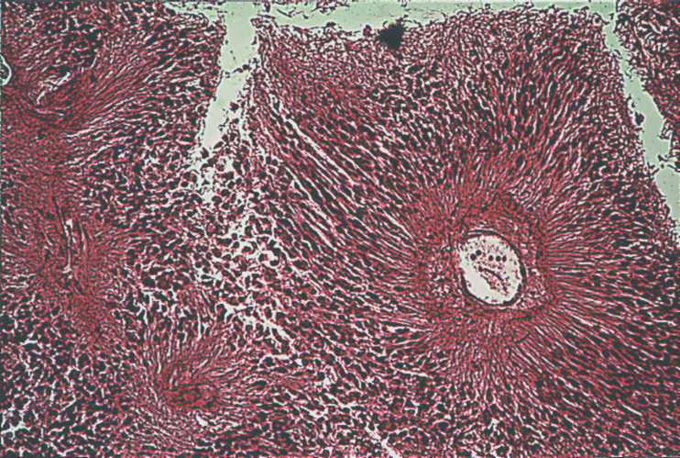
Histological feature of ependymoma : perivascular rosettes - Anne Marie Capodano
Classification
Ependymomas are well-delineated moderately cellular gliomas. Histolological features are perivascular pseudo rosettes and ependymal rosettes WHO classification differentiate four major types :
1. Ependymoma and variants (grade II) :
- Cellular ependymoma : a variant of ependymoma with conspicuous cellularity but often less prominent pseudo-rosette or rosette formation.
- Papillary ependymoma : a rare variant which looks like choroid plexus papilloma.
- Clear cell ependymoma : a rare variant which may be confused with oligodendroglioma neurocytoma or metastatic renal cell carcinoma. 2. Anaplastic (malignant) ependymoma (grade III) : An ependymoma with histological evidence of anaplasia. 3. Myxopapillary ependymoma (grade I) : It occurs almost exclusively in the conus-cauda-filum terminale region, with a generally favourable prognosis. 4. Subependymoma (grade I) : Benign tumor composed of nests of ependymomal cells in a dense glial fibrillary matrix
- Cellular ependymoma : a variant of ependymoma with conspicuous cellularity but often less prominent pseudo-rosette or rosette formation.
- Papillary ependymoma : a rare variant which looks like choroid plexus papilloma.
- Clear cell ependymoma : a rare variant which may be confused with oligodendroglioma neurocytoma or metastatic renal cell carcinoma.
Clinics and Pathology
Epidemiology
Clinics
Clinical manifestations of these tumors are localization dependent.
Pathology
Immunochemistry: The great majority of ependymomas display GFAP immunoreactivity. It is usually observed in pseudo-rosettes, but GFAP is not specific of ependymomas. It is observed in all gliomas. Ependymomas typically express S 100 protein and Vimentin. In ependymomas WHO grade II, epithelial membrane antigen (EMA) immunoreactivity has been reported.
Treatment
The treatment of ependymomas is mainly exeresis of tumor and radiotherapy after exeresis
Prognosis
Ependymoma is a recurrent tumor. The identification of parameters with prognostic value in ependymomas is very important, but controverted. By order of importance the following factors are considered : Age and extent of resection Prognosis in children is significantly worse than in adults. The children¼s cancer group reported a 5 year progression-free survival of 5 % in children with intracranial ependymomas. A retrospective analysis of 83 pediatric ependymomas revealed are below 3 years incomplete tumour resection as indication of a poor outcome.
In adult patients survival at 10 years is 45 %.
Complete or near complete resection emerged as an independent prognostic factor. Localization Supratentorial ependymomas are associated with better survival rates compared to posterior fossa tumors.
Spinal ependymomas are associated with better outcome than cerebral tumors. Cerebrospinal localization shows a poor prognosis.
In adult patients survival at 10 years is 45 %.
Complete or near complete resection emerged as an independent prognostic factor.
Spinal ependymomas are associated with better outcome than cerebral tumors. Cerebrospinal localization shows a poor prognosis.
Cytogenetics
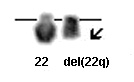
Partial karyotype of a cell of ependymoma : 46, XX, del(22)(q11) with R-banding - Anne Marie Capodano
Cytogenetics morphological
Genes Involved and Proteins
Note
Article Bibliography
| Pubmed ID | Last Year | Title | Authors |
|---|---|---|---|
| 2224780 | 1990 | Cancer in the families of children with soft tissue sarcoma. | Birch JM et al |
| 8331401 | 1993 | Adult intramedullary spinal cord ependymomas: the result of surgery in 38 patients. | Epstein FJ et al |
| 8906366 | 1996 | Prognostic relevance of localization and grading in intracranial ependymomas of childhood. | Ernestus RI et al |
| 9161731 | 1997 | The molecular biology of ependymomas. | Hamilton RL et al |
| 10363853 | 1999 | A multi-institutional retrospective study of intracranial ependymoma in children: identification of risk factors. | Horn B et al |
| 3512139 | 1986 | An immunocytochemical comparison of the glia-associated proteins glial fibrillary acidic protein (GFAP) and S-100 protein (S100P) in human brain tumors. | Kimura T et al |
| 8293185 | 1993 | The new WHO classification of brain tumours. | Kleihues P et al |
| 9525835 | 1998 | Molecular cytogenetic studies of pediatric ependymomas. | Kramer DL et al |
| 8559293 | 1995 | Intracranial ependymomas of childhood: long-term outcome and prognostic factors. | Pollack IF et al |
| 9525716 | 1998 | Survival and prognostic factors following radiation therapy and chemotherapy for ependymomas in children: a report of the Children's Cancer Group. | Robertson PL et al |
| 8402555 | 1993 | Chromosomes in the genesis and progression of ependymomas. | Rogatto SR et al |
| 11063814 | 2000 | Fluorescence in situ hybridization determination of 22q12-q13 deletion in two intracerebral ependymomas. | Rousseau-Merck M et al |
| 8062276 | 1994 | The putative glioma tumor suppressor gene on chromosome 19q maps between APOC2 and HRC. | Rubio MP et al |
| 9705591 | 1998 | Prognostic factors in childhood intracranial ependymomas: the role of age and tumor location. | Sala F et al |
| 8621248 | 1996 | Infrequent alterations of the p15, p16, CDK4 and cyclin D1 genes in non-astrocytic human brain tumors. | Sato K et al |
| 2793229 | 1989 | Cytogenetic abnormalities in human ependymomas. | Stratton MR et al |
| 8950338 | 1997 | Multiple ependymomas in a patient with Turcot's syndrome. | Torres CF et al |
| 10598140 | 1999 | Cytogenetic study of 33 ependymomas. | Vagner-Capodano AM et al |
Citation
Anne Marie Capodano
Nervous system: Ependymomas
Atlas Genet Cytogenet Oncol Haematol. 2001-04-01
Online version: http://atlasgeneticsoncology.org/solid-tumor/5016/nervous-system-ependymomas
