Liver: Fibrolamellar carcinoma
2012-07-01 Xuchen Zhang , Stephen C Ward Affiliation1.The Lillian, Henry M. Stratton-Hans Popper Department of Pathology, Mount Sinai School of Medicine, New York, USA
Summary
Note
Fibrolamellar carcinoma (FLC) is a rare distinctive primary malignant liver tumor that was first described in 1956 by Edmondson (Edmondson, 1956). Although FLC was conventionally considered as a histologic variant of hepatocellular carcinoma (HCC), it is now recognized as a distinct clinical entity with respect to its epidemiology, etiology, and prognosis.
Clinics and Pathology
Phenotype stem cell origin
FLC shows immunohistochemical features of both hepatocytic and biliary differentiation and is most likely derived from a bipotential cell. A recent study examining 26 cases of FLC and 62 cases of classical HCC by immunohistochemistry showed that both tumor types stained uniformly positively with HepPar1 and most showed a canalicular staining pattern for pCEA confirming hepatocytic differentiation. In addition, 39% of hepatocellular carcinoma cases and 59% of fibrolamellar carcinoma cases were positive for glypican-3 and both tumor types were positive for albumin by in situ hybridization. All 22 FLC cases tested showed positive staining for cytokeratin 7 and epithelial membrane antigen, whereas less than one-third of HCC cases were positive for these markers associated with biliary differentiation. Further, 36% of FLC cases showed staining for other markers of biliary differentiation such as B72.3, cytokeratin 19, EpCAM, or mCEA (Ward et al., 2010). Immunopositivity for cytokeratin 19 and EpCAM are associated with a subset of hepatocellular carcinomas with worse prognosis and indicates a progenitor cell phenotype. A higher proportion of hepatoblastomas and pediatric hepatocellular carcinomas are positive for CK19 and EpCAM than adult HCC. As FLC also arises in a younger age group, there may be pathogenic similarities between these tumors and immunopositivity for these markers may indicate a progenitor phenotype. Zenali et al. studied the "stemness" of FLC and found that FLC was positive for the stem cell markers CD133 and CD44 and also showed reduced cell cycle progression (Zenali et al., 2010). Cases of combined (mixed) FLC with HCC or cholangiocarcinoma have also been reported (Malouf et al., 2012; Tanaka et al., 2005).
Etiology
The etiology of FLC is still unclear. In contrast to classic HCC, which is usually associated with cirrhosis, often secondary to chronic infection with hepatitis B virus (HBV), hepatitis C virus (HCV) or other chronic liver diseases (El-Serag, 2011; El-Serag, 2012), FLC generally occurs in noncirrhotic patients without known liver disease. Although studies have shown that 10-20% of cases of FLC occur in patients with HBV and less frequently in patients with HCV, this may just be related to the high worldwide prevalence of viral hepatitis infection (Da Ines et al., 2009). FLC has also been linked to focal nodular hyperplasia (FNH) (Imkie et al., 2005; Vecchio et al., 1984), a type of benign liver lesion that also presents in younger patients without underlying liver disease. FLC and FNH also have a central scar and accumulate copper (Lefkowitch et al., 1983; Vecchio et al., 1984). This has prompted some to suggest FNH as a possible precursor of FLC; however, there is currently no solid evidence to support this.
Epidemiology
FLC has been reported all over the world and the incidence rate for FLC varies by geographical region. In South Africa, FLC accounts 3.3 % of all liver cancers in children < 14 years of age (Moore et al., 2008). In a Mexican study, FLC represents 5.8 % of all liver cancers (Arista-Nasr et al., 2002). In the United States, based on data from the Surveillance, Epidemiology, and End Results (SEER) program of the National Cancer Institute , FLC constituted 0.85% of all cases of primary liver cancer and 13.4% of all cases in patients below the age of 40 (El-Serag and Davila, 2004). Overall, FLC represents a small proportion of primary liver cancers as compared with classic HCC, which accounts for 60-80 % of all primary hepatic tumors (Liu et al., 2009).
FLC occurs in younger individuals, generally between the ages of 10 and 40 years, and more than 85% of patients are younger than 35 years at the time of presentation (Berman et al., 1988; Liu et al., 2009; Soreide et al., 1986; Torbenson, 2007; Ward and Waxman, 2011). This is in stark contrast with HCC, which rarely occurs before the age of 40 years and has a peak incidence at approximately 70 years of age (El-Serag, 2011). Although female or male predominance for FLC has been reported by different groups (Bhaijee et al., 2009; Meriggi and Forni, 2007), others show that FLC affects males and females equally (El-Serag and Davila, 2004). Recently, Malouf et al. reported that pure FLC typically occurs in patients aged < 30 years, often presents with lymph node metastasis and later extrahepatic recurrences while, mixed FLC with HCC appeared to resemble to classic HCC, occurring in patients aged > 40 years and with the liver as the primary site of disease recurrence.
FLC occurs in younger individuals, generally between the ages of 10 and 40 years, and more than 85% of patients are younger than 35 years at the time of presentation (Berman et al., 1988; Liu et al., 2009; Soreide et al., 1986; Torbenson, 2007; Ward and Waxman, 2011). This is in stark contrast with HCC, which rarely occurs before the age of 40 years and has a peak incidence at approximately 70 years of age (El-Serag, 2011). Although female or male predominance for FLC has been reported by different groups (Bhaijee et al., 2009; Meriggi and Forni, 2007), others show that FLC affects males and females equally (El-Serag and Davila, 2004). Recently, Malouf et al. reported that pure FLC typically occurs in patients aged < 30 years, often presents with lymph node metastasis and later extrahepatic recurrences while, mixed FLC with HCC appeared to resemble to classic HCC, occurring in patients aged > 40 years and with the liver as the primary site of disease recurrence.
Clinics
The clinical manifestations of FLC are usually nonspecific and include a palpable epigastric mass, hepatomegaly, abdominal pain, abdominal discomfort, nausea, fatigue, and weight loss. Jaundice may be seen in up to 40% of cases (Liu et al., 2009). Patients may also present with various rare symptoms or signs, such as gynecomastia in men or children (McCloskey et al., 1988; Muramori et al., 2011), metastatic lesions in other organs such as the bone (Kutluk et al., 2001), lung (Mroz et al., 2010), pancreas (Thirabanjasak et al., 2009) and ovary (Benito et al., 2012), hyperammonemic encephalopathy (Sethi et al., 2009), cold agglutinin disease (Al-Matham et al., 2011), shoulder pain (Moghadam et al., 2008), severe inferior vena cava obstruction caused by cardiac spread (Knudson et al., 2012), recurrent deep vein thrombosis (Marrannes et al., 2005), paraneoplastic hyperthyroidism (Carri et al., 1989), Budd-Chiari syndrome with right atrial thrombus, and pulmonary emboli (Asrani and LaRusso, 2012), nonbacterial thrombotic endocarditis (Vaideeswar et al., 1993), and hypoglycemia (Tangkijvanich et al., 2000). The serum levels of aspartate aminotransferase, alanine aminotransferase, and α-fetoprotein (AFP) are usually normal but may be mildly elevated in a minority of cases. Recently, high level of procalcitonin was reported in a case of FLC. Procalcitonin is a relatively specific marker of bacterial disease, and the unusual presentation of FLC mimicking an infectious disease may delay prompt identification of the tumor (Brunel et al., 2011).
Cytology
The cytological features of FLC are very distinct. The aspirates are predominantly comprised of dispersed large tumor cells with abundant, granular cytoplasm, thus resembling oncocytes. Hyaline cytoplasmic inclusions (pale bodies) are observed in some cells which helps in the diagnosis .The nuclei and nucleoli are very large, but the nuclear to cytoplasmic ratio is not very high because of the abundant cytoplasm. Fragments of connective tissue, sometimes in intimate contact with tumor cells and corresponding to tumor lamellae, are also observed. Similar tumor cells are also observed in the metastatic FLC.
Pathology
Approximately 80-90 % of FLC cases present as a solitary mass more frequently involving the left lobe of the liver. Upon gross examination, the tumor is well circumscribed, multinodular, firm, and yellow-tan or brown, with a bulging cut surface, and may show necrosis and hemorrhage. The most distinctive gross feature of FLC is the presence of a central scar with radiating fibrous septae, seen in about 75 % of cases. The background liver is generally noncirrhotic. Lymph node metastases are common at presentation.
Microscopically, the tumor is composed of sheets, nests, and trabeculae of cells that are separated by parallel lamellae of dense collagen bundles. The tumor cells are large and polygonal, with well-defined cell borders and eosinophilic, coarsely granular cytoplasm with large vesiculated nuclei and large nucleoli (Figure 1A and 1B). Stainable copper and bile may be seen in the cytoplasm of tumor cells. Eosinophilic hyaline globules (pale bodies) are present in approximately 50% of cases. Rare variants of FLC have also been described, such as clear cell carcinoma and pseudogland-like tumor with mucin production. FLC features may be seen in tumors with areas of classic HCC or cholangiocarcinoma.
As described above, FLC exhibits immunohistochemical evidence of both hepatocyte (HepPar1, glypican-3, AFP, pCEA, and CD10) and bile duct (CK7, CK19, EMA, B72.3, mCEA, and CA19-9) differentiation (Ward et al., 2010). Recently, Ross et al. demonstrated that tumor positivity for CD68 was highly sensitive for FLC and a lack of CD68 staining should suggest caution in making a diagnosis of FLC (Ross et al., 2011). FLCs are usually negative for neuroendocrine tumor markers such as synaptophysin and chromogranin (Ward et al., 2010). Patonai et al. recently investigated the expression of tight junction proteins claudin 5 and tricellulin by immunohistochemistry and demonstrated an expression pattern of claudin 5 in FLC that differs from all other primary malignant epithelial tumors of the liver and may be useful in diagnosis (Patonai et al., 2011).
Microscopically, the tumor is composed of sheets, nests, and trabeculae of cells that are separated by parallel lamellae of dense collagen bundles. The tumor cells are large and polygonal, with well-defined cell borders and eosinophilic, coarsely granular cytoplasm with large vesiculated nuclei and large nucleoli (Figure 1A and 1B). Stainable copper and bile may be seen in the cytoplasm of tumor cells. Eosinophilic hyaline globules (pale bodies) are present in approximately 50% of cases. Rare variants of FLC have also been described, such as clear cell carcinoma and pseudogland-like tumor with mucin production. FLC features may be seen in tumors with areas of classic HCC or cholangiocarcinoma.
As described above, FLC exhibits immunohistochemical evidence of both hepatocyte (HepPar1, glypican-3, AFP, pCEA, and CD10) and bile duct (CK7, CK19, EMA, B72.3, mCEA, and CA19-9) differentiation (Ward et al., 2010). Recently, Ross et al. demonstrated that tumor positivity for CD68 was highly sensitive for FLC and a lack of CD68 staining should suggest caution in making a diagnosis of FLC (Ross et al., 2011). FLCs are usually negative for neuroendocrine tumor markers such as synaptophysin and chromogranin (Ward et al., 2010). Patonai et al. recently investigated the expression of tight junction proteins claudin 5 and tricellulin by immunohistochemistry and demonstrated an expression pattern of claudin 5 in FLC that differs from all other primary malignant epithelial tumors of the liver and may be useful in diagnosis (Patonai et al., 2011).
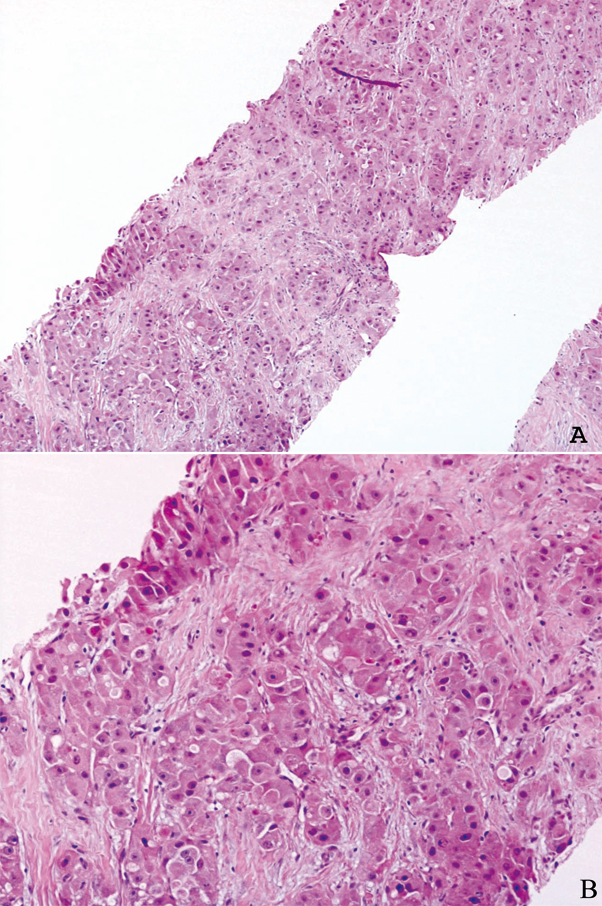
Figure 1: Fibrolamellar carcinoma. A: Liver biopsy specimen showing sheets, nests, and trabeculae of tumor cells that are separated by dense collagen bundles (Hematoxylin and eosin, original magnification x100). B: The tumor cells are large and polygonal, with well-defined cell borders and eosinophilic, coarsely granular cytoplasm with large vesiculated nuclei and large nucleoli (Hematoxylin and eosin, original magnification x200).
Treatment
Complete surgical resection (eg, wedge resection, anatomic liver resection, or total hepatectomy with orthotopic liver transplantation) is the treatment of choice for FLC. There may be occasional utility in treating FLC with neoadjuvant chemotherapy, trans-arterial chemo-embolization (TACE), or tyrosine kinase targeting therapy with Sorafenib, however, the efficacy is still unclear.
Prognosis
The 5-year survival rate of FLC is 37%-76% after complete surgical resection though a high relapse rate (36%-100%) has been reported, especially in patients presenting with advanced-stage disease with large primary tumors and lymphatic metastases. Despite the high rate of recurrence, FLC behaves in a less aggressive fashion, with a 5-year survival rate of 45%-76%, even after relapse (Maniaci et al., 2009). Earlier reports suggested a better prognosis for FLC compared with conventional HCC, however, recent studies have shown that the 5-year survival rate was up to 56% in noncirrhotic HCC, similar to that of FLC (Kakar et al., 2005). It is now widely accepted that the prognosis of FLC is comparable to that of HCC in patients without cirrhosis (Shanbhogue et al., 2011). Recently, Malouf et al. demonstrated that pure and mixed FLC displayed distinct pathological, epigenetic, and clinical patterns at the time of presentation and different outcomes. With a median follow-up of 7.8 years (range, 0.2 years-16 years), the median overall survival among patients with pure FLC was significantly longer than that among patients with mixed FLC (9 years vs 3 years) (Malouf et al., 2012).
Cytogenetics
Note
Although abundant mitochondria are detected in the cytoplasm ultrastructurally, primary FLC has lower total mitochondrial DNA levels than HCC. Metastatic foci of FLC, on the other hand, have markedly increased total mitochondrial DNA when compared with primary FLC or primary HCC. Furthermore, sequencing of the entire mitochondrial genome found no frequent or distinct mutations in FLC (Vivekanandan et al., 2010). Their findings suggest that changes in mitochondrial DNA are not responsible for the alterations in mitochondria seen in FLC.
Genetics
Note
FLC usually occurs sporadically without any apparent genetic predisposition. One case has been reported in a 15-year-old girl with Gardner syndrome after desmoid tumors and colonic polyposis had developed (Gruner et al., 1998). Another case has been reported in a 14-year-old girl belonging to a family with Carney syndrome who developed FLC 5 years after removal of a hepatocellular adenoma (Terracciano et al., 2004).
Article Bibliography
| Pubmed ID | Last Year | Title | Authors |
|---|---|---|---|
| 21293066 | 2011 | Cold agglutinin disease in fibrolamellar hepatocellular carcinoma: a rare association with a rare cancer variant. | Al-Matham K et al |
| 12172578 | 2002 | Fibrolamellar hepatocellular carcinoma in mexican patients. | Arista-Nasr J et al |
| 22105537 | 2012 | Fibrolamellar hepatocellular carcinoma presenting with Budd-Chiari syndrome, right atrial thrombus, and pulmonary emboli. | Asrani SK et al |
| 22296446 | 2012 | Fibrolamellar hepatocellular carcinoma metastatic to the ovary. | Benito V et al |
| 2456977 | 1988 | Fibrolamellar carcinoma of the liver: an immunohistochemical study of nineteen cases and a review of the literature. | Berman MA et al |
| 20141066 | 2009 | Fibrolamellar hepatocellular carcinoma at a tertiary centre in South Africa: a case series. | Bhaijee F et al |
| 21943702 | 2011 | Liver mass in a young adult. | Brunel V et al |
| 2561432 | 1989 | [Fibrolamellar hepatocellular carcinoma: a clinical report with paraneoplastic hyperthyroidism (apropos of a case)]. | Carri J et al |
| 19101982 | 2009 | Unique phenotype of hepatocellular cancers with exon-3 mutations in beta-catenin gene. | Cieply B et al |
| 19361940 | 2009 | [Fibrolamellar hepatocellular carcinoma in a patient with chronic viral B hepatitis]. | Da Ines D et al |
| 21151393 | 2010 | Cell cycle biology of fibrolamellar hepatocellular carcinoma. | Dhingra S et al |
| 13282629 | 1956 | Differential diagnosis of tumors and tumor-like lesions of liver in infancy and childhood. | EDMONDSON HA et al |
| 14999699 | 2004 | Is fibrolamellar carcinoma different from hepatocellular carcinoma? A US population-based study. | El-Serag HB et al |
| 22537432 | 2012 | Epidemiology of viral hepatitis and hepatocellular carcinoma. | El-Serag HB et al |
| 9628444 | 1998 | Hepatocellular carcinoma in children associated with Gardner syndrome or familial adenomatous polyposis. | Gruner BA et al |
| 16220774 | 2005 | Fibrolamellar hepatocellular carcinoma arising in a background of focal nodular hyperplasia: a report of 2 cases. | Imkie M et al |
| 15920538 | 2005 | Clinicopathologic features and survival in fibrolamellar carcinoma: comparison with conventional hepatocellular carcinoma with and without cirrhosis. | Kakar S et al |
| 17367606 | 2007 | Fibrolamellar carcinomas show overexpression of genes in the RAS, MAPK, PIK3, and xenobiotic degradation pathways. | Kannangai R et al |
| 22447385 | 2012 | Fibrolamellar hepatocellular carcinoma with cardiac spread causing severe inferior vena cava obstruction in a 9-year-old child. | Knudson JD et al |
| 11400652 | 2001 | Fibrolamellar hepatocellular carcinoma with skeletal metastases. | Kutluk MT et al |
| 6185196 | 1983 | Copper and copper-binding protein in fibrolamellar liver cell carcinoma. | Lefkowitch JH et al |
| 20224721 | 2009 | Constitutive activation of nuclear factor-kappa B (NF-kB) signaling pathway in fibrolamellar hepatocellular carcinoma. | Li W et al |
| 19638962 | 2009 | Fibrolamellar hepatocellular carcinoma. | Liu S et al |
| 22415897 | 2012 | Pure and mixed fibrolamellar hepatocellular carcinomas differ in natural history and prognosis after complete surgical resection. | Malouf GG et al |
| 19144491 | 2009 | Fibrolamellar hepatocellular carcinoma: prolonged survival with multimodality therapy. | Maniaci V et al |
| 16302333 | 2005 | Fibrolamellar hepatocellular carcinoma in a 65-year-old woman: CT features. | Marrannes J et al |
| 2841641 | 1988 | Gynecomastia as a presenting sign of fibrolamellar carcinoma of the liver. | McCloskey JJ et al |
| 17518332 | 2007 | [Surgical therapy of hepatic fibrolamellar carcinoma]. | Meriggi F et al |
| 18568150 | 2008 | Shoulder pain as the first sign of a hepatic fibrolamellar carcinoma in a young man. | Moghadam FM et al |
| 18305988 | 2008 | Malignant liver tumors in South African children: a national audit. | Moore SW et al |
| 21147631 | 2010 | Lung mass in a 28-year-old male: a case report of a rare tumor. | Mroz RM et al |
| 21552145 | 2011 | High aromatase activity and overexpression of epidermal growth factor receptor in fibrolamellar hepatocellular carcinoma in a child. | Muramori K et al |
| 9249730 | 1997 | Lamellar fibrosis in the fibrolamellar variant of hepatocellular carcinoma: a role for transforming growth factor beta. | Orsatti G et al |
| 21503766 | 2011 | Claudins and tricellulin in fibrolamellar hepatocellular carcinoma. | Patonai A et al |
| 21113139 | 2011 | Fibrolamellar carcinomas are positive for CD68. | Ross HM et al |
| 20010160 | 2009 | Hyperammonemic encephalopathy: a rare presentation of fibrolamellar hepatocellular carcinoma. | Sethi S et al |
| 21339346 | 2011 | Recent advances in cytogenetics and molecular biology of adult hepatocellular tumors: implications for imaging and management. | Shanbhogue AK et al |
| 2421594 | 1986 | Characteristics of fibrolamellar hepatocellular carcinoma. A study of nine cases and a review of the literature. | Soreide O et al |
| 16049296 | 2005 | Combined fibrolamellar carcinoma and cholangiocarcinoma exhibiting biphenotypic antigen expression: a case report. | Tanaka K et al |
| 10932518 | 2000 | Fibrolamellar hepatocellular carcinoma in a Thai man who presented with hypoglycemia: case report and review of literature. | Tangkijvanich P et al |
| 14736278 | 2004 | Fibrolamellar hepatocellular carcinoma occurring 5 years after hepatocellular adenoma in a 14-year-old girl: a case report with comparative genomic hybridization analysis. | Terracciano LM et al |
| 19415023 | 2009 | Fibrolamellar carcinoma presenting as a pancreatic mass: case report and review of the literature. | Thirabanjasak D et al |
| 17452818 | 2007 | Review of the clinicopathologic features of fibrolamellar carcinoma. | Torbenson M et al |
| 8051651 | 1993 | Fibrolamellar carcinoma of the liver--an unusual presentation. | Vaideeswar P et al |
| 6322571 | 1984 | Fibrolamellar carcinoma of the liver: the malignant counterpart of focal nodular hyperplasia with oncocytic change. | Vecchio FM et al |
| 20228784 | 2010 | Mitochondrial mutations in hepatocellular carcinomas and fibrolamellar carcinomas. | Vivekanandan P et al |
| 20495535 | 2010 | Fibrolamellar carcinoma of the liver exhibits immunohistochemical evidence of both hepatocyte and bile duct differentiation. | Ward SC et al |
| 21344351 | 2011 | Fibrolamellar carcinoma: a review with focus on genetics and comparison to other malignant primary liver tumors. | Ward SC et al |
| 22292081 | 2012 | Loss of the orphan nuclear receptor SHP is more pronounced in fibrolamellar carcinoma than in typical hepatocellular carcinoma. | Wilczek E et al |
| 20421623 | 2010 | Stemness characteristics of fibrolamellar hepatocellular carcinoma: immunohistochemical analysis with comparisons to conventional hepatocellular carcinoma. | Zenali MJ et al |
Citation
Xuchen Zhang ; Stephen C Ward
Liver: Fibrolamellar carcinoma
Atlas Genet Cytogenet Oncol Haematol. 2012-07-01
Online version: http://atlasgeneticsoncology.org/solid-tumor/6191/liver-fibrolamellar-carcinoma
