Nervous System: Glioma: an overview
2008-08-01 Ivana Magnani Affiliation1.Dipartimento Di Medicina, Chirurgia E Odontoiatria, Polo Universitario San Paolo, Genetica Medica, Via di Rudini, 8, 20142 Milano, Italy
Classification
Note
Classification
| GLIOMAS | NONGLIOMAS | |||||
| grade | I | II | III | IV | ||
| Astrocytic tumors | Choroid plexus tumors | |||||
| Pilocytic astrocytoma | * | |||||
| Pituicytoma (**) | * | Neuronal and mixed neuronal-glial tumor | ||||
| Pilomyxoid astrocytoma (**) | * | |||||
| Subependymal giant cell astrocytoma | * | Tumors of the pineal region | ||||
| Pleomorphic xanthoastrocytoma | * | |||||
| Diffuse astrocytoma | * | Embryonal tumors, including Medulloblastoma | ||||
| Fibrillary astrocytoma | * | |||||
| Gemistocytic astrocytoma | * | Meningeal tumors | ||||
| Protoplasmic astrocytoma | * | |||||
| Anaplastic astrocytoma | * | Primary CNS Lymphomas | ||||
| Glioblastoma | * | |||||
- Giant cell glioblastoma | * | Germ cell tumors | ||||
- Gliosarcoma | * | |||||
| Gliomatosis cerebri | nd | Pituitary adenomas | ||||
| Oligodendroglial tumors | ||||||
| Oligodendroglioma | * | Tumors of cranial and paraspinal nerves | ||||
| Anaplastic oligodendroglioma | * | |||||
| Oligoastrocytic tumors | Tumors of the sellar region | |||||
| Oligoastrocytoma | * | |||||
| Anaplastic oligoastrocytoma | * | Metastatic tumors | ||||
| Ependymal tumors | ||||||
| Subependymom | * | |||||
| Myxopapillary ependymoma | * | |||||
| Ependymoma | * | |||||
- Cellular | ||||||
- Papillary | ||||||
- Clear Cell | ||||||
- Tanycytic | ||||||
| Anaplastic ependymoma | * | |||||
| nd = not defined | ||||||
Grade I is assigned to the more circumscribed tumors with low proliferative potential, grade II defines diffusely infiltrative tumours with cytological atypia alone, grade III those also showing anaplasia and mitotic activity and grade IV (Glioblastoma) tumours additionally showing microvascular proliferation and/or necrosis.
Clinics and Pathology
Etiology
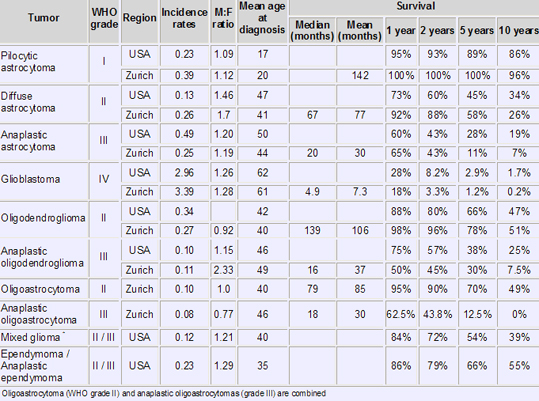
Epidemiology
No underlying cause has been identified for the majority of malignant gliomas. Epidemiologic factors including specific occupational exposures, environmental carcinogens, foods containing N-nitroso compounds, electromagnetic fields, etc. have been associated to only a small proportion of gliomas.
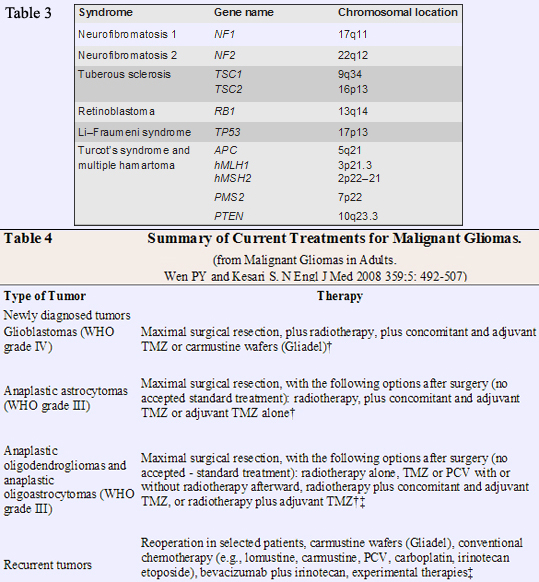
The only two firmly established factors of primary brain tumors are the exposure to high doses of ionizing radiation and inherited mutations of highly penetrant genes associated with rare syndromes (Table 3).
In addition, preliminary evidence points to a lower glioma risk among people with allergic conditions and high levels of serum IgE.
Polymorphisms of genes that affect detoxification, DNA repair, and cell-cycle regulation have also been implicated in the development of gliomas.
Recently, two international Brain Tumor consortia have been formed: the Brain Tumor Epidemiology Consortium (BTEC)( http://epi.grants.cancer.gov/btec/ ) to identify potential genetic and environmental risk factors and the GLIOGENE to study the genetic basis of familial gliomas.
Treatment
Pilocytic Astrocytomas
Pilocytic astrocytoma, when totally resected, has a favourable outcome compared to other astrocytomas. However, when residual tumor remains, the prognosis is less satisfactory. It has been reported that radiation treatment after surgery suppresses residual tumor. Tumor location reveals a cerebellar predominance in both children and adults.
Low-grade Astrocytomas
Favorable prognostic features include younger age at diagnosis, tumor size < 5cm and, possibly, greater extent of tumor resection. Late recurrences are relatively common, and patients should be followed up for at least 15 years. Despite their relatively indolent course, most astrocytomas eventually evolve into more anaplastic lesions and cannot be cured by surgery and radiation therapy.
Low-grade Oligodendrogliomas/Oligoastrocytomas
Approximately half of oligodendrogliomas are characterized by loss of heterozygosity of chromosomes 1p and 19q, a pathognomonic diagnostic feature. For recurrent low-grade oligodendroglial tumors, surgery, radiation, and chemotherapy may each play an important role.
Anaplastic Oligodendroglioma/Oligoastrocytoma
Although uncommon, these tumors are recognized by their unique molecular, histologic and clinical features. Radiation therapy is the most commonly prescribed post-surgical therapy. The role and timing of adjuvant chemotherapy are less clear. Patients with 1p and 19q deletions have significantly better outcomes, regardless of treatment.
Anaplastic Astrocytomas
Anaplastic astrocytomas comprise 10-15% of all glial neoplasms. Currently, the only factors that have been shown to influence prognosis in patients with AA are age and Karnofsky performance status. The most important predictor of response to therapy and survival in AA tumors is the presence or absence of the 1p19q co-deletion, a molecular feature that defines a subset of oligodendroglial tumors, and anaplastic oligodendrogliomas in particular. A further likely prognostic biomarker is the methylation status of O(6)-methylguanine-DNA-methyltranferase gene (the predominant DNA repair enzyme following alkylator-based chemotherapy-induced injury). Evidence-based management of patients with AA recommends maximum safe resection followed by involved-field radiotherapy for newly diagnosed patients, and temozolomide (TMZ) for recurrent disease.
Glioblastoma Multiforme (GBM)
Glioblastomas are among the most devasting neoplasms claiming the lives of patients within a median of 1 year after diagnosis. Although glioblastoma can occur at all ages, including childhood, the average age at which it is diagnosed is 55 years. Poor prognostic clinical variables include increasing age, poor performance status, increased severity of neurologic deficits ad diagnosis and the inability to achieve substantial tumor resection. Treatments include surgery, radiotherapy, chemotherapy and so on. The extremely infiltrative nature of this tumors makes complete surgical removal impossible. Concurrent radiotherapy and the oral alkylating agent TMZ followed by adjuvant TMZ has become the standard of care for patients with newly diagnosed GBM, although the methylation status of the promoter region of the MGMT gene in the tumor specimen is associated with superior survival, regardless of received treatment.
Low-grade and anaplastic ependymomas
Ependymomas may occur anywhere in the spinal axis. In children, they are more commonly found in the posterior fossa and spinal cord. Both the low-grade and anaplastic lesions may disseminate along the leptomeningeal surfaces. Low-grade lesions in the spine are usually treated with surgery alone. Anaplastic or incompletely resected low-grade tumors are usually treated with postoperative radiation therapy. The role of chemotherapy is uncertain and in general should be reserved patients having previously failed surgery and radiotherapy. (see Table 4).
There is growing evidence that glioma stem cells may contribute to the resistance of malignant gliomas to standard treatments. Radioresistance in stem cells generally results from the preferential activation of DNA-damage-response pathways, whereas chemoresistance results partly from the overexpression of O6-methylguanine-DNA methyltransferase (MGMT), the up-regulation of multidrug resistance genes, and the inhibition of apoptosis. Therapeutic strategies that effectively target stem cells sparing normal cells and overcome their resistance to treatment will be necessary if malignant gliomas are to be completely eradicated. Another determined obstacle to effective therapy is the invasive nature of glioma cells into the surrounding brain.
Cytogenetics
Note
The gain of chromosome 7 is the most frequent numerical aberration observed in Astrocytomas (WHO grade I) and Anaplastic Astrocytomas (WHO grade II). In AA other chromosomes showing a tendency toward gain are chromosomes 19 and 20. Chromosomes most often lost include 10 and 22 and a single sex chromosome. Among the oligodendroglioma karyotypes the majority have normal or nonclonal chromosomal pattern often associated with isolated sex chromosomes. The genetic instability of Glioblastoma results in numerous subpopulations and isolated cell types: nonetheless several non-random chromosome changes, in particular aneuploidies, are associated with the progression of this tumor. The numerical abnormalities are similar to the lower-grade tumors, involving the gain of chromosomes 7 and 20 and the loss of chromosomes 10 and 22 and sex chromosomes. In general, numerical changes appear to include more loss than gain of chromosomes, and this is reflected in the frequent loss of 9p and chromosomes 13 and 14. Monosomy of chromosome 22 is the most frequent alteration observed in ependymomas, in addition to deletions or translocations involving 22q.
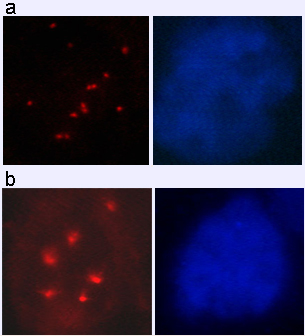
In addition to alterations in chromosome number, most solid tumors are also characterized by centrosome amplification. Centrosome nucleates and organizes the cytoplasmic and mitotic spindle microtubules (MTs) in interphase and mitotic cells, respectively. Because the centrosome is actively involved in proper chromosome segregation during mitosis, it has been hypothesized that centrosome amplification drives tumor aneuploidy by increasing the frequency of abnormal mitosis that lead to chromosome missegregation. In a recent work on primary diffuse astrocytic gliomas Katsetos et al. reported the overexpression of gamma-tubulin, the key structural component of centrosome, associated with supernumerary centrosomes .Interphase and -metaphase amplified centrosomes in glioma cell lines are visible in Figure 1, a and b respectively (personal observations).
Chromosomal imbalances of glioma in childhood and adolescence
Pilocytic astrocytomas account for 23.5% of pediatric brain tumors. The most common aberration consisted of 6q, followed by 7q gain, and loss of 9q. The imbalance +7q is observed in other gliomas such as pleomorphic xanthoastrocytomas and ependymomas, whereas -9q is the most frequent alteration in pleomorphic xanthoastrocytomas and is also present in anaplastic astrocytomas.
Anaplastic astrocytomas account for 7.2% of childhood brain tumors. Among the investigated tumors the most common chromosomal alterations were gains of 5q and 1q and losses of 22q, 9q and 12q.
Glioblastomas account for 7.2% of pediatric brain tumors. The most frequent reported chromosomal imbalances were losses of 17p and 13q whereas gains included 1q, 2q, 3q and 17q .Compared with adult cases, gains of 1p, 2q and 21q as well as losses of 6q, 11q and 16q were more frequently observed among pediatric malignant astrocytomas, supporting differences between childhood and adult chromosomal abnormalities and different genetic pathways.
Oligodendroglial tumors are rare in the pediatric population and only isolated cases have been investigated.
Ependymomas comprise 10.1% of pediatric brain tumors. Among the tumor group investigated classic and anaplastic ependymomas are characterized by +1q, whereas all 3 entities (including the myxopapillary variant) frequently show +9. Other imbalances observed were +7q as well as -22q.
Cytogenetics molecular
Different studies applying cytogenetic, comparative genomic hybridization (CGH), array-CGH and loss of heterozygosity (LOH) methods demonstrated non-random genomic aberrations in gliomas. The characterization of genomic abnormalities enhanced to identify specific genes involved in tumor initiation and progression.
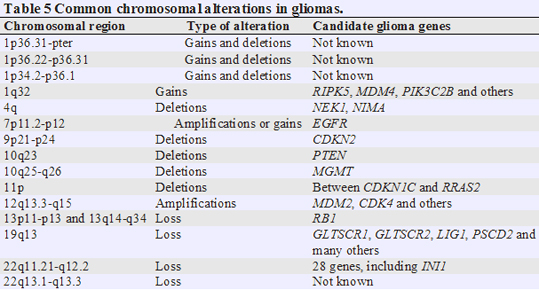
Table 5 summarizes the most common detectable chromosome changes in glioma.
1p/19q loss
Deletions of 1p and 19q are associated with tumors with oligodendroglial components. Combined alterations have been observed in up to 70% of oligodendrogliomas and 50% of mixed oligoastrocytomas. Besides being a relevant diagnostic marker, 1p/19q loss has been recently validated for its prognostic relevance by prospective data suggesting that 1p /19q deletion is predictive of radio-chemosensitivity in anaplastic oligodendroglial tumors and mixed oligoastrocytomas.
Based on the observation that the majority of 1p and 19q deletions seem to involve the entire 1p and 19q arms, in a recent paper Jenkins RB et al showed that an unbalanced t(1;19)(q10;q10) underlies the formation of the combined 1p and 19q deletion in gliomas and in addition it predicts a better prognosis of patients with oligodendroglioma.
Genes Involved and Proteins
Note
Three pathways are implicated :
.They include:
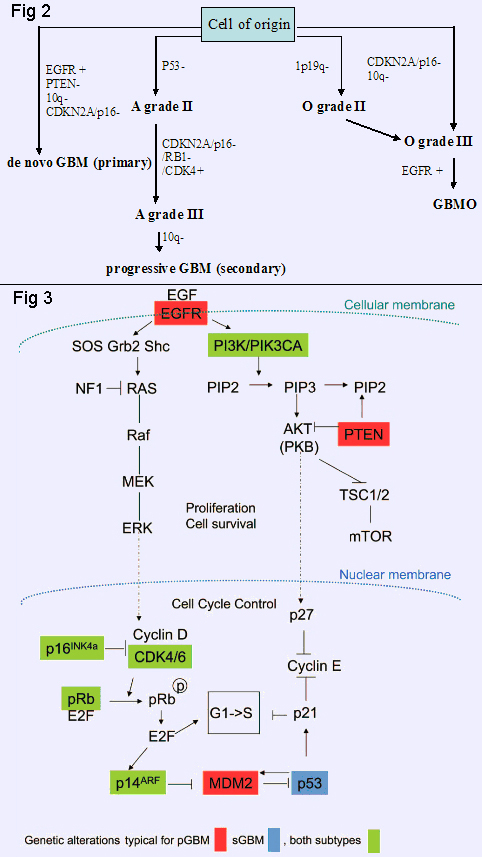
The p16 / RB1 pathway seems to be important in pathways to both primary and secondary GBM. The RB1 inactivation on 13q and CDK4 amplification, also mutually exclusive, are more frequent in anaplastic gliomas. PTEN inactivation on chromosome 10q and epidermal growth factor receptor (EGFR) amplification and/or rearrangement are more frequent in glioblastomas.
The scheme in Figure 2 depicts the genetic pathways to Glioblastoma.
The major signalling pathways involved in the pathogenesis of glioblastomas are depicted in Figure 3 and then shortly commented.
Gene name
Location
Note
Gene name
Location
Gene name
Location
Gene name
Location
Gene name
Location
Note
This means that loss of TP53 function may result from abnormal expression of any of the TP53, MDM2, or p14ARF genes.
Gene name
Location
Note
This means that loss of TP53 function may result from abnormal expression of any of the TP53, MDM2, or p14ARF genes.
Gene name
Location
Note
By
Note
Gene name
Location
Dna rna description
Note
Gene name
Location
Note
Article Bibliography
| Pubmed ID | Last Year | Title | Authors |
|---|---|---|---|
| 18035958 | 2007 | Management of glioblastoma. | Aoki T et al |
| 17387387 | 2007 | Genomic alterations in low-grade, anaplastic astrocytomas and glioblastomas. | Arslantas A et al |
| 17051156 | 2006 | Glioma stem cells promote radioresistance by preferential activation of the DNA damage response. | Bao S et al |
| 18579016 | 2008 | Anaplastic oligodendroglioma. | Blakeley J et al |
| 8625170 | 1995 | What is the etiology of human brain tumors? A report on the first Lebow conference. | Brem S et al |
| 17308273 | 2007 | Clinical and molecular characteristics of malignant transformation of low-grade glioma in children. | Broniscer A et al |
| 17908533 | 2007 | Central nervous system tumors. | Buckner JC et al |
| 12816259 | 2003 | A population-based study of the incidence and survival rates in patients with pilocytic astrocytoma. | Burkhard C et al |
| 12691623 | 2003 | Ependymomas. | Chamberlain MC et al |
| 15803154 | 2005 | Tumour stem cells and drug resistance. | Dean M et al |
| 17964019 | 2007 | Epidemiology of brain tumors. | Fisher JL et al |
| 17047046 | 2006 | A t(1;19)(q10;p10) mediates the combined deletions of 1p and 19q and predicts a better prognosis of patients with oligodendroglioma. | Jenkins RB et al |
| 17260179 | 2007 | Occupational exposure to low frequency magnetic fields and the risk of low grade and high grade glioma. | Karipidis KK et al |
| 16772870 | 2006 | Altered cellular distribution and subcellular sorting of gamma-tubulin in diffuse astrocytic gliomas and human glioblastoma cell lines. | Katsetos CD et al |
| 14531575 | 2003 | Invasion as limitation to anti-angiogenic glioma therapy. | Lamszus K et al |
| 17618441 | 2007 | The 2007 WHO classification of tumours of the central nervous system. | Louis DN et al |
| 18039109 | 2006 | Molecular pathology of malignant gliomas. | Louis DN et al |
| 10214354 | 1999 | A recurrent 19q11-12 breakpoint suggested by cytogenetic and fluorescence in situ hybridization analysis of three glioblastoma cell lines. | Magnani I et al |
| 8055485 | 1994 | Increasing complexity of the karyotype in 50 human gliomas. Progressive evolution and de novo occurrence of cytogenetic alterations. | Magnani I et al |
| 17855690 | 2007 | GLIOGENE an International Consortium to Understand Familial Glioma. | Malmer B et al |
| 17077355 | 2006 | New primary neoplasms of the central nervous system in survivors of childhood cancer: a report from the Childhood Cancer Survivor Study. | Neglia JP et al |
| 17456751 | 2007 | Genetic pathways to primary and secondary glioblastoma. | Ohgaki H et al |
| 15118874 | 2004 | Population-based study on incidence, survival rates, and genetic alterations of low-grade diffuse astrocytomas and oligodendrogliomas. | Okamoto Y et al |
| 9731511 | 1998 | Centrosome defects and genetic instability in malignant tumors. | Pihan GA et al |
| 15198120 | 2004 | Comparative genomic hybridization in central and peripheral nervous system tumors of childhood and adolescence. | Rickert CH et al |
| 16247447 | 2006 | Identification of novel genomic markers related to progression to glioblastoma through genomic profiling of 25 primary glioma cell lines. | Roversi G et al |
| 18299277 | 2008 | Occupational exposure to pesticides and risk of adult brain tumors. | Samanic CM et al |
| 15627025 | 2004 | Molecular changes in gliomas. | Sanson M et al |
| 16932614 | 2006 | Epidemiology and molecular pathology of glioma. | Schwartzbaum JA et al |
| 12407701 | 2002 | Genetic alterations associated with adult diffuse astrocytic tumors. | Shapiro JR et al |
| 18669428 | 2008 | Malignant gliomas in adults. | Wen PY et al |
| 17548690 | 2007 | Allergy-related polymorphisms influence glioma status and serum IgE levels. | Wiemels JL et al |
| 17646205 | 2007 | Allergic conditions and brain tumor risk. | Wigertz A et al |
Citation
Ivana Magnani
Nervous System: Glioma: an overview
Atlas Genet Cytogenet Oncol Haematol. 2008-08-01
Online version: http://atlasgeneticsoncology.org/solid-tumor/5763/nervous-system-glioma-an-overview
