Bone: Haemangiomas and related lesions
2008-02-01 Sofie LJ Verbeke , Judith VMG Bovée Affiliation1.Department of Pathology, Leiden University Medical Center, Leiden, The Netherlands
Summary
Note
Haemangiomas are benign, vasoformative lesions of endothelial origin.
Multiple lesions, involving two or more distant sites in bone, are defined as (haem)angiomatosis. Rarely these lesions are associated with massive osteolysis (Gorham-Stout syndrome).
Multiple lesions, involving two or more distant sites in bone, are defined as (haem)angiomatosis. Rarely these lesions are associated with massive osteolysis (Gorham-Stout syndrome).
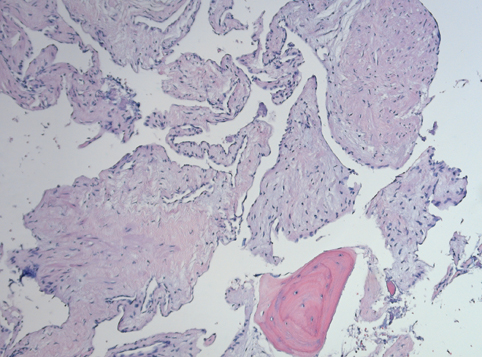
Haemangioma of bone - HE (10x).
Classification
Classification
Multiple variants of haemangiomas are reported, depending on variable histological features.
Haemangioma: cavernous, capillary, epithelioid. Angiomatosis: non-aggressive (regional), disseminated (cystic angiomatosis), aggressive (massive osteolysis).
Clinics and Pathology
Phenotype stem cell origin
Endothelial cell
Etiology
It is suggested that these lesions are congenital or developmental disorders, although the etiology remains unknown.
Epidemiology
Haemangiomas are relatively common. Autopsy studies report in 10 to 12% of the population spinal haemangiomas.
Clinics
Haemangiomas are in general asymptomatic, accidental radiographic findings, which are mostly located in skull (flat bones) and spine although extraspinal locations can occur. They are described at all ages, with a peak incidence at the fifth decade. There is a slight female predilection (M:F is 2:3). Large lesions can be symptomatic and symptoms as pain, cord compression and neurological deficit are reported.
Pathology
Haemangiomas have variable histological features, which are similar to haemangiomas elsewhere in the body.
Cavernous/capillary haemangiomas: with blood filled, thin-walled spaces lined by a single layer of flat, not atypical endothelial cells.
Epithelioid haemangioma: well formed, mature vessels filled with erythrocytes. The vessels are lined by epithelioid cells, characterized by a large amount of eosinophilic cytoplasm. Intracytoplasmic vacuoles can be present. When the cells protrude in the lumen, a tombstone aspect can be seen. A variable inflammatory infiltrate containing lymphocytes and eosinophils is present. There is no hyalinization or myxoid changes of the surrounding stroma.
Cavernous/capillary haemangiomas: with blood filled, thin-walled spaces lined by a single layer of flat, not atypical endothelial cells.
Epithelioid haemangioma: well formed, mature vessels filled with erythrocytes. The vessels are lined by epithelioid cells, characterized by a large amount of eosinophilic cytoplasm. Intracytoplasmic vacuoles can be present. When the cells protrude in the lumen, a tombstone aspect can be seen. A variable inflammatory infiltrate containing lymphocytes and eosinophils is present. There is no hyalinization or myxoid changes of the surrounding stroma.
Treatment
When necessary, surgical intervention (curettage or resection) can be considered with or without reconstruction.
Evolution
Although progression towards an angiosarcoma is described, it is absolute extremely rare.
Prognosis
Haemangiomas have a good prognosis and low recurrence rate.
Note
(Haem)angiomatosis of bone can be associated with
Phenotype stem cell origin
Endothelial cell
Etiology
is still unknown.
Epidemiology
It is a rare disease and in literature only few cases, mostly case reports, are described. Rarely haemangiomatosis is associated with massive regional osteolysis. Multiple, bone-associated haemangiomas can occur within some syndromes, such as: Maffuccis syndrome, Kasabach-Merrit syndrome, Klippel-Trenaunay / Parkes-Weber syndrome and Osler-Weber-Rendu disease.
Clinics
Clinical features are variable and depend on the number of lesions, location and size. Pain and pathological fractures are the most common reported clinical features.
Clinics
Gorham-Stout syndrome or massive osteolysis affects the young adults and is a typical radiological finding. Half of the cases of Gorham-Stout syndrome are associated with trauma.
Pathology
Histological pattern is identical to that of haemangioma.
Treatment
Depends on the extent and location of the haemangiomas. Bone-associated haemangiomatosis syndromes can require a more specific approach.
Evolution
Similar as haemangiomas.
Prognosis
Extended visceral lesions have a more aggressive course mostly due to massive hemorrhaging.
Genetics
Note
No underlying genetic disorders or aberrations are described or known.
Article Bibliography
| Pubmed ID | Last Year | Title | Authors |
|---|---|---|---|
| 4940691 | 1971 | Vascular tumors of bone. | Dorfman HD et al |
| 2076919 | 1990 | Massive pelvic osteolysis in the Gorham-Stout syndrome. | Kulenkampff HA et al |
| 14215843 | 1964 | DIFFUSE SKELETAL HEMANGIOMATOSIS: REPORT OF TWO CASES AND REVIEW OF LITERATURE. | WALLIS LA et al |
| 10741493 | 2000 | Benign vascular lesions of bone: radiologic and pathologic features. | Wenger DE et al |
Citation
Sofie LJ Verbeke ; Judith VMG Bovée
Bone: Haemangiomas and related lesions
Atlas Genet Cytogenet Oncol Haematol. 2008-02-01
Online version: http://atlasgeneticsoncology.org/solid-tumor/5358/bone-haemangiomas-and-related-lesions
