Nervous system: Meningioma
2000-07-01 Anne Marie Capodano Affiliation1.Laboratoire de Cytogénétique Oncologique, Hpital de la Timone, 264 rue Saint Pierre, 13005 Marseille, France
Classification
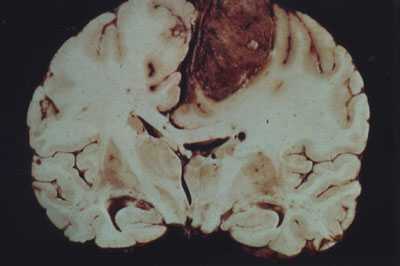
Macroscopic aspect of a parassagital meningioma - Anne Marie Capodano.
Clinics and Pathology
Etiology
Meningiomas are known to be induced by radiation with an average time interval to tumor appearence of 20-35 years. The majority of patients with radio-induced meningiomas have received irradiation for tinea capitis or for primary brain tumor.
Epidemiology
Clinics
The vast majority of meningiomas arise within the intracranial, orbital, and intravertebral cavities.
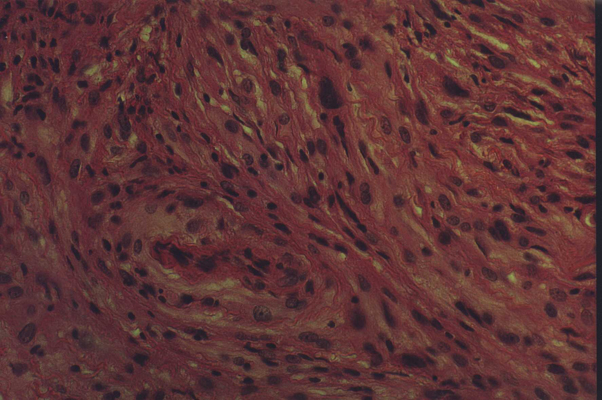
Histological features of a fibroblastic meningioma - Anne Marie Capodano.
Pathology
According to the World Health Classification (WHO 1993), the tumors are defined as Meningiothelial meningioma, Fibroblastic meningioma, Transitional meningioma, Psamommatous meningioma, Angiomatous meningioma, Chordoïd meningioma., and are classified according to increased degrees of anaplasia in grades I, II and III. 90% of meningiomas are slowly growing benign tumors that histologically correspond to grade I according WHO classification. 6-8% of meningiomas are designated as atypical meningiomas : WHO grade II. These tumors show a tendancy for local recurrence even after complete resection. 2-3% of meningiomas exibit histological signs of malignancy : these tumors are classified as anaplastic malignant meningiomas of WHO grade III. They have a high risk for local recurrence and metastasis.
Treatment
The treatment consists of total surgical resection of tumor.
Prognosis
Cytogenetics
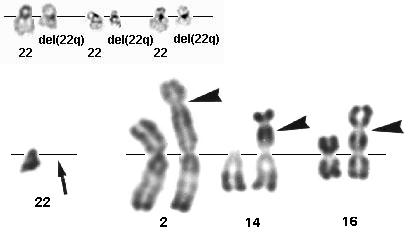
Top: del(22q) (G-banding) - Courtesy G. Reza Hafez, Eric B. Johnson, Sara Morrison-Delap Cytogenetics at the Waisman Center; bottom: partial karyotype of a fibroblatic meningioma cell; there was hypoploidy (39,XX), a monosommy 22 (arrow), and tas (arrowheads) - Courtesy Anne Marie Capodano.
Cytogenetics morphological
Meningiomas were among the first solid tumors recognized as having cytogenetic alterations. The most consistent change reported in benign meningiomas is partial (del(22)(q12)) or total deletion of chromosome 22. Loss of chromosome 22 more often occurs in meningiomas grade I. Other karyotypic abnormalities, associated or not with monosomy 22, are seen in grade II (atypical meningiomas), and grade III (anaplastic meningiomas); The most frequent abnormalities changes are deletion of the short arm of chromosome 1, partial or complete loss of chromosome 10, and loss of chromosome 14. Unstable chromosome alterations including rings, dicentrics and telomeric associations, have been observed. A statistical correlation between fibroblastic type and some chromosome abnormalities (monosomy 22 and telomeric associations), was reported. Studies support a postulated role of chromosome 22 as the primary event in the developpement of the majority of the meningiomas.
Genes Involved and Proteins
Note
Allelic losses: Molecular genetic findings using polymorphic DNA markers, confirmed that half of meningiomas have allelic loss of band q12 on chromosome 22. Atypical and anaplastic meningiomas often show allelic losses of chromosomal arms 1p, 9q, 10q, 14q, and 17p. LOH of chromosome 14 was the most frequent abnormality in atypical meningiomas : for this reason it is considered to be a step of malignant progression.
Gene name
NF2 (neurofibromatosis type 2)
Location
22q12.2
Dna rna description
Tumor suppressor gene
Protein description
Called merlin or schwannomin
Germinal mutations
In neurofibromatosis type 2 patients
Somatic mutations
Note
Article Bibliography
| Pubmed ID | Last Year | Title | Authors |
|---|---|---|---|
| 2393856 | 1990 | Molecular genetic analysis of chromosome 22 in 81 cases of meningioma. | Dumanski JP et al |
| 7731706 | 1995 | Cloning and characterization of MN1, a gene from chromosome 22q11, which is disrupted by a balanced translocation in a meningioma. | Lekanne Deprez RH et al |
| 8314321 | 1994 | Chromosomal deletions in anaplastic meningiomas suggest multiple regions outside chromosome 22 as important in tumor progression. | Lindblom A et al |
| 7670657 | 1995 | Neuropathology and molecular genetics of neurofibromatosis 2 and related tumors. | Louis DN et al |
| 1527622 | 1992 | Classic, atypical, and anaplastic meningioma: three histopathological subtypes of clinical relevance. | Maier H et al |
| 4142025 | 1972 | Identification by fluorescence of the G chromosome lost in human meningomas. | Mark J et al |
| 8834533 | 1996 | Homozygous deletions of the CDKN2/p16 gene in dural hemangiopericytomas. | Ono Y et al |
| 7868131 | 1995 | Somatic mutations in the neurofibromatosis type 2 gene in sporadic meningiomas. | Papi L et al |
| 8467468 | 1993 | Abnormalities of chromosome 22 in human brain tumors determined by combined cytogenetic and molecular genetic approaches. | Rey JA et al |
| 2888021 | 1987 | Genetic linkage of bilateral acoustic neurofibromatosis to a DNA marker on chromosome 22. | Rouleau GA et al |
| 3037550 | 1987 | Molecular genetic approach to human meningioma: loss of genes on chromosome 22. | Seizinger BR et al |
| 6939216 | 1981 | On the pathology of meningiomas. A study of 412 cases. | Tedeschi F et al |
| 1524412 | 1992 | Telomeric association of chromosomes in human meningiomas. | Vagner-Capodano AM et al |
| 9405679 | 1997 | Analysis of genomic alterations in benign, atypical, and anaplastic meningiomas: toward a genetic model of meningioma progression. | Weber RG et al |
| 7717450 | 1995 | Analysis of the neurofibromatosis 2 gene reveals molecular variants of meningioma. | Wellenreuther R et al |
| 9833072 | 1998 | Contribution of cytogenetics and FISH in the diagnosis of meningiomas. A study of 189 tumors. | Zattara-Cannoni H et al |
Citation
Anne Marie Capodano
Nervous system: Meningioma
Atlas Genet Cytogenet Oncol Haematol. 2000-07-01
Online version: http://atlasgeneticsoncology.org/solid-tumor/5014/nervous-system-meningioma
