Head and Neck: Oral leukoplakia
2012-11-01 Patrícia Carlos Caldeira , Maria Auxiliadora Vieira do Carmo Affiliation1.Department of Oral Pathology, Surgery, School of Dentistry, Universidade Federal de Minas Gerais, Belo Horizonte, Brazil
Summary
Note
Classification
Note
Clinics and Pathology
Etiology
Epidemiology
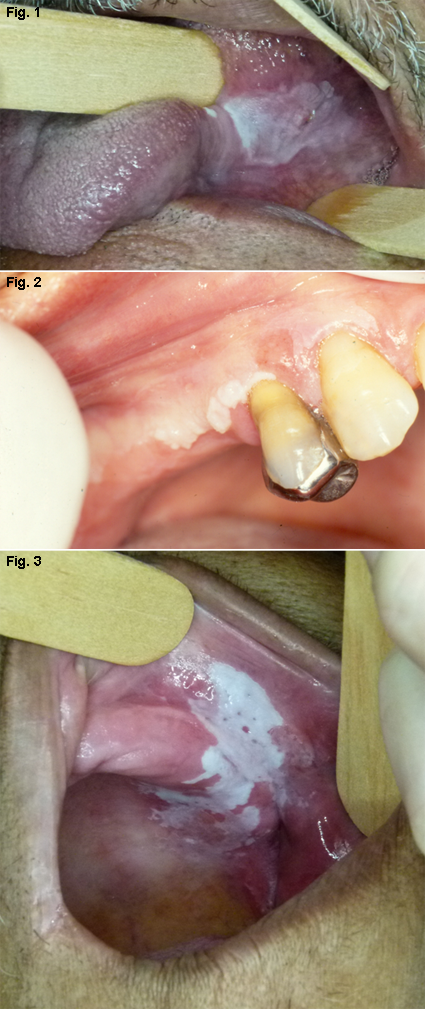
Middle-aged and elderly man are the most affected individuals, and growing indexes are observed towards age. OL often arises in cheek and alveolar mucosa (Neville and Day, 2002). Conversely, lesions in the floor of the mouth and lateral border of tongue seem to present displastic or malignant alterations more frequently (Neville and Day, 2002; Napier and Speight, 2008).
Clinics
The proliferative verrucous leukoplakia presents a multifocal evolvement, mainly in elderly female patients who do not present known risk factors (Figure 3). These lesions are usually resistant to treatment and show a high risk for malignant transformation (Warnakulasuriya et al., 2007; van der Waal, 2009).
Some alterations of the oral mucosa can mimic OL, and these lesions must be considered as OL differential diagnosis. So, for the establishment of a correct diagnosis of OL, such lesions must be excluded (Warnakulasuriya et al., 2007; van der Waal, 2009):
1. Frictional lesion
2. Candidiasis
3. Linea alba
4. Leukoedema
5. Chemical injuries
6. Hairy leukoplakia
7. Nicotinic stomatitis
Once a provisional clinical diagnosis of OL was made, a biopsy must be performed in order to obtain the histopathological features. This is of paramount importance because it is believed that the presence and degree of epithelial dysplasia is a great indicator of evolution and prognosis (see below) (Warnakulasuriya et al., 2008).
Pathology
Despite many efforts towards new evaluative methods, the histological analysis is still the most useful method for grading epithelial dysplasia in OL (Warnakulasuriya et al., 2008). In this field, the WHOs system for grading epithelial dysplasia in OL is widely accepted among pathologists. However, it is not able to reflect the clinical behaviour of every single lesion and does not provide a clear therapeutic guideline to clinicians (Izumo, 2011). Moreover, in spite of its wide acceptance, this system presents great variability and low reproducibility (Warnakulasuriya et al., 2008; van der Waal, 2009). According to it, lesions are classified considering the architectural features and cytological alterations listed below (WHO, 2005).
Architectural features:
- Irregular epithelial stratification
- Loss of polarity of basal cells
- Drop-shaped rete ridges
- Increased number of mitotic figures
- Abnormally superficial mitoses
- Premature keratinisation in single cells (dyskeratosis)
Cytological alterations
- Nuclear pleomorphism: abnormal variation in nuclear shape
- Cellular pleomorphism: abnormal variation in cell shape
- Anisonucleosis: abnormal variation in nuclear size
- Anisocytosis: abnormal variation in cell size
- Increased nuclear size
- Increased nuclear-cytoplasm ratio
- Atypical mitotic figures
- Increased number and size of nucleoli
Considering the epithelium divided into "thirds", lesions are classified into five categories:
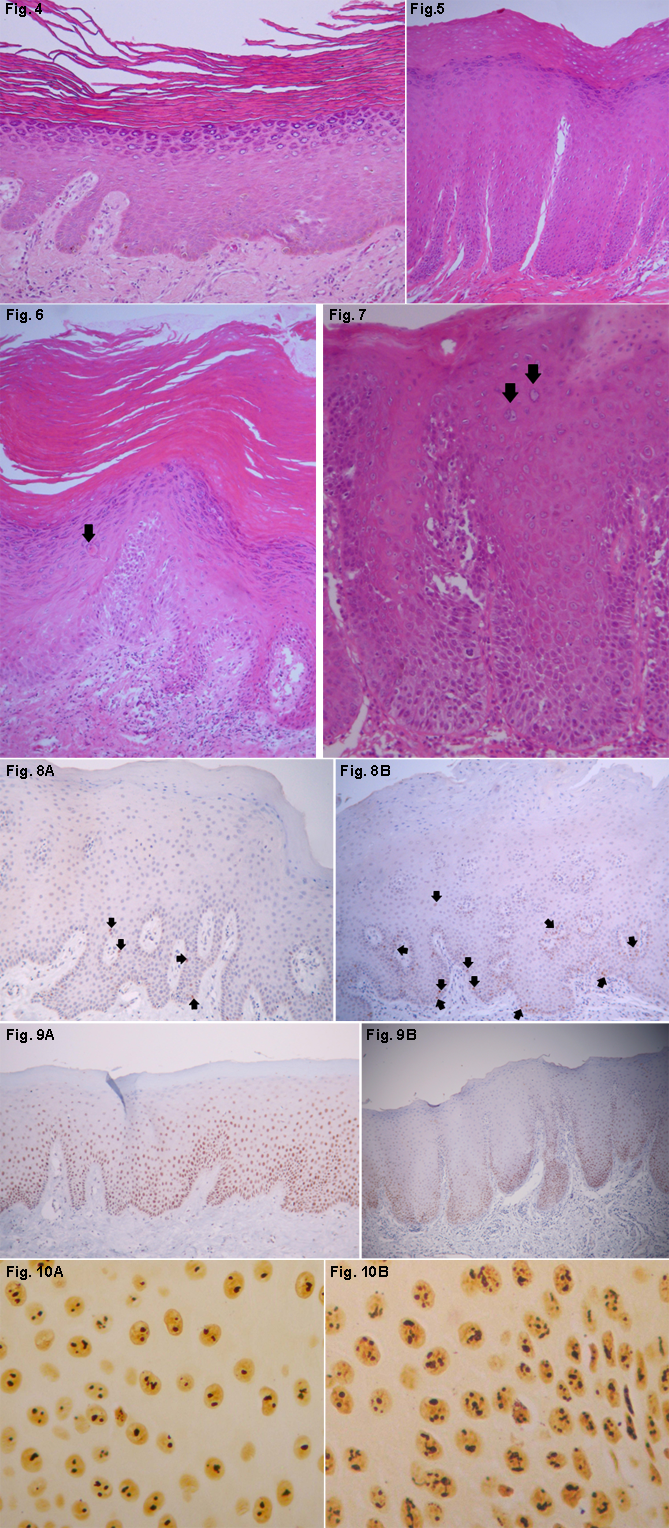
1. Hyperplasia: increase in cell number in the spinous layer and/or in the basal/parabasal cell layers. There is regular stratification and no cellular atypia (Figure 4).
2. Mild dysplasia: architectural disturbance only in the lower third of the epithelium with cytological atypia (Figure 5).
3. Moderate dysplasia: architectural disturbance extending into the middle third of the epithelium is the initial criteria, but the degree of cytological atypia may require upgrading it to "severe" (Figure 6).
4. Severe dysplasia: architectural disturbance affecting greater than two thirds of the epithelium, with cytological atypia (Figure 7).
5. Carcinoma "in situ": theorically, indicates that malignant transformation has occurred but invasion has not. Full or almost full thickness architectural disturbance is present in viable cellular layers with pronounced cellular atypia. Atypical mitotic figures and abnormal superficial mitoses are common.
Concerning the microscopic classification schemes for OL, a new binary system was proposed (Kujan et al., 2006). Accoding to it, pathologists would observe the same morphological criteria used in the WHO classification, but lesions would be classified as low-risk OL (former "no/mild/questionable" dysplasia) or as high-risk OL (former "moderate/severe" dysplasia). Shorten the degrees of dysplasia from five, i.e. no, mild, moderate, and severe, to two - low-risk and high-risk - would provide a more feasible and reproducible classification system. Also, it could offer a more reliable criteria upon which to rely for the selection of patient treatment. Accordingly, OL classified as "high-risk" would be more prone to develop into cancer and, thus, should be removed. On the other hand, low-risk OL could be clinically followed up as they are less expected to evolve (Kujan et al., 2006; Warnakulasuriya et al., 2008; van der Waal, 2009).
In a study with 218 patients with OL, the authors reported that high-risk OL was associated with a 4.57-fold increased risk for malignant transformation, compared with low-risk OL (Liu et al., 2010). Moreover, in another research with 138 patients with histologically confirmed oral dysplasia, 115 had OL and 23 had lichen planus. From these 138 lesions, 37 (26.8%) developed into cancer and the "high-risk" degree of dysplasia was an independent risk factor for transformation (Liu et al., 2011). The authors then suggest the utilization of high-risk dysplasia as a significant indicator for evaluating malignant transformation risk in patients with potentially malignant lesions.
In a recently published paper, our research group showed statistically significant differences for hMLH1 - a DNA repair protein - , p53 - a tumor supressor protein - , and AgNOR - an indicative of cell proliferation - indexes between low- and high-risk OL. This suggests that the biological processes linked to the impairment of those proteins remain enhancing from low-risk OL to high-risk OL. Thus, the use of the binary system would give support to a more reliable clinical approach involving the removal of high-risk OL (Caldeira et al., 2012).
Treatment
Evolution
Prognosis
Genetics
Note
Ki-67 is a cell cycle associated protein, of which expression is associated with cell proliferation. Ki-67 immunoexpression is used as a proliferation marker in pathology. Kodani et al. (2001) showed that OL presented lower indexes of Ki-67 than oral squamous cell carcinoma. Also, Zhao et al. (2005) demonstrated that OL with mild dysplasia shows low levels of Ki-67, while severe dysplasia shows a significantly higher expression than oral normal mucosa and mild dysplasia.
Our research group investigated the immunoexpression of hMLH1 (a protein of the mismatch repair system) in OL with different degrees of dysplasia. We found that hMLH1 indexes decreased from a lower degree of dysplasia to a higher one, despite statistical significance. So, hMLH1 immunoexpression was inversely related to the OL degree of dysplasia. Our findings also suggest a role of such alterations in this pathway of DNA repair as an early event in oral carcinogenesis (Caldeira et al., 2011a).
Briefly, some information about the most frequent genetic alterations of OL are shown below. A complete and detailed revision on this topic was published by Mithani et al. (2007).
p53 alterations: The p53 protein can induce DNA repair, cell cycle arrest, cell death or senescence, showing a pivotal role in tumor avoidance (Joerger and Fersht, 2008). Its alteration is a common finding in human cancers, including those of oral mucosa (Kurokawa et al., 2003). Investigations demonstrated that the normal oral mucosa presents negative or low indexes of p53 immunoexpression (Kurokawa et al., 2003; Fan et al., 2006; Caldeira et al., 2011b). Likewise, p53 immunopositive cells were identified in OL with mild dysplasia, with increasing indexes from hyperplasia, to dysplastic lesions (Figure 8) and to oral squamous cell carcinoma, with immunopositivity found in superficial layers of moderate and severe dysplasias (Kerdpon et al., 1997; Cruz et al., 2002; Kurokawa et al., 2003; Caldeira et al., 2011b). The detection of p53 in oral dysplastic lesions prompted many investigators to suggest that its abnormalities may constitute an early event in carcinogenesis.
Loss of heterozygosity (LOH): describes the elimination of a genetic loci containing tumor suppressor genes. In OL, LOH of the chromosome arms 3p and 9p seem to be related to a higher risk of malignant transformation. Fifty percent of OL contains allelic loss of either the 3p or 9p chromosome arms (Mithani et al., 2007).
Microsatellite instability (MSI) and the mammalian mismatch repair system (MMR): Microsatellites are DNA regions in which multiple repeated sequencies of nucleotides are found. These regions are prone to the occurence of mismatched DNA, developing the MSI phenotype (Jascur and Boland, 2006; Jiricny, 2006). MSI was detected in many OL and there is a trend toward an increased prevalence of MSI in more aggressive histologic OL lesions (Ha et al., 2002). The MMR is responsible for maintaining genomic stability during repeated duplication, and microsatellites regions are hypersensitive to MMR dysfunction. The immunoexpression of hMLH1 - one of the main MMR protein - was shown to decrease in OL with more severe grades of dysplasia (Figure 9) (Caldeira et al., 2011a). Taken together, these results may suggest that the altered function of MMR and the occurence of MSI could be early events in the carcinogenic process, but these findings still need more investigation.
Methylation / hypermethylation: is an epigenetic alteration which can inactivate genes. In OL, it was described to occur in RAR-b2, p16, hMLH1, hMSH2, and MGMT (Ha et al., 2002; López et al., 2003; Youssef et al., 2004; Sengupta et al., 2007).
AgNOR number: AgNOR staining technique is used to assess cellular proliferation, and normal oral epithelium showed lower AgNOR number than dysplastic OL (Figure 10), which in turn presents lower indexes than oral squamous cell carcinoma (Chattopadhyay et al., 1994; Caldeira et al., 2011b). It was suggested that mean AgNOR number would be useful in distinguishing OL with mild and moderate dysplasia (Chattopadhyay and Ray, 2008).
Telomerase activity: these are the enzymes that degradate telomers, which are a sequence of nucleotides that prevents DNA to undergo degradation and fusion. The telomerase activity was detected in OL.
Article Bibliography
| Pubmed ID | Last Year | Title | Authors |
|---|---|---|---|
| 17257863 | 2007 | Management of oral epithelial dysplasia: a review. | Brennan M et al |
| 22283367 | 2012 | Binary system of grading oral epithelial dysplasia: evidence of a bearing to the scores of an immunohistochemical study. | Caldeira PC et al |
| 17332919 | 2007 | Human papillomavirus: its identity and controversial role in oral oncogenesis, premalignant and malignant lesions (review). | Campisi G et al |
| 18197851 | 2008 | AgNOR cut-point to distinguish mild and moderate epithelial dysplasia. | Chattopadhyay A et al |
| 11865002 | 2002 | Suprabasal p53 immunoexpression is strongly associated with high grade dysplasia and risk for malignant transformation in potentially malignant oral lesions from Northern Ireland. | Cruz I et al |
| 16246616 | 2006 | Immunohistochemical analysis of P57(kip2), p53 and hsp60 expressions in premalignant and malignant oral tissues. | Fan GK et al |
| 22505902 | 2012 | Oral Leukoplakia as It Relates to HPV Infection: A Review. | Feller L et al |
| 12448003 | 2002 | Progression of microsatellite instability from premalignant lesions to tumors of the head and neck. | Ha PK et al |
| 15533209 | 2004 | The prevalence of oral leukoplakia in 138 patients with oral squamous cell carcinoma. | Haya-Fernández MC et al |
| 16316774 | 2006 | Long-term treatment outcome of oral premalignant lesions. | Holmstrup P et al |
| 17181738 | 2007 | Malignant transformation in 1458 patients with potentially malignant oral mucosal disorders: a follow-up study based in a Taiwanese hospital. | Hsue SS et al |
| 21234636 | 2011 | Oral premalignant lesions: from the pathological viewpoint. | Izumo T et al |
| 16804905 | 2006 | Structure and function of the components of the human DNA mismatch repair system. | Jascur T et al |
| 16612326 | 2006 | The multifaceted mismatch-repair system. | Jiricny J et al |
| 18410249 | 2008 | Structural biology of the tumor suppressor p53. | Joerger AC et al |
| 9467348 | 1997 | Expression of p53 in oral mucosal hyperplasia, dysplasia and squamous cell carcinoma. | Kerdpon D et al |
| 11872961 | 2001 | Expression of minichromosome maintenance 2 (MCM2), Ki-67, and cell-cycle-related molecules, and apoptosis in the normal-dysplasia-carcinoma sequence of the oral mucosa. | Kodani I et al |
| 280847 | 1978 | Definition of leukoplakia and related lesions: an aid to studies on oral precancer. | Kramer IR et al |
| 16731030 | 2006 | Evaluation of a new binary system of grading oral epithelial dysplasia for prediction of malignant transformation. | Kujan O et al |
| 12969225 | 2003 | Immunohistochemical study of syndecan-1 down-regulation and the expression of p53 protein or Ki-67 antigen in oral leukoplakia with or without epithelial dysplasia. | Kurokawa H et al |
| 21916948 | 2011 | Malignant transformation of oral epithelial dysplasia: clinicopathological risk factors and outcome analysis in a retrospective cohort of 138 cases. | Liu W et al |
| 21159209 | 2010 | Malignant transformation of oral leukoplakia: a retrospective cohort study of 218 Chinese patients. | Liu W et al |
| 18197849 | 2008 | Management of potentially malignant disorders: evidence and critique. | Lodi G et al |
| 14556921 | 2003 | Gene promoter hypermethylation in oral rinses of leukoplakia patients--a diagnostic and/or prognostic tool? | López M et al |
| 17305612 | 2007 | Molecular genetics of premalignant oral lesions. | Mithani SK et al |
| 18154571 | 2008 | Natural history of potentially malignant oral lesions and conditions: an overview of the literature. | Napier SS et al |
| 12139232 | 2002 | Oral cancer and precancerous lesions. | Neville BW et al |
| 13679200 | 2003 | Pooled estimate of world leukoplakia prevalence: a systematic review. | Petti S et al |
| 17219447 | 2007 | Inactivation of human mutL homolog 1 and mutS homolog 2 genes in head and neck squamous cell carcinoma tumors and leukoplakia samples by promoter hypermethylation and its relation with microsatellite instability phenotype. | Sengupta S et al |
| 19442563 | 2009 | Biomarkers in dysplasia of the oral cavity: a systematic review. | Smith J et al |
| 1175136 | 1975 | Leukoplakia revisited. A clinicopathologic study 3256 oral leukoplakias. | Waldron CA et al |
| 18251935 | 2008 | Oral epithelial dysplasia classification systems: predictive value, utility, weaknesses and scope for improvement. | Warnakulasuriya S et al |
| 15014026 | 2004 | Hypermethylation of the retinoic acid receptor-beta(2) gene in head and neck carcinogenesis. | Youssef EM et al |
| 16235539 | 2005 | [Expression of p53 and Ki-67 genes in epithelial dysplasia from old oral mucosa and clinical significance]. | Zhao J et al |
| 18674954 | 2009 | Potentially malignant disorders of the oral and oropharyngeal mucosa; terminology, classification and present concepts of management. | van der Waal I et al |
Citation
Patrícia Carlos Caldeira ; Maria Auxiliadora Vieira do Carmo
Head and Neck: Oral leukoplakia
Atlas Genet Cytogenet Oncol Haematol. 2012-11-01
Online version: http://atlasgeneticsoncology.org/solid-tumor/5937/head-and-neck-oral-leukoplakia
