Ovary: Epithelial tumors
2003-12-01 Lisa Lee-Jones Affiliation1.Tumour Molecular Genetics Group, Institute of Medical Genetics, University of Wales College of Medicine, Heath Park, Cardiff, CF14 4XN, UK
Summary
Note
Classification
Note
- serous,
- mucinous,
- endometrioid,
- clear cell,
- Brenner,
- transitional cell,
- small cell,
- mixed mesodermal and
- undifferentiated.
Classification
- Serous cystadenoma
- Borderline serous tumour
- Serous cystadenocarcinoma
- Adenofibroma
- Cystadenofibroma
- Mucinous cystadenoma
- Borderline mucinous tumour
- Mucinous cystadenocarcinoma
- Adenofibroma
Clinics and Pathology
Etiology
1 Theory of incessant ovulation: repeated ovarian follicular rupture and subsequent repair results in increased likelihood of genetic alterations within the surface epithelium.
2. The Gonadotrophin Theory hypothesis: persistent stimulation of the ovaries by gonadotrophins, together with local effects of endogenous hormones, results in increased proliferation and mitotic activity of the surface epithelium. This is consistent with ovarian cancer being associated with high gonadotrophin states such as the menopause, and less commonly associated with low gonadotrophin states such as oral contraceptive use and high parity.
Epithelial ovarian carcinoma develops sporadically in about 90-95% of patients. Environmental and dietary factors are thought to have a role. These include use of talc on the perineum and vulva, asbestos, pelvic irradiation, viruses (particularly mumps), high-fat diet, and lactose consumption. Other factors are associated with an increased number of ovulation cycles: low parity, delayed childbearing, early menarche and late menopause. However, genetic factors are the most important risk factor for ovarian epithelial carcinoma (See Genetics section of this review for further details).
Factors that decrease the risk for ovarian cancer predominantly reduce the number of ovulation cycles a women encounters-such as the use of oral contraceptives, breast-feeding and multiparity. Long-term use of oral contraceptives has reduced the risk of ovarian cancer by more than 50% in unselected women. Decreased risk of ovarian cancer has also been associated with tubal ligation and hysterectomy.
Epidemiology
Clinics
Brenner tumours are virtually always benign, and the exceptional malignant cases resemble transitional cell carcinoma of the bladder. As with the other types of ovarian neoplasm, it is usually asymptomatic until it has grown to a large size.
Pathology
http://www-medlib.med.utah.edu/WebPath/FEMHTML/FEM054.html - gross appearance
http://www-medlib.med.utah.edu/WebPath/FEMHTML/FEM073.html - gross appearance
http://www-medlib.med.utah.edu/WebPath/FEMHTML/FEM052.html - gross appearance
http://www-medlib.med.utah.edu/WebPath/FEMHTML/FEM053.html -demonstrates internal papillae
http://www-medlib.med.utah.edu/WebPath/FEMHTML/FEM051.html - illustrates external papillae
http://www-medlib.med.utah.edu/WebPath/FEMHTML/FEM056.html - H and E staining
http://pathweb.uchc.edu/eAtlas/GYN/1314.htm
http://pathweb.uchc.edu/eAtlas/GYN/1315.htm
http://pathweb.uchc.edu/eAtlas/GYN/1316.htm
http://pathweb.uchc.edu/eAtlas/GYN/61.htm
http://pathweb.uchc.edu/eAtlas/GYN/159.htm
Histological analysis of borderline serous tumours reveals papillary cystic pattern, stratification, tufting, increased mitotic figures and cytologic atypia. H and E histology of borderline serous tumour can be viewed at:
http://www-medlib.med.utah.edu/WebPath/FEMHTML/FEM055.html.
http://pathweb.uchc.edu/eAtlas/GYN/463.htm
Histological review of malignant serous tumours indicates significant stromal invasion. Calcifications (Psammoma bodies) are present in one-third of patients. Characteristic microscopic features include finger-like papillae with fibrovascular core, covered by multilayered cuboidal or columnar epithelium, hyperchromatic nuclei, prominent nucleoli, frequent mitoses, Psammoma bodies and desmoplasia (invasion of stroma with fibrosis). Examples can be viewed at:
http://pathweb.uchc.edu/eAtlas/GYN/1927.htm
http://pathweb.uchc.edu/eAtlas/GYN/1928.htm
http://pathweb.uchc.edu/eAtlas/GYN/1929.htm
http://pathweb.uchc.edu/eAtlas/GYN/1097.htm
http://pathweb.uchc.edu/eAtlas/GYN/1098.htm
http://pathweb.uchc.edu/eAtlas/GYN/1099.htm
http://www-medlib.med.utah.edu/WebPath/FEMHTML/FEM072.html -shows Psammoma bodies
Mucinous
http://pathweb.uchc.edu/eAtlas/GYN/1930.htm
http://pathweb.uchc.edu/eAtlas/GYN/1931.htm
http://pathweb.uchc.edu/eAtlas/GYN/1932.htm
http://pathweb.uchc.edu/eAtlas/GYN/1933.htm
http://pathweb.uchc.edu/eAtlas/GYN/1310.htm
http://pathweb.uchc.edu/eAtlas/GYN/1311.htm
http://pathweb.uchc.edu/eAtlas/GYN/1312.htm
http://pathweb.uchc.edu/eAtlas/GYN/1313.htm
http://pathweb.uchc.edu/eAtlas/GYN/530.htm
Their microscopic appearance resembles intestinal adenocarcinoma. Multiple glands comprising mucin-containing cells are present, demonstrating nuclear atypia, hyperchromasia with prominent nuclei and desmoplasia.
Borderline/LMP
Borderline/LMP tumours are characterised by epithelial multilayering of more than 4 cell layers, and less than 4 mitoses per 10 high-power field, mild nuclear atypia, increased nuclear/cytoplasmic ratio, slight-to-complex branching of epithelial papillae and pseudopapillae, epithelial budding and cell detachment into the lumen and no destructive stromal invasion. Borderline mucinous tumours have similar gross morphology to their benign counterparts, cysts with smooth surfaces. The epithelial layer is characterised by stratification of 2-3 layers, nuclear atypia, enlarged nuclei and mitotic figures. Histological examples of borderline mucinous tumours can be found at:
http://pathweb.uchc.edu/eAtlas/GYN/1934.htm
http://pathweb.uchc.edu/eAtlas/GYN/1935b.htm
Approximately 25% of borderline tumours show cell proliferations on the outer surface only. Of these, 90% develop peritoneal implants, which can be invasive or non-invasive. Both have a similar appearance, glandular or papillary proliferations with cell detachments, sometimes Psammoma bodies, cellular atypia and desmoplastic fibrosis. However, epithelial cells infiltrate the stroma in the invasive implants.
Brenner tumours
Brenner tumours are solid or cystic, yellow-tan colour and firm upon gross examination. Histological examination of Brenner tumour reveals epithelial nests or cysts of cells, resembling urothelium, separated by a cellular, fibrous stroma (composed of spindle-like cells). The nuclei are relatively uniform, lacking pleomorphism, hyperchromasia or macronucleoli, and mitoses are not identified. There is a moderate amount of eosinophilic cytoplasm. Examples of Brenner tumours can be viewed at:
http://pathweb.uchc.edu/eAtlas/GYN/1941b.htm
http://pathweb.uchc.edu/eAtlas/GYN/1942.htm
http://pathweb.uchc.edu/eAtlas/GYN/1943.htm
http://pathweb.uchc.edu/eAtlas/GYN/1299.htm
http://pathweb.uchc.edu/eAtlas/GYN/1300.htm
http://pathweb.uchc.edu/eAtlas/GYN/1301.htm
http://pathweb.uchc.edu/eAtlas/GYN/1302.htm
Clear Cell Carcinoma
Clear cell carcinoma accounts for 5-12% of ovarian adenocarcinomas. The gross appearance of clear cell carcinoma shows a smooth, lobulated external surface. These tumours are usually solid and firm, but can be cystic. They have a yellow-tan colour. Microscopic examination reveals cells arranged in tubules, nests or cysts, with clear, glycogen rich cytoplasm, sharply demarcated cell borders, and hyperchromatic, pleomorphic nuclei. Hobnail cells with nucleus standing on a stalk of cytoplasm are visible microscopically. Examples of clear cell carcinoma can be found using the following weblinks:
http://pathweb.uchc.edu/eAtlas/GYN/1937.htm
http://pathweb.uchc.edu/eAtlas/GYN/1938.htm
http://pathweb.uchc.edu/eAtlas/GYN/1939.htm
http://pathweb.uchc.edu/eAtlas/GYN/1940.htm
http://pathweb.uchc.edu/eAtlas/GYN/1049.htm
http://pathweb.uchc.edu/eAtlas/GYN/1050.htm
http://pathweb.uchc.edu/eAtlas/GYN/1051.htm
http://pathweb.uchc.edu/eAtlas/GYN/1052.htm
http://pathweb.uchc.edu/eAtlas/GYN/1053.htm
Endometrioid Carcinoma
Endometrioid carcinomas are solid, white, firm tumours with smooth or irregular surfaces. They may contain a cystic component and have areas of necrosis and haemorrhage. Histological analysis reveals glands, or glands mixed with solid areas, round-oval vesicular, clear nuclei with prominent nucleoli. Endometrioid carcinoma is indistinguishable from endometrial carcinoma. An example of endometrioid carcinoma can be found at:
http://pathweb.uchc.edu/eAtlas/GYN/437.htm
Mixed Mesodermal
The gross appearance of mixed mesodermal ovarian tumours are exemplified in the following weblinks:
http://pathweb.uchc.edu/eAtlas/GYN/134.htm
http://pathweb.uchc.edu/eAtlas/GYN/135.htm
http://pathweb.uchc.edu/eAtlas/GYN/136.htm
They are usually large variegated lesions with necrotic and haemorrhagic regions, and may have adhesions. Microscopic examination reveals serous or endometrioid epithelial component displaying squamous differentiation. Stroma may comprise spindle cell or soft tissue differentiation including cartilage, skeletal muscle or smooth muscle.
Treatment
Evolution
Prognosis
Clear cell adenocarcinoma has a worse prognosis that the other histological subtypes as it is resistant to platinum-based chemotherapy. Some data suggests familial ovarian cancers have prolonged survival in comparison to the nonfamilial cases. In one study, patients with familial ovarian cancer exhibited a 67% 5-year survival, in comparison with a 17% 5-year survival in the nonfamilial ovarian cancer cases.
| STAGE | DEFINITION |
| Stage I | Growth limited to ovaries |
| Stage Ia | Growth limited to one ovary, no ascites, no tumour on external surface, capsule intact |
| Stage Ib | Growth limited to both ovaries, no ascites, no tumour on external surface, capsule intact |
| Stage Ic | Tumour either stage Ia or Ib, but with tumour on one or both ovaries, with capsule ruptured, with ascites present containing malignant cells, or with positive peritoneal washings |
| Stage II | Growth involving one or both ovaries with pelvic extension |
| Stage IIa | Extension and/or metastases to the uterus and/or tubes |
| Stage IIb | Extension to other pelvic tissues |
| Stage IIc | Tumour either stage IIa or IIb, with tumour on the surface of one or both ovaries, but with capsule(s) ruptured, with ascites present containing malignant cells, or with positive peritoneal washings |
| Stage III | Tumour involving one or both ovaries with peritoneal implants outside the pelvis and/or positive retroperitoneal or inguinal nodes. Superficial liver metastases equal stage III. Tumour limited to the true pelvis but with histologically proven malignant extension to small bowel or omentum |
| Stage IIIa | Tumour grossly limited to the true pelvis with negative nodes but with histologically confirmed microscopic seeding of abdominal peritoneal surfaces. |
| Stage IIIb | Tumour involving one or both ovaries with histologically confirmed implants of abdominal peritoneal surfaces, none exceeding 2cm in diameter. Nodes are negative. |
| Stage IIIc | Abdominal implants >2cm in diameter and/or positive retroperitoneal or inguinal nodes. |
| Stage IV | Growth involving one or both ovaries with distant metastases. |
Table 1 Definitions of the FIGO classification scheme for Staging Primary Ovarian Carcinoma (taken from Jones, 2000)
| STAGE No | PATIENTS TREATED | SURVIVAL3-yr (%) | SURVIVAL 5-yr (%) |
| I | 5,559 | 87.5 | 82.1 |
| II | 3,364 | 72.1 | 64.5 |
| III | 2,530 | 47.0 | 38.1 |
| IV | 492 | 20.7 | 14.0 |
| TOTAL | 11,945 | 71.6 | 65.4 |
Table 2 Survival Rates of Ovarian Carcinoma according to Disease Stage (adapted table from Jones, 2000)
Cytogenetics
Cytogenetics morphological
Invasive serous and undifferentiated ovarian carcinomas have complex cytogenetic rearrangements, including amplification of oncogenes. Complex chromosomal anomalies are rarely found in mucinous and endometrioid carcinomas (mainly in advanced stages), and are never found in serous LMP tumours. Epithelial ovarian tumours are characterised by gains at 3q, 8q and 20q, often with high level amplification. Thus the cytogenetic profiles of ovarian carcinomas differ from that of ovarian granulosa cell tumours, trisomy 14 and monsomy 22 are rarely found in ovarian carcinomas. Chromosome 1 and 3 abnormalities are the commonest aberrations found in ovarian metastatic tumours. Cytogenetic investigation of 11 individuals with bilateral ovarian carcinoma showed identical baseline karyotypes, suggesting both tumours arise from the same transformed cell, rather than the tumours arising independently.
46/52 ovarian carcinomas had complex karyotypes, often with a stemline chromosome number that was approaching near-triploid or hypodiploid. Chromosome losses of X, 22, 17, 13, 14 and 8, (lost in 15 imbalances
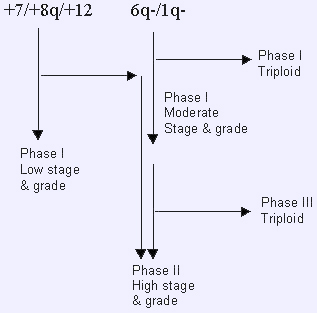
Their analyses hypothesised that the temporal order of imbalances were as follows: 1q-, 6q-, +7 and +8q occurred early, -4, -8, +1q, +12 and +20 were intermediate imbalances, and the remaining imbalances were late events. It has been concluded that karyotypic evolution in ovarian carcinomas followed at least 2 cytogenetic pathways. The first pathway involved chromosomal gains of +7/+8q/+12 and was associated with low-stage and low-grade tumours. The second pathway involved chromosomal losses of 6q- and 1q- was found in tumours of moderate stage and grade. The early stages of karyotypic evolution result from the step-wise acquisition of changes resulting in Phase I tumours. Chromosome instability resulted in the transition to Phase II tumours, possibly as a result of extensive telomere crisis and breakage fusion breakage cycles, which is linked to imbalances characteristic of the 6q-/1q- pathway. Consequently, low-grade and borderline tumours cannot progress unless they have mixed-pathway features. The 6q-/1q- pathway was associated with triploidization. The 6q-/1q- pathway is instrumental in the progression of ovarian carcinomas. The proposed pathway of karyotypic evolution in ovarian carcinomas is summarised in Figure 1.
A cohort of 114 ovarian neoplasms was analysed, including benign, borderline and invasive carcinomas by conventional and molecular cytogenetics. The chromosome abnormalities were categorised as follows:
The presence of cytogenetic aberrations common to all subtypes suggests these tumours develop by progression.
The main conclusions from cytogenetic investigations of ovarian epithelial tumours are as follows:
Cytogenetics molecular
| Ovarian Neoplasm Subtype | Loss | Amplification | Percentage (number of cases) |
| Ovarian Cancer | (1p21-p31) | 7 (5/72) | |
| 1p34.1-p34.3 | 11 (5/44) | ||
| 1q | 7 (5/71) | ||
| 2p15p22 | 4 (1/24) | ||
| 2q22-q24 | 5 (1/20) | ||
| 3cen-q23 | 4 (1/24) | ||
| 3q25-q27 | 13 (6/47) | ||
| 4q21-q32 | 16 (30/184) | ||
| 4q32-qter | 16 (15/91) | ||
| 4q32-qter | 16 (15/91) | ||
| 5q12-q23 | 16 (30/184) | ||
| 6p21 | 7 (3/144) | ||
| 6q13-qter | 5 (1/20) | ||
| 6q16-qter | 13 (23/184) | ||
| 7q36 | 7 (2/27) | ||
| 8p21-pter | 17 (32/184) | ||
| 8q | 4 (1/24) | ||
| 8q22-qter | 18 (8/44) | ||
| 9p | 10 (16/159) | ||
| 9p24 | 4 (1/27) | ||
| 9q | 13 (17/136) | ||
| 10p15 | 4 (1/27) | ||
| 10q11-qter | 17 (10/59) | ||
| 12p12 | 19 (9/47) | ||
| 12p12 | 9 (4/47) | ||
| 12q24-qter | 10 (14/140) | ||
| 13q12-q21 | 18 (24/135) | ||
| 13q21-q32 | 12 (18/160) | ||
| 16p | 13 (12/93) | ||
| 16q | 23 (24/184) | ||
| 17p | 20 (37/184) | ||
| 17q11.2-q32 | 23 (31/137) | ||
| 17q21-qter | 6 (3/47) | ||
| 18p11.3 | 4 (1/27) | ||
| 18q12-qter | 18 (33/184) | ||
| 19p | 23 (10/44) | ||
| 19q | 16 (11/69) | ||
| 21q | 10 (12/116) | ||
| 22q | 18 (17/93) | ||
| Xp | 19 (35/184) | ||
| Xq | 19 (9/47) | ||
| Xq11.2-q21 | 13 (12/89) | ||
| Xq21-qter | 24 (16/68) | ||
| Primary epithelial ovarian cancer | 4p15.2 | 18 (5/28) | |
| 4q23-q24 | 18 (5/28) | ||
| 4q26-q27 | 18 (5/28) | ||
| 5q14 | 14 (4/28) | ||
| 5q15 | 14 (4/28) | ||
| 9p22-p24 | 11 (3/28) | ||
| 9q22-q31 | 18 (5/28) | ||
| 13q14 | 14 (4/28) | ||
| 13q31-q32 | 21 (6/28) | ||
| 14q24.3-q31 | 14 (4/28) | ||
| 15q21.1 | 25 (7/28) | ||
| 18q21 | 11 (3/28) | ||
| Ovarian Inherited (BRCA1 & BRCA2) | 1q32-qter | 10 (2/20) | |
| 3q26.1 | 10 (2/20) | ||
| 5p | 5 (1/20) | ||
| 6p22-p24 | 10 (2/20) | ||
| 6q21-q22 | 5 (1/20) | ||
| 6q25-qter | 15 (3/20) | ||
| 8p23 | 40 (8/20) | ||
| 8q23-q24.1 | 30 (6/20) | ||
| 12p | 5 (1/20) | ||
| 12q13-q21 | 5 (1/20) | ||
| 18p11.2-pter | 15 (3/20) | ||
| 18q21-qter | 20 (4/20) | ||
| 20p | 5 (1/20) | ||
| Xp | 15 (3/20) | ||
| Xq12-21 | 15 (3/20) | ||
| Ovarian cancer, sporadic & inherited | 1p34-p36 | 25 (4/18) | |
| 4q31.3-q35 | 19 (3/16) | ||
| 9q31-q34 | 40 (8/16) | ||
| 10q23-q26 | 25 (4/16) | ||
| 11q23-q25 | 19 (3/16) | ||
| 16p | 19 (3/16) | ||
| 16q22-q24 | 38 (6/16) | ||
| 17p | 19 (3/16) | ||
| 19 | 19 (3/16) | ||
| 22q12-q13 | 25 (4/16) | ||
| Xp | 19 (3/18) |
Table 4 Recurrent amplifications and losses in epithelial ovarian tumours, including hereditary neoplasms (data taken from http://www.helsinki.fi/cmg/cgh_data.html)
Other studies have identified gain of chromosome 8 in 1/10 ovarian carcinomas.
A study of 31 primary ovarian carcinomas in Chinese women by CGH identified several non-random changes in copy number including gains of 3q (17 cases, 55%) with a minimum region of gain of 3q25-q26, 8q (16 cases, 52%), 19q (12 cases, 39%), Xq (11 cases, 35%), 1q (10 cases, 32%), 12p12-q13 (10 cases, 32%), 17q (10 cases, 32%) with a minimum region of gain at 17q21, and 20q (9 cases, 29%); together with losses of 16q (9 cases, 29%), 1p (7 cases, 23%), 18q (7 cases, 23%) and 22 (7 cases, 23%). High copy number amplifications were observed at 3q25-q26 (4 cases), 8q24 (3 cases) and 12p11.2-q12 (3 cases). The commonest imbalances detected by CGH of epithelial neoplasms were gain of 3q25-26, gain of 8q24, loss of 16q, and loss of 17pter-q21. 12p gains were seen in 8/44 cases, which has been reported previously in both ovarian and testicular germ cell tumours. Another study by Hauptmann et al., 2002 using CGH to analyse ovarian carcinomas identified frequent gains of 3q, 6p, 7, 8q and 20, together with losses of 4q, 6q, 12q, 13q and 16q, which have supported the available cytogenetic data.
CGH was used to screen a mucinous ovarian carcinoma and a Brenner tumour coexisting in different ovaries of the same female. Amplification of 12q14-q21 was identified in both tumours, in the presence of other copy number changes, 4 such changes in the Brenner tumour and 6 in the mucinous carcinoma.
Correlation of CGH data with Clinical data
In a large study of 106 primary ovarian carcinomas, the CGH findings were correlated with clinical parameters such as tumour grade of differentiation. 103 tumours displayed imbalances. Amplifications of 8q, 1q, 20q, 3q and 19p were frequent findings present in 69-53% of the tumours. Underrepresentations of 13q, 4q and 18q were also common, present in 54-50% of cases. Underrepresentation of 11p and 13q and overrepresentation of 8q and 7q correlated with undifferentiated ovarian carcinoma, whereas 12p underrepresentation and 18p overrepresentation were more commonly associated with well-differentiated and moderately differentiated tumours. These findings corroborate other CGH studies including.
A CGH study of a cohort of 12 ovarian clear cell carcinomas revealed similarities to the data of other subtypes of epithelial neoplasms, such as gains of 8q and 17q and losses of 19p. They also correlated their findings with disease status (i.e. disease free, recurrent disease, or death from disease). DNA copy number changes present in over 20% of cases included overrepresentation of 8q11-q13, 8q21-q22, 8q23, 8q24-qter, 17q25-qter, 20q13-qter and 21q22; and underrepresentation of 19p. Overrepresentation of 8q11-q13, 8q21-q22, 8q23, 8q24-qter was more common in disease-free patients than in those with recurrent disease or who had died. Conversely, overrepresentation of 17q25-qter, 20q13-qter was more frequent in patients with recurrent disease or non-survivors, than in disease-free patients. This data suggests ovarian clear cell carcinoma develop along 2 cytogenetic pathways.
In a study correlating CGH genomic imbalances with clinical endpoints in 60 ovarian carcinomas, the following associations were found:
CGH findings of Sporadic and Hereditary Ovarian Carcinoma
CGH profiles were compared from sporadic and hereditary (3 BRCA1 and 1 BRCA2 mutation carriers) ovarian cancers. The commonest imbalance included amplification of 8q22.1-qter (66.6%), 1q22-32.1 (41.1%), 3q (75%) and 10p (33.2 %), and deletion of 9q (41.6%) and 16q21-q24 (33.3%). Deletions of 9q were found in all 3 BRCA1 carriers and 2/8 sporadic tumours, and deletions of 19 were found in 2/3 BRCA1 carriers and none of the sporadic cases. These findings suggest preferential somatic losses of chromosome 9 and 19 in BRCA1 mutation carriers. In contrast, another study identified extensive similarity by CGH between sporadic and hereditary ovarian carcinomas, except for 2q24-q32. CGH analysis of a further 36 hereditary tumours found the majority of imbalances to be similar to that of sporadic tumours (Gains: 8q23-qter, 3q26.3-qter, 11q22, 2q31-32; losses: 8p21-pter, 16q22-qter, 22q13, 12q24, 15q11-15, 17p12-13, Xp21-22, 20q13, 15q24-25, 18q21). However some imbalances were identified that were specific to hereditary tumours, including deletions of 15q11-15, 15q24-25, 8p21-pter, 22q13 and 12q24, and gains of 11q22, 13q22 and 17q23-35. Deletions of 15q11-15 and 15q24-25 were found in 16/36 and 12/36 cases respectively which implicated hRAD51 and other tumour suppressor genes in these loci in the genesis of hereditary ovarian cancer.
Genetics
Note
As mentioned in the Aetiology section, genetic factors are the most important risk factor for ovarian epithelial carcinoma. Having 1 or 2 first-degree relatives with ovarian cancer increases the lifetime risk to 3-5% and 39% respectively. Three hereditary syndromes in which familial aggregation of ovarian carcinoma occurs have been described:
All 3 patterns of familial ovarian cancer are consistent with autosomal-dominant transmission of one or more genes responsible for the development of >1 cancers, with incomplete penetrance and variable expression. The age of diagnosis of hereditary epithelial ovarian cancer is approximately 10 years earlier than its sporadic counterpart.
Breast-Ovarian Syndrome
Of the about 10% of ovarian epithelial cancers thought to have a hereditary component, 90% are associated with breast-ovarian syndrome. This syndrome is associated with two genes, BRCA1 at 17q21, and BRCA2 at 13q12.3 (see below), which are involved in DNA repair and transcription regulation. Mutations are distributed throughout the entire coding regions of BRCA1 and BRCA2, and most result in truncation of the protein. Germline mutations in BRCA1 account for about 80% of hereditary breast-ovarian cancers. Germline mutations of BRCA2 account for about 10-35% of familial ovarian cancers. BRCA1 is associated with a 26% cumulative risk for ovarian cancer for most mutation carriers, and a much higher risk, 85%, in a small subset. Women with a germline BRCA1 mutation have an about 40% risk of developing ovarian cancer by 70 years of age. BRCA2 increases susceptibility to a smaller degree. The lifetime risk for developing ovarian cancer in BRCA2 mutation carriers is 27%. However the risks of developing ovarian cancer associated with germline mutations of BRCA1 and BRCA2 vary according to the population studied. A study by revealed a lifetime risk of ovarian cancer of 40-60% for BRCA1 mutation carriers, whereas another one found a 25-30% risk for BRCA1 mutation carriers. Approximately 1/4000 in the general population has a mutation of BRCA1, although some populations have much higher incidences, for example the Ashkenazi Jews. Patients with breast cancer who had BRCA1 or BRCA2 mutations had a tenfold increased risk of developing ovarian cancer.
The variable penetrance of BRCA1 suggests that other genetic and non-genetic factors contribute to the pathogenesis in these individuals. One such modifier is a VNTR polymorphism, 1-kb downstream of HRAS. BRCA1 carriers with rare alleles of the VNTR had an 2.11 increased risk of developing ovarian cancer compared with the common alleles (p=0.015).
about 50% of familial ovarian cancers are not associated with germline BRCA1 or BRCA2 mutations. Linkage and LOH analysis has suggested a susceptibility gene for familial ovarian cancer at 3p22-p25. LOH of 3p33-p25 is higher (52%) in non-BRCA1/BRCA2 familial ovarian cancers than in the BRCA1 (29.7%) group.
HNPCC
Mutations of the mismatch repair genes (MMR) including MLH1, MSH2 and MSH6 are present in HNPCC syndrome (Lynch 2 Syndrome). This represents the second most common type of ovarian cancer with a hereditary component.
Site-Specific Ovarian Cancer Syndrome
The least common of the familial ovarian cancers is the site-specific ovarian cancer syndrome, in which ovarian cancer is the dominant cancer. It has been suggested that site-specific ovarian cancer is a variant of breast-ovarian syndrome attributable to mutation in either BRCA1 or BRCA2, and not a distinct clinical entity.
Early onset ovarian carcinoma (
Genes Involved and Proteins
Note
Cytogenetic and loss of heterozygosity (LOH) studies have implicated many regions of the genome in the pathogenesis of ovarian cancer. Numerous allelotype studies have been performed on ovarian carcinomas and identified frequent losses of 1p, 4p, 5q, 6p, 6q, 7p, 8p, 8q, 9p, 9q, 11p, 11q, 12p, 12q, 13q, 14q, 15q, 16p, 16q, 17p, 17q, 18q, 19p, 21q, 22q and Xp. However most of these studies examined ovarian serous adenocarcinoma. From the few studies that have analysed LOH of benign and LMP tumours, LOH is rarely found at most loci, with the exception of the X chromosome in LMP tumours. LOH analysis of early-stage malignant and borderline ovarian tumours displayed similar LOH patterns suggesting that malignant ovarian tumours may develop from benign and borderline tumours. Frequent allelic losses are found at 5p15.2, 5q13-21, 6p24-25, 6q21-23, 6q25.1-27, 7q31.1, 11p15.5, 11p13, 11q22, 11q23.3-qter, 17p13.3 and 17p11.2, suggesting the presence of tumour suppressor genes involved in ovarian carcinoma. Microcell-mediated chromosome transfer of normal chromosome 11 and 17 confirmed the presence of tumour suppressor gene(s) on these chromosomes. Complete suppression of tumourigenicity was obtained by transfer of chromosome 11, whereas reduced in vivo and in vitro growth rates together with increased latency period were obtained by the transfer of chromosome 17. Furthermore transfer of 17p11.2 had the same effect as transfer of the entire chromosome. Microsatellite analysis has suggested the presence of a tumour suppressor gene at 22q11-q12 (between D22S301 and D22S304). This was also supported by microcell-mediated chromosome transfer of chromosome 22 into ovarian carcinoma cell line SKOV3 which resulted in complete abrogation of anchorage-independent growth and a dramatic reduction of in vitro doubling times and tumourigenicity in nude mice.
The pattern of allelic loss differs according to the histological subtypes of epithelial ovarian cancer. Clear cell adenocarcinoma predominantly demonstrates LOH of 1p, 19p and 11q. Serous adenocarcinoma demonstrates allelic losses in >50% of cases of 1p, 4p, 5q, 6p, 8p, 9q, 12q, 13q, 15q, 16p, 17p, 17q, 18p, 18q, 19p, 20p and Xp. Endometrioid adenocarcinoma frequently demonstrated LOH of 7p, and mucinous adenocarcinoma demonstrated recurrent LOH at 17p13.1. LOH analysis using RFLP markers in 6q24-q27 demonstrated allelic loss at a few or all loci in 17/33 ovarian serous tumours, 1/15 ovarian mucinous tumours, and 2/12 ovarian clear cell tumours. Allelic loss of 1p31 has been found in about 40% of ovarian carcinomas, where the maternally imprinted tumour suppressor gene ARH1(NOEY2) resides. Approximately 1/3 of epithelial ovarian tumours of all stages demonstrate LOH of 9p. 69% of 78 ovarian epithelial tumours displayed LOH of 17p13.1 where TP53 is located. Allelic loss at 10q23.3 flanking PTEN and within PTGN have been found in 45% of ovarian epithelial cancers (n=68). Loss of PTEN expression was associated with elevated phosphorylated AKT levels. No microsatellite instability (MSI) was apparent among the 23 benign cystadenomas and 31 LMP ovarian tumours examined using 69 microsatellite markers. Thus these findings suggest MSI is not a pathogenic mechanism in the development of LMP tumours, and abnormalities of the DNA mismatch repair mechanisms are not involved. In contrast, about one-third of endometrioid carcinomas and up to 40% of serous LMP tumours display MSI, although in serous LMP tumours the MSI is low level.
LOH of 3p14.2, 11p15.5, 11q23.3, 11q24, 16q24.3 and 17p13.1 are more frequent in advanced than lower stage tumours. LOH of 3p14.2 correlated with tumour metastasis, whereas LOH at 11p15.5 and 11q23.3 were associated with reduced survival. LOH of 11q22.3 was associated with reduced survival and a serous histology, meanwhile LOH of 11q24-25 correlated with a higher tumour stage, serous histology, presence of residual tumour, but not with survival. LOH of 1p36 is associated with poor histological grade.
Alterations in tumour suppressor genes such as P53, RB1, ARH1 (NOEY2), BRCA1 are involved in ovarian carcinogenesis.
Allelic deletions of 17p or P53 mutations occur frequently in ovarian carcinoma. P53 mutations are found in about 50-80% of tumours when analysed by complete gene sequencing. LOH of P53 is also a frequent finding in ovarian carcinomas, ranging from 30% to 80%. P53 mutations have been found in ovarian carcinoma and borderline ovarian tumours. Invasive serous and undifferentiated ovarian carcinomas are characterised by P53 mutations with protein accumulation, extensive allelic loss of chromosome 17 and complex cytogenetic aberrations. Functional wild-type P53 is required for chemo- and radio-sensitivity due to its role in apoptosis. Thus mutation of P53 followed by loss of the wild-type results in resistance to therapy. Of the ovarian neoplasms that express nuclear P53, 90% of them have mutations of P53 which increases the half-life of the P53 protein. 50% of advanced ovarian carcinomas have overexpressed or mutant P53 which correlates with high grade and poor survival, but not with chemoresponsiveness. However, P53 does not appear to be involved in the pathogenesis of clear cell adenocarcinoma.
Homozygous deletions or intragenic mutations of CDKN2A (p16INK4A) are also found in ovarian epithelial tumours. CDKN2A encodes an inhibitory protein of cyclin-dependent kinase 4. The CDKN2A complex blocks phosphorylation of the Retinoblastoma (RB) protein. Phosphorylation of the RB protein is a prerequisite for cells to enter the S phase of the cell cycle. Thus CDKN2A is a negative regulator of the cell cycle.
Reduced expression of RNASET2 (RNASE6PL), located at 6q27, was found in 30% of ovarian cancers. Transfection of RNASET2 cDNA into ovarian cancer cell lines suppressed tumourigenicity, suggesting it to be a candidate tumour suppressor gene.
Somatic mutations of BRCA1 and BRCA2 have not been found in sporadic ovarian neoplasms, however allelic losses including 17q21, were BRCA1 is located, were common. This suggests that additional tumour suppressor genes are required in the molecular aetiology of sporadic tumours, one proximal to BRCA1, the other on 17p.
Alterations in oncogenes KRAS, MYC and ERBB2 are frequently involved in ovarian carcinogenesis.
KRAS mutations are found in 30% of ovarian carcinomas, and are frequently observed in mucinous adenoma and thus may be an early event in the pathogenesis of ovarian mucinous tumours. KRAS mutations are present in 40-50% of mucinous LMP tumours and mucinous carcinomas, and also in one-third of serous LMP tumours. Amplification of KRAS has been reported in 3-5% of ovarian cancers. In one study, KRAS2 amplification occurred in 2/53 of ovarian epithelial tumours, (6 borderline serous, 2 low grade serous, 31 high grade serous; 4 low grade mucinous; 2 low grade endometrioid, 8 high grade endometrioid), and only in the aggressive types (2 high grade serous tumours). A mutation in codon 12 of KRAS has been identified in small cell carcinoma.
HRAS acquires transforming activity either as a result of substitution mutations or by increased expression of the normal gene. Mutated HRAS lack GTPase activity, resulting in dysregulation of cell growth.
Abnormal cell signalling mediated by protein kinases can result from alterations of the growth factor receptors in ovarian epithelial neoplasms. These include:
Amplification of MYC oncogene, 8q24, occurs in 10-20 % of ovarian cancers, and in about one-third of advanced ovarian carcinomas. MYC amplification is more frequently found in the serous subtypes than the mucinous subtypes. MYC encodes a DNA-binding nuclear-associated protein that regulates cell proliferation. Dividing cells have increased amounts of nuclear c-myc, whereas quiescent cells express negligible quantities. MYC amplification is often indicative of biologically aggressive tumours. MYC amplification was not associated with prognosis or survival. Significantly higher levels of p62c-myc were found in serous papillary ovarian carcinoma. LMP tumours expressed MYC at values intermediate between that of normal ovary tissue and carcinoma.
Amplification, altered expression, and malfunction of several protein kinases and phosphatases are involved in the pathogenesis of ovarian epithelial neoplasms, in particular the phosphatidylinositol 3-kinase (PI3K) pathway. Increased PI3K activity is important in the growth and dissemination of ovarian cancer cells. The PIK3CA gene which encodes the catalytic subunit of PI3K, and its downstream effector AKT2 are amplified in primary ovarian tumours. Overexpression of AKT2 is found in high-grade and late-stage tumours. Mutation and/or down-regulation of the PI3K phosphatase PTEN/MMAC1 are frequently observed in ovarian endometrioid carcinomas. AKT2 mediates some of the transforming signals of RAS and SRC which are mutated and overexpressed/activated respectively in late-stage tumours. Downregulation of the cGMP-dependent protein kinase PKG and upregulation of MAP2K6 (MEK6) were significantly correlated with the genesis of ovarian cancer. Amplification of AKT2 has been reported in 3-5% of ovarian cancers.
Expression Profiling
Amplification of other oncogenes such as FGF3 (formerly INT2) and MDM2 have been reported in 3-5% of ovarian cancers. As mentioned in the Molecular Cytogenetics section, high level amplification of 20q12-q13.2 is a frequent finding in ovarian carcinomas, and a gene located at 20q11.2-12, TGIF2, was amplified and over-expressed in 14 ovarian cancer cell lines. EIF5A2 is a candidate oncogene for the 3q25-q26 amplification in ovarian carcinomas. Overexpression of the Kallikrein gene, KLK4, located at 19q13.4, has been found in 69/147 ovarian tumours and is indicative of a poor prognosis. NME1 is thought to have a role in ovarian neoplastic process. Elevated levels of inhibin are found in most postmenopausal women with mucinous ovarian cancers.
Overexpression of BCL2 is present in about 90% of endometrioid carcinomas, and MSI is present in about one-third of cases, as has been described in endometrioid endometrial carcinomas. Overexpression of P53, EGFR, ERBB2 and ERBB3 was also detected in ovarian endometrioid carcinoma.
Expression microarrays were used to compare differential expression between 7 early stage ovarian carcinomas and 7 late stage ovarian carcinomas, and showed that several genes are aberrantly regulated to the same extent in both groups. Genes which function in cell-cell interaction such as cadherin 11 (CDH11), cadherin 2 (CDH2) and nidogen (NID) were downregulated in most tumours. Genes involved in invasion and metastasis such as matrilysin (MMP7), gelatinase (MMP9), matrix metalloproteinase 10 and 12 were upregulated in most tumours.
Several other expression profiling studies have been undertaken which identified differentially expressed genes between serous and mucinous carcinomas; and also identified differences in gene expression during progression of ovarian carcinoma.
Article Bibliography
| Pubmed ID | Last Year | Title | Authors |
|---|---|---|---|
| 10549271 | 1999 | Amplification of C-MYC as the origin of the homogeneous staining region in ovarian carcinoma detected by micro-FISH. | Abeysinghe HR et al |
| 11314033 | 2001 | Cloning and characterization of a senescence inducing and class II tumor suppressor gene in ovarian carcinoma at chromosome region 6q27. | Acquati F et al |
| 10564676 | 1999 | Mutational spectra of PTEN/MMAC1 gene: a tumor suppressor with lipid phosphatase activity. | Ali IU et al |
| 11426968 | 2001 | Allele loss on chromosome 1p36 in epithelial ovarian cancers. | Alvarez AA et al |
| 10518542 | 1999 | BRCA1-associated growth arrest is RB-dependent. | Aprelikova ON et al |
| 9162197 | 1996 | Overrepresentation of 3q and 8q material and loss of 18q material are recurrent findings in advanced human ovarian cancer. | Arnold N et al |
| 2227545 | 1990 | c-myc amplification in ovarian cancer. | Baker VV et al |
| 7657393 | 1995 | Molecular alterations of the AKT2 oncogene in ovarian and breast carcinomas. | Bellacosa A et al |
| 2298505 | 1990 | Chromosome aberrations in metastatic ovarian cancer: relationship with abnormalities in primary tumors. | Bello MJ et al |
| 8296829 | 1994 | The p53 tumor suppressor gene frequently is altered in gynecologic cancers. | Berchuck A et al |
| 9346940 | 1997 | Interaction between the adhesion receptor, CD44, and the oncogene product, p185HER2, promotes human ovarian tumor cell activation. | Bourguignon LY et al |
| 8406999 | 1993 | Increased accumulation of p53 protein in cisplatin-resistant ovarian cell lines. | Brown R et al |
| 7903948 | 1993 | Familial ovarian cancer. | Buller RE et al |
| 9786454 | 1998 | Inhibin and ovarian cancer. | Burger HG et al |
| 10733345 | 1999 | Characteristics of EGFR family-mediated HRG signals in human ovarian cancer. | Campiglio M et al |
| 11566343 | 2001 | Suppression of tumorigenicity in human ovarian carcinoma cell line SKOV-3 by microcell-mediated transfer of chromosome 11. | Cao Q et al |
| 8934544 | 1996 | DNA sequence analysis of exons 2 through 11 and immunohistochemical staining are required to detect all known p53 alterations in human malignancies. | Casey G et al |
| 10208417 | 1999 | Methylation of the BRCA1 promoter region in sporadic breast and ovarian cancer: correlation with disease characteristics. | Catteau A et al |
| 9115967 | 1997 | Analysis of loss of heterozygosity and KRAS2 mutations in ovarian neoplasms: clinicopathological correlations. | Chenevix-Trench G et al |
| 1409633 | 1992 | AKT2, a putative oncogene encoding a member of a subfamily of protein-serine/threonine kinases, is amplified in human ovarian carcinomas. | Cheng JQ et al |
| 8606379 | 1996 | Potential role of the inactivated X chromosome in ovarian epithelial tumor development. | Cheng PC et al |
| 8485726 | 1993 | Human epithelial ovarian cancer allelotype. | Cliby W et al |
| 9216725 | 1997 | Karyotypic analysis of 32 malignant epithelial ovarian tumors. | Deger RB et al |
| 11894392 | 2001 | [Phenotype--genotype--correlation in ovarian neoplasia]. | Diebold J et al |
| 10727982 | 2000 | 20q13 and cyclin D1 in ovarian carcinomas. Analysis by fluorescence in situ hybridization. | Diebold J et al |
| 8306318 | 1994 | Evidence of functional RB protein in epithelial ovarian carcinomas despite loss of heterozygosity at the RB locus. | Dodson MK et al |
| 9291430 | 1997 | Reduced expression of retinoblastoma gene product (pRB) and high expression of p53 are associated with poor prognosis in ovarian cancer. | Dong Y et al |
| 8460634 | 1993 | Genetic linkage analysis in familial breast and ovarian cancer: results from 214 families. The Breast Cancer Linkage Consortium. | Easton DF et al |
| 7825587 | 1995 | Breast and ovarian cancer incidence in BRCA1-mutation carriers. Breast Cancer Linkage Consortium. | Easton DF et al |
| 9464537 | 1998 | A one centimorgan deletion unit on chromosome Xq12 is commonly lost in borderline and invasive epithelial ovarian tumors. | Edelson MI et al |
| 9497246 | 1998 | Genetic heterogeneity and penetrance analysis of the BRCA1 and BRCA2 genes in breast cancer families. The Breast Cancer Linkage Consortium. | Ford D et al |
| 1874572 | 1991 | Pooled analysis of 3 European case-control studies of epithelial ovarian cancer: III. Oral contraceptive use. | Franceschi S et al |
| 9667259 | 1998 | Sequence analysis of BRCA1 and BRCA2: correlation of mutations with family history and ovarian cancer risk. | Frank TS et al |
| 2647292 | 1989 | Association of Ki-ras with amplified DNA sequences, detected in human ovarian carcinomas by a modified in-gel renaturation assay. | Fukumoto M et al |
| 11321488 | 2001 | Detection of numerical aberration in chromosome 17 and c-erbB2 gene amplification in epithelial ovarian cancer using recently established dual color FISH. | Fukushi Y et al |
| 10329046 | 1999 | Inhibin subunit gene expression in ovarian cancer. | Fuller PJ et al |
| 2227564 | 1990 | Chromosome abnormalities in human epithelial ovarian malignancies. | Gallion HH et al |
| 10632339 | 1999 | Prognostic significance of p53 expression in advanced-stage ovarian serous borderline tumors. | Gershenson DM et al |
| 11325856 | 2001 | Isolation of a novel candidate oncogene within a frequently amplified region at 3q26 in ovarian cancer. | Guan XY et al |
| 12833457 | 2003 | Distribution of HER-2 overexpression in ovarian carcinoma tissue and its prognostic value in patients with ovarian carcinoma: from the Danish MALOVA Ovarian Cancer Study. | Høgdall EV et al |
| 12810674 | 2003 | Ovarian carcinoma develops through multiple modes of chromosomal evolution. | Höglund M et al |
| 2266460 | 1990 | c-erbB-2 oncogene expression in ovarian cancer. | Haldane JS et al |
| 12152163 | 2002 | Genetic alterations in epithelial ovarian tumors analyzed by comparative genomic hybridization. | Hauptmann S et al |
| 8206402 | 1994 | p53 expression in epithelial ovarian neoplasms: relationship to clinical and pathological parameters, Ki-67 expression and flow cytometry. | Henriksen R et al |
| 10741711 | 2000 | In vivo and in vitro ovarian carcinoma growth inhibition by a phosphatidylinositol 3-kinase inhibitor (LY294002). | Hu L et al |
| 8261457 | 1994 | Mutation of K-ras protooncogene is associated with histological subtypes in human mucinous ovarian tumors. | Ichikawa Y et al |
| 8543315 | 1996 | Ovarian small cell carcinoma with K-ras mutation: a case report with genetic analysis. | Idei Y et al |
| 11006116 | 2000 | Amplification and overexpression of TGIF2, a novel homeobox gene of the TALE superclass, in ovarian cancer cell lines. | Imoto I et al |
| 11118061 | 2000 | Differential gene expression between normal and tumor-derived ovarian epithelial cells. | Ismail RS et al |
| 8521410 | 1995 | Genetic analysis of benign, low-grade, and high-grade ovarian tumors. | Iwabuchi H et al |
| 11104025 | 2000 | Comparison of comparative genomic hybridization and interphase fluorescence in situ hybridization in ovarian carcinomas: possibilities and limitations of both techniques. | Jacobsen A et al |
| 8275457 | 1993 | Cytogenetic studies of epithelial ovarian carcinoma. | Jenkins RB et al |
| 8205289 | 1994 | Epidemiology and primary prevention of cancers of the breast, endometrium, and ovary. A brief overview. | Kelsey JL et al |
| 11169935 | 2001 | Comparative genomic hybridization detects genetic imbalances in primary ovarian carcinomas as correlated with grade of differentiation. | Kiechle M et al |
| 7959284 | 1994 | Recurrent cytogenetic aberrations and loss of constitutional heterozygosity in ovarian carcinomas. | Kiechle-Schwarz M et al |
| 1429209 | 1992 | High incidence of p53 gene mutation in human ovarian cancer and its association with nuclear accumulation of p53 protein and tumor DNA aneuploidy. | Kihana T et al |
| 8306317 | 1994 | Loss of heterozygosity on chromosome 13 is common only in the biologically more aggressive subtypes of ovarian epithelial tumors and is associated with normal retinoblastoma gene expression. | Kim TM et al |
| 8360934 | 1993 | Spectrum of mutation and frequency of allelic deletion of the p53 gene in ovarian cancer. | Kohler MF et al |
| 437912 | 1979 | Homogeneously staining regions on marker chromosomes in malignancy. | Kovacs G et al |
| 11175342 | 2000 | Functional evidence for an ovarian cancer tumor suppressor gene on chromosome 22 by microcell-mediated chromosome transfer. | Kruzelock RP et al |
| 10499629 | 1999 | Gains of 1q21-q22 and 13q12-q14 are potential indicators for resistance to cisplatin-based chemotherapy in ovarian cancer patients. | Kudoh K et al |
| 8506342 | 1993 | p53 gene mutations and protein accumulation in human ovarian cancer. | Kupryjańczyk J et al |
| 11395387 | 2001 | Frequent loss of PTEN expression is linked to elevated phosphorylated Akt levels, but not associated with p27 and cyclin D1 expression, in primary epithelial ovarian carcinomas. | Kurose K et al |
| 7605168 | 1995 | Familial occurrence of small-cell carcinoma of the ovary. | Lamovec J et al |
| 1614522 | 1992 | Cancer. p53, guardian of the genome. | Lane DP et al |
| 11104033 | 2000 | Loss of heterozygosity at chromosomes 3, 6, 8, 11, 16, and 17 in ovarian cancer: correlation to clinicopathological variables. | Launonen V et al |
| 8536236 | 1995 | p53 mutation in epithelial ovarian carcinoma and borderline ovarian tumor. | Lee JH et al |
| 11324501 | 1997 | Overexpression of p53, EGFR, c-erbB2 and c-erbB3 in endometrioid carcinoma of the ovary. | Leng J et al |
| 903249 | 1977 | Chromosomes and cancer. | Levan A et al |
| 9450858 | 1998 | Is hereditary site-specific ovarian cancer a distinct genetic condition? | Liede A et al |
| 9679957 | 1998 | AKT2, a member of the protein kinase B family, is activated by growth factors, v-Ha-ras, and v-src through phosphatidylinositol 3-kinase in human ovarian epithelial cancer cells. | Liu AX et al |
| 8730291 | 1996 | Familial cluster of ovarian small cell carcinoma: a new mendelian entity? | Longy M et al |
| 9445131 | 1998 | Heterogeneous distribution of K-ras-mutated epithelia in mucinous ovarian tumors with special reference to histopathology. | Mandai M et al |
| 2032235 | 1991 | Overexpression and mutation of p53 in epithelial ovarian cancer. | Marks JR et al |
| 12218213 | 2002 | Characteristic pattern of genetic aberrations in ovarian granulosa cell tumors. | Mayr D et al |
| 1923532 | 1991 | p53 mutations in ovarian cancer: a late event? | Mazars R et al |
| 6147754 | 1984 | Comparative biochemical properties of normal and activated human ras p21 protein. | McGrath JP et al |
| 8522248 | 1995 | DNA amplification of HER-2/neu and INT-2 oncogenes in epithelial ovarian cancer. | Medl M et al |
| 11489816 | 2001 | Higher human kallikrein gene 4 (KLK4) expression indicates poor prognosis of ovarian cancer patients. | Obiezu CV et al |
| 12149146 | 2002 | Allelotype analysis of common epithelial ovarian cancers with special reference to comparison between clear cell adenocarcinoma with other histological types. | Okada S et al |
| 1680546 | 1991 | Frequent allelic losses and mutations of the p53 gene in human ovarian cancer. | Okamoto A et al |
| 11016619 | 2000 | Identification by cDNA microarray of genes involved in ovarian carcinogenesis. | Ono K et al |
| 8123469 | 1994 | Polymerase chain reaction allelotyping of human ovarian cancer. | Osborne RJ et al |
| 10958937 | 2000 | Comparative genomic hybridization in inherited and sporadic ovarian tumors in Israel. | Patael-Karasik Y et al |
| 7742004 | 1995 | Genetic changes in ovarian cancer. | Pejovic T et al |
| 10385566 | 1999 | Well-differentiated mucinous carcinoma of the ovary and a coexisting Brenner tumor both exhibit amplification of 12q14-21 by comparative genomic hybridization. | Pejovic T et al |
| 1377010 | 1992 | Chromosome aberrations in 35 primary ovarian carcinomas. | Pejovic T et al |
| 8589723 | 1996 | Ovarian cancer risk in BRCA1 carriers is modified by the HRAS1 variable number of tandem repeat (VNTR) locus. | Phelan CM et al |
| 8564979 | 1996 | Allelic deletion on chromosome 17p13.3 in early ovarian cancer. | Phillips NJ et al |
| 2397455 | 1990 | Cytogenetic study of solid ovarian tumors. | Roberts CG et al |
| 8494710 | 1993 | First experience with FGF-3 (INT-2) amplification in women with epithelial ovarian cancer. | Rosen A et al |
| 9579428 | 1998 | BRCA1, BRCA2, and hereditary nonpolyposis colorectal cancer gene mutations in an unselected ovarian cancer population: relationship to family history and implications for genetic testing. | Rubin SC et al |
| 1394208 | 1992 | Fine-scale deletion mapping of the distal long arm of chromosome 6 in 70 human ovarian cancers. | Saito S et al |
| 1969381 | 1990 | Protooncogene amplification and tumor ploidy in human ovarian neoplasms. | Sasano H et al |
| 1314775 | 1992 | Immunolocalization of c-myc oncoprotein in mucinous and serous adenocarcinomas of the ovary. | Sasano H et al |
| 1655245 | 1991 | Allelotype of human ovarian cancer. | Sato T et al |
| 8420353 | 1993 | Expression of ras oncogene p21 protein in normal and neoplastic ovarian tissues: correlation with histopathologic features and receptors for estrogen, progesterone, and epidermal growth factor. | Scambia G et al |
| 9166952 | 1997 | Prognostic significance of ras/p21 alterations in human ovarian cancer. | Scambia G et al |
| 2205100 | 1990 | C-myc proto-oncogene amplification detected by polymerase chain reaction in archival human ovarian carcinomas. | Schreiber G et al |
| 11766142 | 2001 | Nongenetic screening of ovarian malignancies. | Schwartz PE et al |
| 10853025 | 2000 | Detection of c-erbB-2 and FGF-3 (INT-2) gene amplification in epithelial ovarian cancer. | Seki A et al |
| 11440995 | 2001 | Localization of a novel susceptibility gene for familial ovarian cancer to chromosome 3p22-p25. | Sekine M et al |
| 11890988 | 2002 | Recurrent chromosome alterations in primary ovarian carcinoma in Chinese women. | Sham JS et al |
| 9916799 | 1999 | PIK3CA is implicated as an oncogene in ovarian cancer. | Shayesteh L et al |
| 7669555 | 1995 | The genetic analysis of ovarian cancer. | Shelling AN et al |
| 9648589 | 1998 | No evidence for microsatellite instability from allelotype analysis of benign and low malignant potential ovarian neoplasms. | Shih YC et al |
| 11479231 | 2001 | Genetic analysis of early- versus late-stage ovarian tumors. | Shridhar V et al |
| 8700537 | 1996 | An abundance of p53 null mutations in ovarian carcinoma. | Skilling JS et al |
| 2470152 | 1989 | Studies of the HER-2/neu proto-oncogene in human breast and ovarian cancer. | Slamon DJ et al |
| 9408747 | 1997 | Comparative genomic hybridization detects frequent overrepresentation of chromosomal material from 3q26, 8q24, and 20q13 in human ovarian carcinomas. | Sonoda G et al |
| 9115961 | 1997 | Detection of DNA gains and losses in primary endometrial carcinomas by comparative genomic hybridization. | Sonoda G et al |
| 10577927 | 1999 | The genetic epidemiology of early-onset epithelial ovarian cancer: a population-based study. | Stratton JF et al |
| 10895067 | 2000 | Genetic aberrations detected by comparative genomic hybridization in ovarian clear cell adenocarcinomas. | Suehiro Y et al |
| 11034075 | 2000 | An approach to analysis of large-scale correlations between genome changes and clinical endpoints in ovarian cancer. | Suzuki S et al |
| 10379876 | 1999 | Chromosome abnormalities in ovarian adenocarcinoma: I. Nonrandom chromosome abnormalities from 244 cases. | Taetle R et al |
| 7606717 | 1995 | Mutation analysis of the BRCA1 gene in ovarian cancers. | Takahashi H et al |
| 8632895 | 1996 | A 400 kb novel deletion unit centromeric to the BRCA1 gene in sporadic epithelial ovarian cancer. | Tangir J et al |
| 9475195 | 1998 | C-myc mRNA expression in epithelial ovarian carcinomas in relation to estrogen receptor status, metastatic spread, survival time, FIGO stage, and histologic grade and type. | Tanner B et al |
| 10815905 | 2000 | Frequent amplification of chromosomal region 20q12-q13 in ovarian cancer. | Tanner MM et al |
| 9192982 | 1997 | Evidence for divergence of DNA copy number changes in serous, mucinous and endometrioid ovarian carcinomas. | Tapper J et al |
| 11454421 | 2001 | Changes in gene expression during progression of ovarian carcinoma. | Tapper J et al |
| 9661879 | 1998 | Genetic changes in inherited and sporadic ovarian carcinomas by comparative genomic hybridization: extensive similarity except for a difference at chromosome 2q24-q32. | Tapper J et al |
| 8679443 | 1996 | Loss of heterozygosity on chromosome 5q in ovarian cancer is frequently accompanied by TP53 mutation and identifies a tumour suppressor gene locus at 5q13.1-21. | Tavassoli M et al |
| 7545631 | 1995 | Abnormal expression of the retinoblastoma gene in ovarian neoplasms and correlation to p53 and K-ras mutations. | Taylor RR et al |
| 8319218 | 1993 | p53 and Ki-ras gene mutations in epithelial ovarian neoplasms. | Teneriello MG et al |
| 8174072 | 1994 | Clonal chromosome abnormalities in 54 cases of ovarian carcinoma. | Thompson FH et al |
| 14553949 | 2003 | Genetic and cytogenetic observations among different types of ovarian tumors are compatible with a progression model underlying ovarian tumorigenesis. | Tibiletti MG et al |
| 12407696 | 2002 | Cytogenetics and molecular genetics of ovarian cancer. | Wang N et al |
| 11330945 | 2001 | A novel amplification at 17q21-23 in ovarian cancer cell lines detected by comparative genomic hybridization. | Watanabe T et al |
| 14568172 | 2003 | Platelet-derived endothelial cell growth factor predicts of progression and recurrence in primary epithelial ovarian cancer. | Watanabe Y et al |
| 9674705 | 1998 | Loss of heterozygosity on chromosomes 7p, 7q, 9p and 11q is an early event in ovarian tumorigenesis. | Watson RH et al |
| 9190962 | 1997 | Loss of heterozygosity at the alpha-inhibin locus on chromosome 2q is not a feature of human granulosa cell tumors. | Watson RH et al |
| 7959292 | 1994 | Molecular genetic changes associated with ovarian cancer. | Weitzel JN et al |
| 9364294 | 1997 | Molecular genetics of gynecologic cancer. | Whang JD et al |
| 9042908 | 1997 | Prevalence and contribution of BRCA1 mutations in breast cancer and ovarian cancer: results from three U.S. population-based case-control studies of ovarian cancer. | Whittemore AS et al |
| 10473101 | 1999 | Decreased Src tyrosine kinase activity inhibits malignant human ovarian cancer tumor growth in a nude mouse model. | Wiener JR et al |
| 11531284 | 2001 | Profiling of protein kinases in the neoplastic transformation of human ovarian surface epithelium. | Wong AS et al |
| 9764830 | 1998 | Frequent loss of heterozygosity and three critical regions on the short arm of chromosome 8 in ovarian adenocarcinomas. | Wright K et al |
| 8099899 | 1993 | Allelic loss in ovarian cancer. | Yang-Feng TL et al |
| 9874798 | 1999 | NOEY2 (ARHI), an imprinted putative tumor suppressor gene in ovarian and breast carcinomas. | Yu Y et al |
| 11598149 | 2001 | Comparative genomic hybridization of microdissected familial ovarian carcinoma: two deleted regions on chromosome 15q not previously identified in sporadic ovarian carcinoma. | Zweemer RP et al |
| 7799045 | 1995 | Value of P-glycoprotein, glutathione S-transferase pi, c-erbB-2, and p53 as prognostic factors in ovarian carcinomas. | van der Zee AG et al |
Citation
Lisa Lee-Jones
Ovary: Epithelial tumors
Atlas Genet Cytogenet Oncol Haematol. 2003-12-01
Online version: http://atlasgeneticsoncology.org/solid-tumor/5230/ovary-epithelial-tumors
