Prostate tumors: an overview
2011-07-01 Anne Chauchereau , Safae Aarab-Terrisse Affiliation1.Prostate cancer group, INSERM U981, Institut Gustave Roussy, 114 rue Edouard Vaillant, 94800 Villejuif, France, University Paris-Sud 11, France
Classification
Classification
Epithelial tumours
Glandular neoplasms:
Adenocarcinoma (acinar)
- Atrophic
- Pseudohyperplastic
- Foamy
- Colloid
- Signet ring
- Oncocytic
- Lymphoepithelioma-like
Carcinoma with spindle cell differentiation (carcinosarcoma, sarcomatoid carcinoma)
Prostatic intraepithelial neoplasia (PIN)
Prostatic intraepithelial neoplasia, grade III (PIN III)
Ductal adenocarcinoma
- Cribriform
- Papillary
- Solid
Urothelial tumours:
Urothelial carcinoma
Squamous tumours:
Adenosquamous carcinoma
Squamous cell carcinoma
Basal cell tumours:
Basal cell adenoma
Basal cell carcinoma
Neuroendocrine tumours
Endocrine differentiation within adenocarcinoma
Carcinoid tumour
Small cell carcinoma
Paraganglioma
Neuroblastoma
Prostatic stromal tumours
Stromal tumour of uncertain malignant potential
Stromal sarcoma
Mesenchymal tumours
Leiomyosarcoma
Rhabdomyosarcoma
Chondrosarcoma
Angiosarcoma
Malignant fibrous histiocytoma
Malignant peripheral nerve sheath tumour
Haemangioma
Chondroma
Leiomyoma
Granular cell tumour
Haemangiopericytoma
Solitary fibrous tumour
Hematolymphoid tumours
Lymphoma
Leukaemia
Miscellaneous tumours
Cystadenoma
Nephroblastoma (Wilms tumour)
Rhabdoid tumour
Germ cell tumours
Yolk sac tumour
Seminoma
Embryonal carcinoma & teratoma
Choriocarcinoma
Clear cell adenocarcinoma
Melanoma
Metastatic tumours
TNM classification: The TNM system is the most widely used for the stratification of prostatic carcinoma and is the standard system only for prostate adenocarcinomas. The current revision of the TNM system is shown in the Table (ICD-O C61):
Classification of Prostatic Carcinoma: TNM classification:
T-Primary Tumor
TX Primary tumour cannot be assessed
T0 No evidence of primary tumor
T1 Clinically inapparent tumour, neither palpable nor visible by imaging
T1a Tumour incidental histological finding in 5% or less of tissue resected
T1b Tumour incidental histological finding in more than 5% of tissue resected
T1c Tumour identified by needle biopsy (e.g., because of elevated PSA)
T2 Tumour confined within prostate
T2a Tumour involves one-half of one lobe of less
T2b Tumour involves more than one-half of one lobe, but not both lobes
T2c Tumour involves both lobes
T3 Tumour extends through the prostatic capsule
T3a Extracapsular extension (unilateral or bilateral) including microscopic bladder neck involvement
T3b Tumour invades seminal vesicle(s)
T4 Tumour is fixed or invades adjacent structures other than seminal vesicles: external sphincter, rectum, levator muscles and/or pelvic wall
N-Regional Lymph Nodes
NX regional lymph nodes cannot be assessed
N0 No regional lymph node metastasis
N1 Regional lymph node metastasis
M-Distant Metastasis
M0 No distant metastasis
M1 Distant metastasis
M1a Non-regional lymph node(s)
M1b Bone(s)
M1c Other site(s)
| Stage Grouping | |||
| Stage I | T1, T2a | N0 | M0 |
| Stage II | T2b, T2c | N0 | M0 |
| Stage III | T3 | N0 | M0 |
| Stage IV | T4 | N0 | M0 |
| Any T | N1 | M0 | |
| Any T | Any N | M1 | |
Clinics and Pathology
Etiology
Epidemiology
In the US, it is estimated that 217730 men will be diagnosed with and 32050 men will die of cancer of the prostate in 2010 (NCI). In Europe, the number of new cases was estimated at 338732 men in 2008 with 70821 deaths (21.1%). The age-adjusted incidence rate was 156.0 per 100000 men per year in the US, 110.5 per 100000 men per year in the Europe and 178.7 men per year in the France.
The worldwide mortality was estimated to 258000 deaths in 2008. Mortality rates are generally high in predominantly black populations, very low in Asia and intermediate in Europe and Oceania.
Prostate cancer rates increase with age. From 2004-2008, the median age at diagnosis for cancer of the prostate was 67 years of age in the US and the median age at death for cancer of the prostate was about 80 years.
Incidence can be influenced by several risk factors including genetic susceptibility, environmental exposure (cigarette smoking, alcohol consumption, infectious agents, dietary fat, endogenous hormones, ...) and difference in health care and cancer registration. Large clues on risk factors for prostate cancer are still not found.
Clinics
- Bladder outflow obstruction symptoms: poor stream, hesitancy, sensation of incomplete emptying, frequency, urgency, urinary incontinence due to chronic urinary retention, recurrent urinary sepsis... The symptoms of bladder outlet obstruction are commonly related to concomitant nodular hyperplasia but may also result from the prostate cancer, especially if it is locally advanced.
- Symptoms related to local extension of the tumor: Pain, haematuria, rectal obstruction or bleeding, haemospermia, symptoms of renal failure...
- Symptoms of metastatic disease: include bone pain and tenderness. Involvement of the spinal column may lead to cord compression. Lymphatic involvement from prostate cancer may also cause a variety of symptoms including lymphoedema (particularly lower limb).
Digital rectal examination (DRE) should be performed and serum PSA measured in patients in whom there is clinical suspicion of prostate cancer or in those who wished to be screened.
Prostate-specific marker
PSA (Prostate-Specific Antigen) represents the best serum marker for prostate carcinoma. It is a 34 kD glycoprotein which is exclusively secreted from epithelial cells of the prostatic ducts. A small portion is absorbed into the blood. PSA is useful in diagnostic, staging and monitoring men who have prostate carcinoma, 4 ng/ml was established as the upper limit of normal. An elevation in the total PSA level can be the result of benign prostate hyperplasia, prostatitis, prostatic manipulations (DRE, needle biopsy, transrectal ultrasound) and intravesical BCG therapy rather than prostate carcinoma.
Despite the reasonable performance of PSA in this setting, serum PSA lacks high sensitivity and specificity for prostate cancer. To improve this point, several approaches have been used including PSA density, PSA velocity and the fraction of free serum PSA.
Pathology
The studies from J. Mc Neal on the zonale topography of the prostate and from D. Gleason on the tumoral differentiation constituted the basis of anatomopathological descriptions of prostate cancers. The most widely internationally accepted grading model is the Gleason score based on the progressive loss of the gland pattern and the increased peritumoural stroma invasion. Histopathological grading and Gleason scores range as follow:
Histopathological Grading and Gleason score
GX: Grade cannot be assessed.
G1: Well differenciated, Gleason 2-4.
G2: Moderately differenciated; Gleason score 5-6.
G3-4: Poorly differentiated/undifferentiated; Gleason score 7-10.
Treatment
Therapeutic options for localized prostate cancer
- Watchful waiting: or active surveillance is the best option for low risk cancers or for patients with a short life expectancy, estimated by age and co-morbidities. This therapeutic decision is also based on patient general health, potential side effects of treatment and patient preference.
- Radical prostatectomy: is the best treatment in localised prostate cancer for patients with at least 10 years life expectancy. This option is classically used in low or intermediate intra-capsular tumors. Otherwise, surgical treatment may include not only prostatectomy but lymphadenectomy.
- External-beam radiation therapy (EBRT): is one of the primary treatment modalities in localised and locally advanced prostate cancer. The introduction of 3D conformal radiotherapy in the early 1990s allows higher doses and safety radiation. The second generation 3D technique, intensity modulated radiotherapy (IMRT) is now required.
- Brachytherapy: interstitial permanent brachytherapy as monotherapy is indicated for patients with low risk cancer. Intermediate risk patient could benefit from the brachytherapy if they have only one of the pre-mentionned risk factors.
- Androgen deprivation: is not recommended in low and intermediate risk disease.
- Cryotherapy, HIFU (High-intensity focused ultrasound) and other focal therapies are not recommended as standard initial treatment.
Therapeutic options for locally advanced prostate cancer (T3-4N0M0)
- Management of locally advanced prostate cancer is usually EBRT combined to androgen deprivation therapy.
Actually, a study of Messing and al. suggests that immediate androgen deprivation by surgical castration or LHRH agonist therapies decrease the risk of mortality. The benefit of neo-adjuvant hormone therapy remains unclear.
- Radical prostatectomy in this case is indicated only occasionally in a very high selected patients.
Management of metastatic disease
Androgen suppression using surgical castration or LHRH agonist therapies are the first line. Short-course anti-androgen should be used to prevent the disease flare up on starting an LHRH agonist.
Management of castration-refractory prostate cancer (CRPC)
- The patients with castration refractory prostate cancer should be considered for second line hormonal therapies by anti-androgen, corticosteroid, oestrogen or ketoconazol.
- Docetaxel (Taxotere): Chemotherapy with Docetaxel should be envisaged after the failure of all second lines hormonal manipulations and in a symptomatic disease. In a phase III trial, Tannock et al. demonstrated that Docetaxel plus prednisone every 3 weeks improved patients survival by 3 months over Mithoxantrone plus prednisone.
- Cabazitaxel (Jevtana): In june 2010, chemotherapy with Cabazitaxel was approved by the FDA (US Food and Drug Administration) for CRPC previously treated with Docetaxel containing regimen.
- Abiraterone (Zytiga): abiraterone is a new generation androgen inhibitor approved for CRPC previously treated with Docetaxel.
- Sipuleucel-T (Provenge): is an immunotherapy approved by the FDA since April 2010 for asymptomatic or minimally symptomatic prostate cancer resistant to standard hormonotherapy.
- Biphosphonates: mainly zoledronic acid (Zometa) may be offered to patients with skeletal metastasis to prevent osseous complications.
Recently, RANK ligand inhibitor, such as denosumab has been developed. Denosumab has the effect to slow down metastasis in patients with hormonal therapy and also prevents osseous complications much more than zoledronic acid.
- Radiopharmaceuticals: like samarium and strontium, can be used for the management of painful osseous metastasis.
Evolution
Prognosis
The most established independent prognostic factors are: the anatomical extend or stage of the disease (TNM stage) evaluated by digital rectal examination supplemented when necessary by ultrasound or MRI, the Gleason score, PSA level and post prostatectomy margin status.
Clinically localized prostate cancer should be classified as low, intermediate and high risk.
- Low risk is corresponding to T1-T2a, Gleason
Cytogenetics
Note
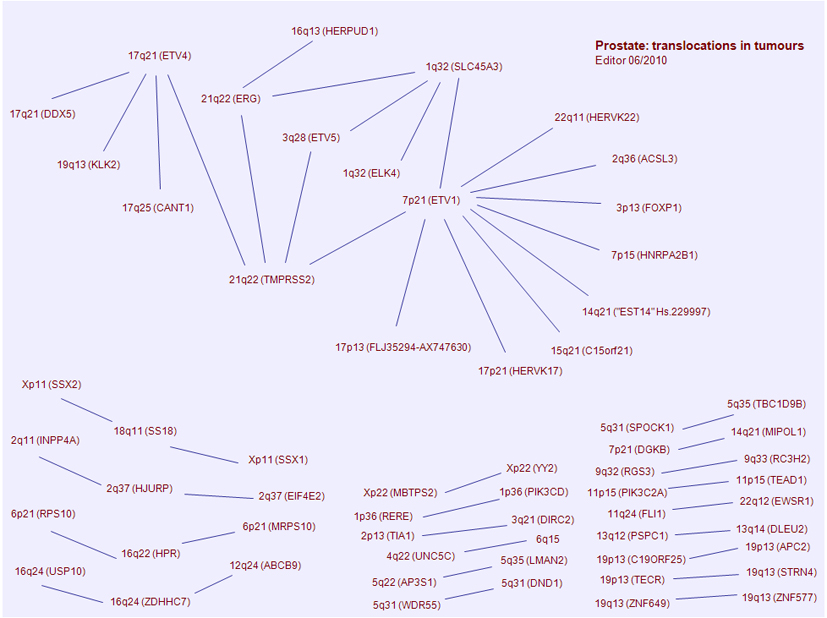
CGH (comparative genomic hybridization) was used to identify gains or losses of chromosomal regions. The most common alterations include chromosome 8 (23%) and chromosome 7 (20%). The most commonly reported are gains of 2p, 3q, 7q, 8q, 9q, 17q, 20q, and Xq, deletions of 2q, 5q, 6q, 8p, 10q, 12p, 13q, 16q, 17p, 17q, 18q, 21q, and 22q, hyperdiploidy, and aneusomy of chromosomes 7 and 17.
Outlier profile analysis was used to identify the TMPRSS2-ERG fusion as the single most prevalent gene fusion in prostate cancer (>60%) on 21q22. TMPRSS2 encodes for the androgen-activated transmembrane protease serine 2 and ERG encodes a member of the ETS transcription factor. Other gene fusions have been found with ETS genes (including ERG, ETV1, ETV4, and ETV5) involving different 5 partners (~10%): TMPRSS2 (t(7;21)(p21;q22)), SLC45A3 (t(1;7)(q32;p21.2)), ACSL3 (t(2;7)(q36.1;p21.2)), HERV-K (t(7;22)(p21.2;q11.23)), FLJ35294 (t(7;17)(p21.2;p13.1)), FOXP1 (t(3;7)(p13;p21)), EST14 (t(7;14)(p21;q21)), C15orf21 (t(7;15)(p21.3;q21)), and HNRPA2B1 (t(7;7)(p21.2;p15)) for ETV1; TMPRSS2 (t(17;21)(q21;q22)), KLK2 (t(17;19)(q21;q13)), CANT1 (inv(17;17)(q22;q25)) and DDX5 (t(17;17)(q24;q21)) for ETV4; TMPRSS2 (t(3;21)(q28;q22)) or SLC45A3 (t(1;3)(q32;q28)) for ETV5. TMPRSS2-ERG fusions may occur as an early event in the development of prostate cancer, but the gene fusion is not sufficient to cause cancer formation by itself. The prognostic significance of the TMPRSS2-ERG fusion and other ETS rearrangements in prostate cancer is still controversial. Integrative genomic profiling was used to identify a narrow deletion on 3p14 is highly associated with TMPRSS2-ERG fusion-positive tumors. PTEN loss is also associated with the presence of the fusion gene TMPRSS2-ERG.
For more details on the fusion gene TMPRSS2-ERG, see the section Deep insight: TMPRSS2:ETS gene fusions in prostate cancer.
Genetics
Note
Genes Involved and Proteins
Note
Gene name
Location
Protein description
Somatic mutations
The AR plays a role of a dominant oncogene in castration-resistant prostate cancer. AR gene amplification has been recovered in ~30% of CRPC. AR is also activated by missense mutations (frequencies of 10-30%) that modify the scope of hormone specificity and/or enhance hormonal response. Activation of AR in androgen-independent disease may also be accomplished by activation of co-regulators that interact with AR to activate gene transcription. Another potential AR activation mechanism is a ligand-independent activation by growth-factors or cytokines. Several structurally different AR variants with divergent biologic activity recently identified could emerge as a primary cause of resistance to androgens. All of those variants required full-length AR through dimerisation to activate endogenous AR target genes and confer castration-resistant growth.
Gene name
Location
Protein description
Germinal mutations
Somatic mutations
Gene name
Location
Protein description
Somatic mutations
In mouse, concomitant inactivation of PTEN and CDKN1B accelerates spontaneous neoplastic transformation and incidence of tumors.
Gene name
Location
Protein description
Somatic mutations
Gene name
Location
Protein description
The KLK3 protein is commonly known as the Prostate-Specific Antigen (PSA) which is the most acceptable and broadly used cancer biomarker. Serum level of PSA in the clinical setting is useful in the diagnosis and monitoring of prostatic carcinoma.
Gene name
Location
Protein description
Somatic mutations
Gene name
Location
Protein description
Somatic mutations
The locus at 8q24 was identified as a major susceptibility locus in several large-scale genome-wide association studies of prostate cancer as well as other epithelial cancers. Experiments with mouse models of prostate cancer provided strong causal connection between the overexpression of MYC and the development of prostate cancer.
Gene name
Location
Protein description
Germinal mutations
Somatic mutations
Nkx3.1 has been shown to be a critical regulator of prostate epithelial differentiation and stem cell function in mouse models. NKX3.1 represents a haploinsufficient tumor suppressor gene that acts as a gatekeeper gene for prostate cancer initiation.
Gene name
Location
Protein description
Gene name
Location
Protein description
Somatic mutations
PTEN loss is associated with the presence of the fusion gene TMPRSS2-ERG.
Article Bibliography
| Pubmed ID | Last Year | Title | Authors |
|---|---|---|---|
| 20116997 | 2010 | Estimates of cancer incidence and mortality in Europe in 2008. | Ferlay J et al |
| 21351269 | 2010 | Estimates of worldwide burden of cancer in 2008: GLOBOCAN 2008. | Ferlay J et al |
| 20555062 | 2010 | Prostate cancer: ESMO Clinical Practice Guidelines for diagnosis, treatment and follow-up. | Horwich A et al |
| 20690139 | 2011 | Meta-analysis of genome-wide and replication association studies on prostate cancer. | Liu H et al |
| 18657973 | 2008 | Counseling for male BRCA mutation carriers: a review. | Mohamad HB et al |
| 20104229 | 2010 | Molecular characterisation of ERG, ETV1 and PTEN gene loci identifies patients at low and high risk of death from prostate cancer. | Reid AH et al |
| 20844012 | 2010 | Molecular genetics of prostate cancer: new prospects for old challenges. | Shen MM et al |
| 20644256 | 2010 | Castration resistance in human prostate cancer is conferred by a frequently occurring androgen receptor splice variant. | Sun S et al |
| 20823238 | 2010 | Constitutively active androgen receptor splice variants expressed in castration-resistant prostate cancer require full-length androgen receptor. | Watson PA et al |
| 16397218 | 2006 | Germ-line mutation of NKX3.1 cosegregates with hereditary prostate cancer and alters the homeodomain structure and function. | Zheng SL et al |
Citation
Anne Chauchereau ; Safae Aarab-Terrisse
Prostate tumors: an overview
Atlas Genet Cytogenet Oncol Haematol. 2011-07-01
Online version: http://atlasgeneticsoncology.org/solid-tumor/5041/prostate-tumors-an-overview
