Kidney: Renal cell carcinoma with t(X;17)(p11;q23) CLTC/TFE3
2016-08-01 Pedram Argani , Marc Ladanyi Affiliation1.Department of Pathology, The Johns Hopkins Hospital, Baltimore MD (PA) [email protected].
Abstract
Review on Renal cell carcinoma with t(X;17)(p11;q23) CLTC/TFE3, with data on clinics, and the genes involved.
Classification
Classification
Clinics and Pathology
Etiology
Epidemiology
Pathology
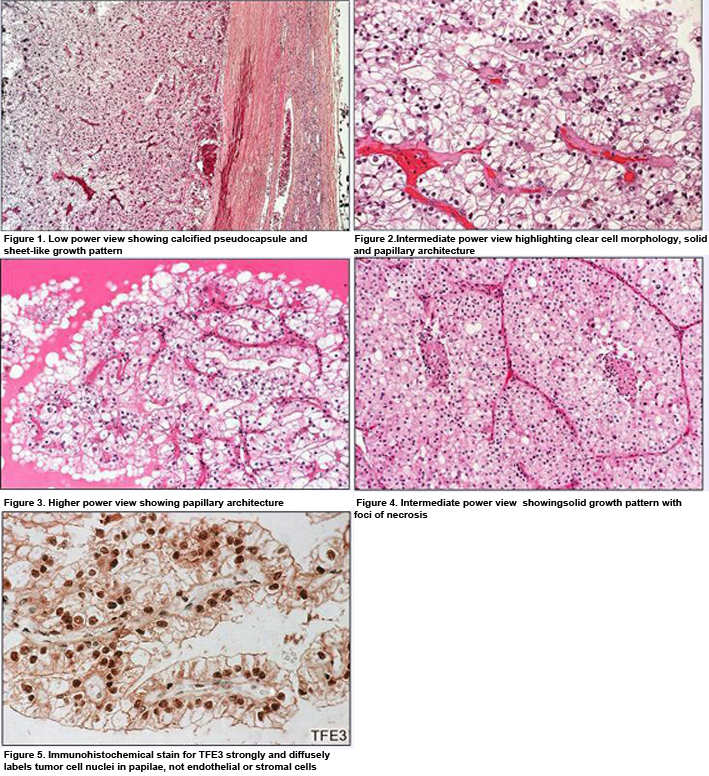
Immunohistochemical (IHC) analysis showed strong and diffuse nuclear labeling with a polyclonal antibody to the TFE3 C-terminal portion, as seen in other tumors associated with TFE3 gene fusions. Since native TFE3 protein is not detectable in non-neoplastic cells by the same assay, this finding is consistent with constitutive expression of a nuclear fusion protein containing the TFE3 C-terminal portion, such as the predicted CLTC-TFE3 protein. Like most conventional (clear cell) and papillary RCCs, the tumor contained tumor cells were strongly and diffusely immunoreactive for CD10, showing strong cytoplasmic staining with membranous accentuation. However, unlike most typical adult RCCs, IHC with all cytokeratin antibodies (Cam5.2, AE1/3, Cytokeratin 7) and the "RCC" monoclonal antibody yielded negative reactions, though tumor cells did label in one isolated area for Epithelial Membrane Antigen (EMA). Underexpression of common epithelial proteins is a typical feature of Xp11.2-translocation carcinomas. Surprisingly, the tumor was focally immunoreactive for the melanocytic proteins Melan-A and HMB45 but IHC assays for MiTF and S100 protein were negative. While unusual, the immunoreactivity for melanocytic markers can be seen in Xp11 translocation carcinomas.
Treatment
Prognosis
Genes Involved and Proteins
Note
Gene name
Location
Dna rna description
Protein description
TFE3, TFEB, TFEC and Mitf comprise the members of the microphthalmia transcription factor subfamily, which have homologous DNA binding domains and can bind to a common DNA sequence. These four transcription factors may homo- or heterodimerize to bind DNA, and they may have functional overlap.
Gene name
Location
Note
Result of the chromosomal anomaly
Description
Highly cited references
| Pubmed ID | Year | Title | Citations |
|---|---|---|---|
| 25048860 | 2014 | Molecular genetics and cellular features of TFE3 and TFEB fusion kidney cancers. | 107 |
| 12917640 | 2003 | A novel CLTC-TFE3 gene fusion in pediatric renal adenocarcinoma with t(X;17)(p11.2;q23). | 0 |
| 23224603 | 2012 | A renal epithelioid angiomyolipoma/perivascular epithelioid cell tumor with TFE3 gene break visualized by FISH. | 0 |
| 19563413 | 2009 | Adult-onset renal cell carcinoma associated with Xp11.2 translocations/TFE3 gene fusion with smooth muscle stroma and abnormal vessels. | 0 |
Article Bibliography
| Pubmed ID | Last Year | Title | Authors |
|---|
Citation
Pedram Argani ; Marc Ladanyi
Kidney: Renal cell carcinoma with t(X;17)(p11;q23) CLTC/TFE3
Atlas Genet Cytogenet Oncol Haematol. 2016-08-01
Online version: http://atlasgeneticsoncology.org/solid-tumor/5035/kidney-renal-cell-carcinoma-with-t(x;17)(p11;q23)-cltc-tfe3
Historical Card
2005-04-01 Kidney: Renal cell carcinoma with t(X;17)(p11;q23) CLTC/TFE3 by Pedram Argani,Marc Ladanyi Affiliation
