Head and Neck: Pleomorphic salivary gland adenoma with inv(8)(q12q12) CHCHD7/PLAG1
2007-04-01 Julia Asp , Goran Stenman Affiliation1.Molecular Cell Biology, Regenerative Medicine, Department of Clinical Chemistry, Transfusion Medicine, Institute of Biomedicine, Bruna Straket 16, Sahlgrenska University Hospital, 413 45 Goteborg, Sweden.
Clinics and Pathology
Cytogenetics
inv(8)(q12.1;q12.1)
Genes Involved and Proteins
Gene name
CHCHD7 (coiled-coil-helix-coiled-coil-helix domain containing 7)
Location
8q12.1
Dna rna description
The gene spans about 7 kb and includes 5 exons. Six isoforms of RNA, spliced with or without exon 2, exist with transcript sizes ranging from 1575 bp to 1767 bp.
Protein description
The protein contains a conserved CHCH domain and is included in a multifamily of proteins which show a strong conservation at the structural level but a low conservation at the amino acid level.
Gene name
PLAG1 (Pleomorphic adenoma gene 1)
Location
8q12.1
Dna rna description
The gene spans 50 kb and includes 5 exons. The size of the transcript is about 7.3 kb. Two splicing forms of RNA have been found, with or without exon 2.
Protein description
500 amino acids (aa), 74 kDa. The gene encodes a zinc finger protein with two putative nuclear localization signals. It contains a conserved SFP1 domain (aa 58-139), which is a putative transcriptional repressor regulating G2/M transition.
Result of the chromosomal anomaly
Note
The two genes CHCHD7 and PLAG1 are located head-to-head about 500 bp apart in 8q12. The fusion results from a cryptic, paracentric inversion.
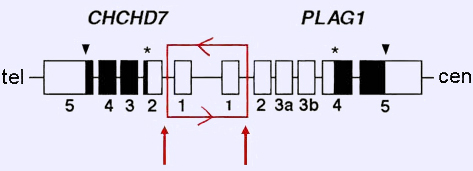
Map of the 8q12 region including the CHCHD7 and PLAG1 genes (not drawn to scale). Exons are shown as boxes and the start and stop codons are shown as asterisks and arrowheads, respectively. Breakpoints are shown in red. Reprinted partially from publication CHCHD7-PLAG1 and TCEA1-PLAG1 gene fusions resulting from cryptic, intrachromosomal 8q rearrangements in pleomorphic salivary gland adenomas, Genes Chromosomes Cancer, Vol. 45, No. 9, 2006, 820-828. Copyright 2006 Wiley-Liss, Inc. Reprinted with permission of Wiley-Liss, Inc..
Description
The CHCHD7-PLAG1 fusion transcript is formed by fusion of exon 1 of CHCHD7 to exon 2 or 3 of PLAG1.
Detection protocole
RT-PCR using total RNA extracted from frozen tumor tissue. The CHCHD7-PLAG1 gene fusion was detected by amplification of cDNA using the primers CHCHD22S, 5-GTGAGCCATTGACGTGTTTG-3 located in exon 1 of CHCHD7, and PLAG564AS, 5-GGTTTCACCACGCTTACGTT3 located in exon 4 of PLAG1. Fusion transcripts of 467 and 362 bp were detected.
Description
Exon 1 of CHCHD7 fused to either exon 2 or 3 of PLAG1 results in a promoter swapping where the intact coding region of PLAG1 is expressed from a different promoter.
Expression localisation
Nucleus.
Article Bibliography
| Pubmed ID | Last Year | Title | Authors |
|---|---|---|---|
| 16736500 | 2006 | CHCHD7-PLAG1 and TCEA1-PLAG1 gene fusions resulting from cryptic, intrachromosomal 8q rearrangements in pleomorphic salivary gland adenomas. | Asp J et al |
| 4009321 | 1985 | Salivary gland tumours. A review of 2410 cases with particular reference to histological types, site, age and sex distribution. | Eveson JW et al |
| 9020842 | 1997 | Promoter swapping between the genes for a novel zinc finger protein and beta-catenin in pleiomorphic adenomas with t(3;8)(p21;q12) translocations. | Kas K et al |
| 15826837 | 2005 | Fusion oncogenes and tumor type specificity--insights from salivary gland tumors. | Stenman G et al |
| 15177562 | 2004 | C2360, a nuclear protein expressed in human proliferative cytotrophoblasts, is a representative member of a novel protein family with a conserved coiled coil-helix-coiled coil-helix domain. | Westerman BA et al |
Citation
Julia Asp ; Goran Stenman
Head and Neck: Pleomorphic salivary gland adenoma with inv(8)(q12q12) CHCHD7/PLAG1
Atlas Genet Cytogenet Oncol Haematol. 2007-04-01
Online version: http://atlasgeneticsoncology.org/solid-tumor/5431/head-and-neck-pleomorphic-salivary-gland-adenoma-with-inv(8)(q12q12)-chchd7-plag1
