Testis: Spermatocytic seminoma
2012-12-01 Ewa Rajpert-De Meyts Affiliation1.Department of Growth, Reproduction, Copenhagen University Hospital, Rigshospitalet, Section GR-5064, 9 Blegdamsvej, DK-2100 Copenhagen, Denmark
Summary
Note
Spermatocytic seminoma is a rare testicular neoplasm derived from mature germ cells (spermatogonia). This tumour was first distinguished from classical seminoma by Masson (Masson, 1946). This tumour occurs exclusively in the testes, in relatively older men. There is no female (ovarian) equivalent.
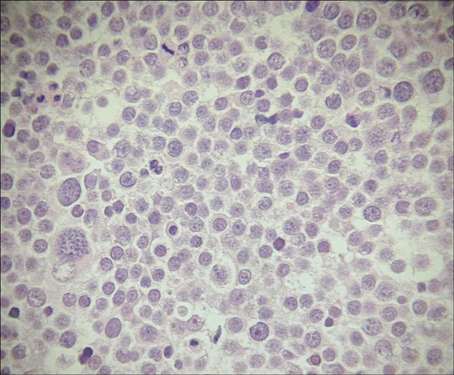
An example of spermatocytic seminoma, HE-stained.
Classification
Note
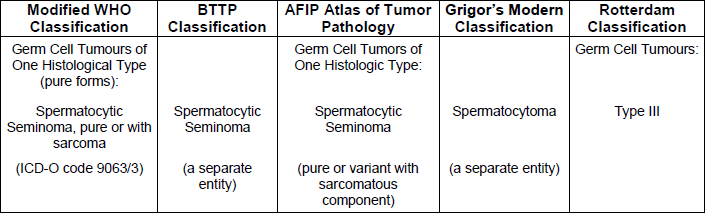
Classification of germ cell tumours (GCT) has not been adapted uniformly in the world. Two classifications most commonly used in the past were the modified WHO classification and the British Testicular Panel (BTTP) classification (Collins and Pugh, 1964). WHO has updated its classification in 2004 but spermatocytic seminoma remains classified together with other testicular GCT (Eble et al., 2004). In 1993, Grigor proposed a new classification based on biological features, and listed this tumour as a separate entity named spermatocytoma to distinguish it better from the classical seminoma (Grigor, 1993). In the Atlas of Tumor Pathology of Armed Forces Institute of Pathology (AFIP) a modified classification of testicular and paratesticular tumours and tumour-like lesions was suggested, where spermatocytic seminoma is also listed separately (Ulbright et al., 1999). More recently, a research team from the Erasmus University in Rotterdam proposed a new classification of GCT that comprises entire body, in men and women, and classified spermatocytic seminoma as a separate type III GCT (Oosterhuis and Looijenga, 2005). Spermatocytic seminoma is classified in these five systems as follows:
Clinics and Pathology
Note
Spermatocytic seminoma is a rare germ cell tumour (GCT) that occurs only in the testis of older men.
Phenotype stem cell origin
The origin of spermatocytic seminoma from the germ cell lineage has been clearly demonstrated by a number of studies, however the stage of germ cell maturation from which the tumour originates has been a matter of debate (Eble, 1994; Rajpert-De Meyts et al., 2003; Looijenga et al., 2007; Waheeb and Hofmann, 2011). The initial hypothesis suggested that the spermatocyte was the progenitor cell (Masson, 1946 ; Rosai et al., 1969). This hypothesis was supported by the subsequent studies of the Rotterdam group, which demonstrated in spermatocytic seminoma the expression of genes involved in the first step of meiosis (Looijenga et al., 2006; Looijenga et al., 2007). Other hypotheses, mainly based on comparative immunoprofiles, stipulated that spermatocytic seminoma might originate from type B spermatogonia (Romanenko and Persidskii, 1983; Rajpert-De Meyts et al., 2003). More recent studies support the origin from spermatogonia, both A and B, based on the discovery in the tumour of activating mutations in FGFR3 (Goriely et al., 2009), a gene encoding a receptor which in the testis is expressed in spermatogonia (Juul et al., 2007; von Kopylow et al., 2010). Recently, a small subset of spermatocytic seminomas expressing OCT2 and likely derived from A-dark spermatogonia (stem spermatogonia) was detected (Lim et al., 2011).
The expression of some proteins linked to the iniation of meiosis in spermatocytic seminoma is explained by the marked plasticity of malignant germ cells, which are capable of partial maturation towards primary spermatocyte but are unable to truly enter or complete meiosis (Lim et al., 2011).
Spermatocytic seminoma begins as intratubular clump of cells, which gradually spread inside seminiferous tubules and finally break into the interstitial compartment (Eble, 1994).
The expression of some proteins linked to the iniation of meiosis in spermatocytic seminoma is explained by the marked plasticity of malignant germ cells, which are capable of partial maturation towards primary spermatocyte but are unable to truly enter or complete meiosis (Lim et al., 2011).
Spermatocytic seminoma begins as intratubular clump of cells, which gradually spread inside seminiferous tubules and finally break into the interstitial compartment (Eble, 1994).
Embryonic origin
Spermatocytic seminoma is not of embryonic origin and is not derived from carcinoma in situ, the gonocyte-like intratubular precursor lesion for germ cell tumours of adolescents and young adults (Muller et al., 1987).
Etiology
Based on the presumed origin of spermatocytic seminoma from mature (postpubertal) germ cells, it has been hypothesised that the increased proliferation of these cells causes the growth of the tumours, but the etiology has long been unknown. Molecular cytogenetic analysis postulated that an amplification of a locus on chromosome 9, with the DMRT1 locus as the candidate gene could be involved (Looijenga et al., 2006). Subsequently, a targeted molecular analysis of a series of spermatocytic seminomas for the presence of mutations in genes which had been previously linked to paternal-age-effect disorders, revealed activating mutations in FGFR3 or HRAS in about 25% of tumour specimens (Goriely et al., 2009). This finding suggested that random mutational events may occur in spermatogonia and accumulate with age, leading to a selective proliferation of cells with mutations that give them growth or survival advantage and eventually to tumour formation (Goriely and Wilkie, 2012).
Epidemiology
Spermatocytic seminoma is rare and represents less than 1% of primary germ cell tumours in the testis. In comparison to classical seminoma this tumour is about 20-25 times less common (Eble, 1994). Reported age at diagnosis ranges from 19 to 92, with a median age of 54 years (Carrière et al., 2007).
Clinics
Pure spermatocytic seminoma has a relatively mild clinical course. Most patients present with a painless swelling of one testis, but in some cases tenderness was reported. Bilateral presence of spermatocytic seminoma is not uncommon (Looijenga et al., 2007). Metastases are very rare and have been reported nearly only in cases with sarcomatous transformation (see Evolution).
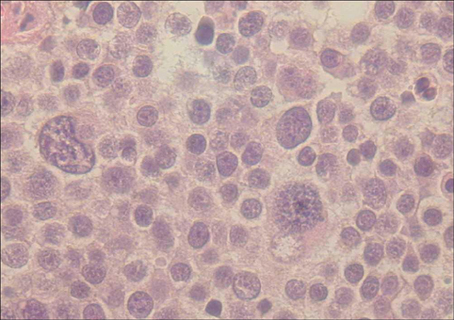
A high power image showing characteristic polymorphism of the cell nucleus size of spermatocytic seminoma.
Cytology
A characteristic feature of spermatocytic seminoma is a great variablity of the cell size, so the tumour cells are roughly divided into three types according to the nuclear size: large, intermediate and small (Masson, 1946; Eble, 1994). Some nuclei may exhibit a presence of thread-like chromatin.
Pathology
In gross appearance spermatocytic seminomas consist of light greyish soft tissue, usually easily separable from the normal testis parenchyma but some tumours seem composed of smaller nodules. In rare instances, the pre-invasive intratubular spermatocytic seminoma can be detected (Eble, 1994).
There is no specific immunocytological marker for spermatocytic seminoma. Genes/antigens that are highly expressed in spermatogonia (some of them also present either in primary spermatocytes or in gonocytes), are usually detected in spermatocytic seminoma. The so-called cancer-testis antigens are highly expressed in spermatocytic seminomas, both at the transcript and protein level: SSX1, SSX2, SSX3, SSX4 (Stoop et al., 2001; Lim et al., 2011), MAGE-A4 (Aubry et al., 2001), NY-ESO-1/CTAG1A (Satie et al., 2002), GAGE4 (Looijenga et al., 2006), SAGE1 (Looijenga et al., 2006; Lim et al., 2011). Other proteins were described mainly in the studies by Stoop et al. 2001, Rajpert-De Meyts et al. 2003, and Looijenga et al. 2006; and include, among others: SYCP1, NSE (neuron-specific enolase), CHK2, VASA, DMRT1 (Looijenga et al., 2007), FGFR3 or HRAS (Goriely et al., 2009), (reviewed by Waheeb and Hofmann, 2011). Recently, a subset of spermatocytic seminomas that express OCT2, a marker of stem spermatogonia in the testis, was detected (Lim et al., 2011).
Genes expressed in embryonic germ cells and gonocytes as well as in classical seminoma and embryonal carcinoma, but not in the normal adult testis, e.g. OCT4, NANOG or PLAP (placental-like alkaline phosphatase), are usually undetectable in spermatocytic seminoma (Dekker et al., 1992; Kraggerud et al., 1999; Rajpert-De Meyts et al., 2003; Looijenga et al., 2007). Likewise, proteins highly abundant in post-meiotic spermatids, e.g. p19INK4d, are not present in spermatocytic seminoma. High expression of p53 protein in a subset of cells was demonstrated in approximately 80% of cases. The expression of telomerase (the RNA component) in spermatocytic seminoma was found to be moderate: lower than in classical seminomas but higher than in mature teratomas (Delgado et al., 1999).
In differential diagnosis, spermatocytic seminoma has to be distinguised from classical seminoma, pure embryonal carcinoma and testicular lymphoma (Eble, 1994; Looijenga et al., 2007; Lim et al., 2011).
There is no specific immunocytological marker for spermatocytic seminoma. Genes/antigens that are highly expressed in spermatogonia (some of them also present either in primary spermatocytes or in gonocytes), are usually detected in spermatocytic seminoma. The so-called cancer-testis antigens are highly expressed in spermatocytic seminomas, both at the transcript and protein level: SSX1, SSX2, SSX3, SSX4 (Stoop et al., 2001; Lim et al., 2011), MAGE-A4 (Aubry et al., 2001), NY-ESO-1/CTAG1A (Satie et al., 2002), GAGE4 (Looijenga et al., 2006), SAGE1 (Looijenga et al., 2006; Lim et al., 2011). Other proteins were described mainly in the studies by Stoop et al. 2001, Rajpert-De Meyts et al. 2003, and Looijenga et al. 2006; and include, among others: SYCP1, NSE (neuron-specific enolase), CHK2, VASA, DMRT1 (Looijenga et al., 2007), FGFR3 or HRAS (Goriely et al., 2009), (reviewed by Waheeb and Hofmann, 2011). Recently, a subset of spermatocytic seminomas that express OCT2, a marker of stem spermatogonia in the testis, was detected (Lim et al., 2011).
Genes expressed in embryonic germ cells and gonocytes as well as in classical seminoma and embryonal carcinoma, but not in the normal adult testis, e.g. OCT4, NANOG or PLAP (placental-like alkaline phosphatase), are usually undetectable in spermatocytic seminoma (Dekker et al., 1992; Kraggerud et al., 1999; Rajpert-De Meyts et al., 2003; Looijenga et al., 2007). Likewise, proteins highly abundant in post-meiotic spermatids, e.g. p19INK4d, are not present in spermatocytic seminoma. High expression of p53 protein in a subset of cells was demonstrated in approximately 80% of cases. The expression of telomerase (the RNA component) in spermatocytic seminoma was found to be moderate: lower than in classical seminomas but higher than in mature teratomas (Delgado et al., 1999).
In differential diagnosis, spermatocytic seminoma has to be distinguised from classical seminoma, pure embryonal carcinoma and testicular lymphoma (Eble, 1994; Looijenga et al., 2007; Lim et al., 2011).
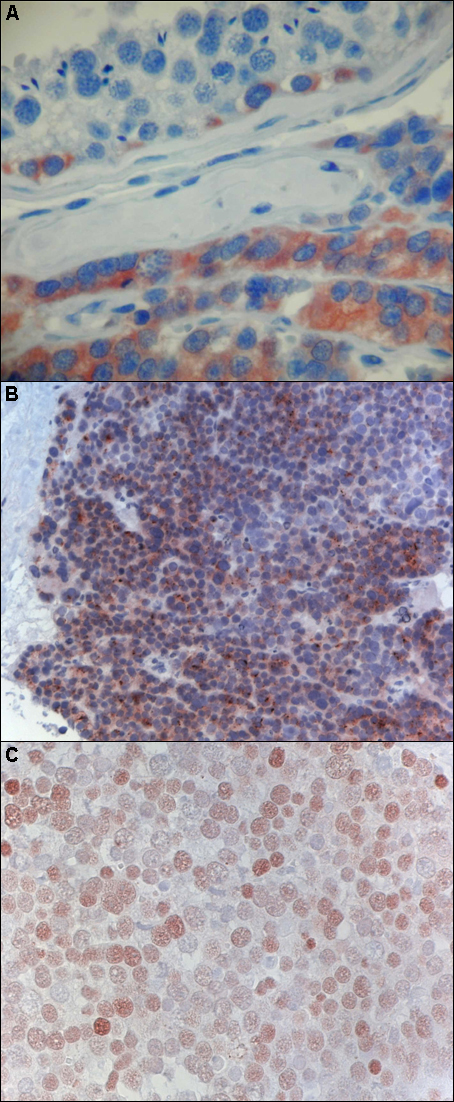
A. MAGE-A4 antigen is abundant is spermatocytic seminoma (visible in a lower part of the picture). Note that MAGE-A4 is also present in normal spermatogonia (visible in the upper part) (from Rajpert-De Meyts et al., Histopathology, 2003). B. Immunohistochemical expression of FGFR3 in a sample of spermatocytic seminoma with a mutation in the FGFR3 gene (Goriely et al., 2009). C. Heterogeneous nuclear expression of the HRAS protein in a spermatocytic seminoma (Goriely et al., 2009).
Treatment
Spermatocytic seminoma is treated by surgery (orchiectomy) alone followed by surveillance. The recurrence is extremely rare.
Evolution
Some cases of spermatocytic seminoma may undergo sarcomatous transformation and spread outside the testis (Floyd et al., 1988).
Prognosis
Sarcomatous differentiation is a very serious complication, often resulting in death (Eble, 1994).
Cytogenetics
Cytogenetics molecular
The first molecular study of four spermatocytic seminomas by comparative genomic hybridisation (CGH) reported a gain of chromosome 9, and less consistent gains of chromosomes 1 and 20, and loss of chromosome 22 material (Rosenberg et al., 1998). The specific gain of chromosome 9, in one tumour restricted to a region in 9p, was subsequently confirmed by the same group, suggesting the involvement of DMRT1 (Looijenga et al., 2006).
Genetics
Note
Very few genetic studies of spermatocytic seminomas have been performed, due to the rarity of this tumour. Only one consistent amplification in chromosome 9p was reported (Looijenga et al., 2006). More recent genetic study using parallel sequencing identified activating somatic mutations (in tumour DNA) in two genes, which are physiologically connected to each other; FGFR3 (1948A>G), detected in 2/26 samples, and HRAS (181C>A and 182A>G, QK650E), detected in 5/26 spermatocytic seminomas (Goriely et al., 2009). These mutations - if occuring somatically - are oncogenic and have been linked to other cancers, e.g. bladder cancer. If these mutations are transmitted in germline - they cause severe, often lethal skeletal abnormalities, e.g. thanatophoric dysplasia or Costello syndrome. Milder ligand-dependent mutations in FGFR3 can cause achondroplasia. All FGFR3 and HRAS mutations identified in spermatocytic seminoma were homozygous and present in significantly older men than the average age of diagnosis, consistent with the paternal age-effect mutations (Goriely et al., 2009).
Genes Involved and Proteins
Gene name
DMRT1 (doublesex and mab-3 related transcription factor 1)
Location
9p24.3
Note
A transcription factor involved in sex differentiation, germ cell maturation and meiosis regulation.
Protein description
Contains a zinc finger-like DNA-binding motif (DM domain).
Gene name
FGFR3 (Fibroblast Growth Factor Receptor 3)
Location
4p16.3
Note
A member of the FGF receptor family, can bind at least 20 different factors and numerous modulating co-factors.
Protein description
Receptor with tyrosine kinase activity.
Gene name
HRAS (Harvey rat sarcoma viral oncogene homolog)
Location
11p15.5
Note
A classical proto-oncogene, involved in signal transduction of several pathways.
Protein description
Can bind GTP/GDP or have GTPase activity.
Article Bibliography
| Pubmed ID | Last Year | Title | Authors |
|---|---|---|---|
| 11753951 | 2001 | MAGE-A4, a germ cell specific marker, is expressed differentially in testicular tumors. | Aubry F et al |
| 17499277 | 2007 | Population based incidence and age distribution of spermatocytic seminoma. | Carrière P et al |
| 14184707 | 1964 | CLASSIFICATION AND FREQUENCY OF TESTICULAR TUMOURS. | COLLINS DH et al |
| 1310437 | 1992 | Placental-like alkaline phosphatase and DNA flow cytometry in spermatocytic seminoma. | Dekker I et al |
| 10547554 | 1999 | Expression of the RNA component of human telomerase in adult testicular germ cell neoplasia. | Delgado R et al |
| 7927308 | 1994 | Spermatocytic seminoma. | Eble JN et al |
| 3334976 | 1988 | Spermatocytic seminoma with associated sarcoma of the testis. | Floyd C et al |
| 19855393 | 2009 | Activating mutations in FGFR3 and HRAS reveal a shared genetic origin for congenital disorders and testicular tumors. | Goriely A et al |
| 22325359 | 2012 | Paternal age effect mutations and selfish spermatogonial selection: causes and consequences for human disease. | Goriely A et al |
| 8386662 | 1993 | A new classification of germ cell tumours of the testis. | Grigor KM et al |
| 17554105 | 2007 | Preserved fertility in a non-mosaic Klinefelter patient with a mutation in the fibroblast growth factor receptor 3 gene: case report. | Juul A et al |
| 10223302 | 1999 | Spermatocytic seminoma as compared to classical seminoma: an immunohistochemical and DNA flow cytometric study. | Kraggerud SM et al |
| 21706474 | 2011 | OCT2, SSX and SAGE1 reveal the phenotypic heterogeneity of spermatocytic seminoma reflecting distinct subpopulations of spermatogonia. | Lim J et al |
| 17573843 | 2007 | Genomic and expression profiling of human spermatocytic seminomas: pathogenetic implications. | Looijenga LH et al |
| 20291001 | 1946 | [Study on the semome]. | MASSON P et al |
| 3583416 | 1987 | The spermatocytic seminoma: views on pathogenesis. | Müller J et al |
| 15738984 | 2005 | Testicular germ-cell tumours in a broader perspective. | Oosterhuis JW et al |
| 12605640 | 2003 | The immunohistochemical expression pattern of Chk2, p53, p19INK4d, MAGE-A4 and other selected antigens provides new evidence for the premeiotic origin of spermatocytic seminoma. | Rajpert-De Meyts E et al |
| 6880135 | 1983 | [Ultrastructure and histogenesis of spermatocytic seminoma]. | Romanenko AM et al |
| 5790295 | 1969 | Spermatocytic seminoma. I. Clinicopathologic study of six cases and review of the literature. | Rosai J et al |
| 9824200 | 1998 | Chromosomal constitution of human spermatocytic seminomas: comparative genomic hybridization supported by conventional and interphase cytogenetics. | Rosenberg C et al |
| 12065688 | 2002 | The cancer-testis gene, NY-ESO-1, is expressed in normal fetal and adult testes and in spermatocytic seminomas and testicular carcinoma in situ. | Satie AP et al |
| 11454979 | 2001 | Reactivity of germ cell maturation stage-specific markers in spermatocytic seminoma: diagnostic and etiological implications. | Stoop H et al |
| 6471811 | 1984 | Spermatocytic seminoma. Ultrastructural and microspectrophotometric observations. | Talerman A et al |
| 21790653 | 2011 | Human spermatogonial stem cells: a possible origin for spermatocytic seminoma. | Waheeb R et al |
| 20208059 | 2010 | Screening for biomarkers of spermatogonia within the human testis: a whole genome approach. | von Kopylow K et al |
Citation
Ewa Rajpert-De Meyts
Testis: Spermatocytic seminoma
Atlas Genet Cytogenet Oncol Haematol. 2012-12-01
Online version: http://atlasgeneticsoncology.org/solid-tumor/5119/testis-spermatocytic-seminoma
Historical Card
2003-11-01 Testis: Spermatocytic seminoma by Ewa Rajpert-De Meyts Affiliation
Department of Growth, Reproduction, Copenhagen University Hospital, Rigshospitalet, Section GR-5064, 9 Blegdamsvej, DK-2100 Copenhagen, Denmark
