Bone: Chondrosarcoma
2002-03-01 Judith VMG Bovée Affiliation1.Afdeling Pathologie, Leids Universitair Medisch Centrum, Postbus 9600, L1-Q, 2300 RC Leiden, the Netherlands
Summary
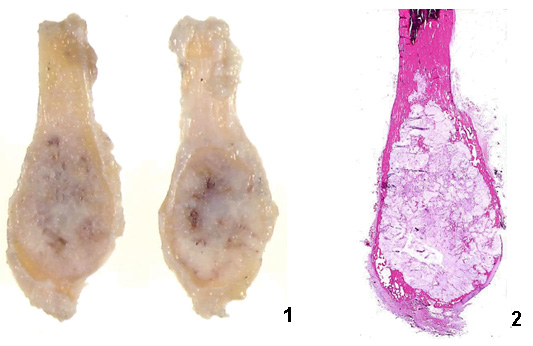
Figure 1: En bloc resection specimen of the proximal fibula of a 43 year old female, containing a lobulated bluish white, translucent tumour (4.5 x 2 x 1.9 cm) located centrally within the medullary cavity, consistent with central chondrosarcoma
Figure 2: Corresponding macro-slice showing a lobular architecture, and endosteal cortical thinning. Cytonucle ar appearance can be more readily appreciated in figure 3
Figure 2: Corresponding macro-slice showing a lobular architecture, and endosteal cortical thinning. Cytonucle ar appearance can be more readily appreciated in figure 3
Classification
Note
approximately 90% of chondrosarcomas are histologically of the conventional type; in addition to conventional chondrosarcoma, some rare variants with distinctive microscopic and clinical features are discerned: clear cell chondrosarcoma (1%), mesenchymal chondrosarcoma (2%), juxtacortical chondrosarcoma (2%) and extra-skeletal myxoid chondrosarcoma (5%). Furthermore, dedifferentiated chondrosarcoma is a relatively rare high grade sarcoma next to a low-grade conventional malignant cartilage-forming tumor, comprising 6-10% of all chondrosarcomas. Conventional chondrosarcomas can be categorized according to their location in bone. The majority of chondrosarcomas (75%) are located centrally within the medullary cavity (central chondrosarcoma), a small percentage of which arise within a preexisting benign precursor (enchondroma). While most enchondromas are solitary, patients with Olliers disease and Maffuccis syndrome demonstrate multiple enchondromas.A minority (15%) of chondrosarcomas develops from the surface of bone (peripheral chondrosarcoma) as a result of malignant transformation within the cartilaginous cap of a solitary or hereditary pre-existent osteochondroma.
Clinics and Pathology
Epidemiology
primary malignant bone tumours occur 1/100,000, of which 17-24% consists of chondrosarcoma; the majority of patients are between 35 and 60 years old with equal sex distribution
Clinics
compared to benign cartilaginous tumours, chondrosarcomas more frequently present with pain and tenderness; they usually develop in the trunk, pelvis and long bones.
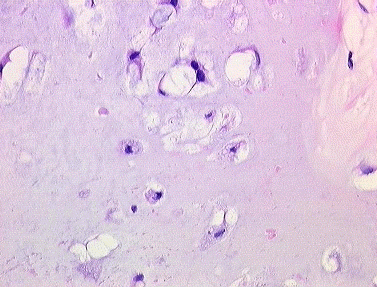
Figure 3: Micrograph displaying low cellularity with limited cytonuclear atypia, and a high amount of chondroid matrix surrounding tumor cells consistent with a grade I chondrosarcoma. Note the presence of a binucleated cell
Pathology
There are no apparent cytonuclear differences between central and peripheral conventional chondrosarcomas and both are histologically classified into three grades using the criteria of Evans et al. Grade I chondrosarcomas demonstrate low cellularity, limited cytonuclear atypia, few multinucleated cells, a mainly chondroid matrix and the absence of mitoses; Grade II chondrosarcomas demonstrate increased cellularity, and increased muco-myxoid degeneration of the matrix. There is moderate cytonuclear atypia and occasional mitoses are found. Grade III chondrosarcomas are highly cellular, with nuclear polymorphism, mitoses and a mostly myxoid matrix; Increasing histological grade is correlated with higher metastatic potential; it is considered difficult to assess the histological grade of cartilaginous tumours and to reliably distinguish between benign tumours and those of low-grade malignancy.
Treatment
because chondrosarcoma is highly resistant to chemotherapy and radiotherapy, surgical treatment is the only option for curative treatment
Evolution
the majority of central chondrosarcomas are considered to arise de novo and malignant transformation of solitary enchondroma is extremely rare (
Prognosis
metastasis in chondrosarcoma highly depends on the histological grade of malignancy; grade I chondrosarcomas demonstrate local recurrence, but seldom metastasize; grade II chondrosarcomas demonstrate metastases in 10-30% of the cases, whereas grade III chondrosarcomas demonstrate metasases in the majority of cases. In contrast to chondrosarcomas located elsewhere in the skeleton, those located in the phalanx behave as a locally aggressive lesion with minimal metastatic potential
Cytogenetics
Cytogenetics morphological
Additional anomalies
Article Bibliography
| Pubmed ID | Last Year | Title | Authors |
|---|---|---|---|
| 8101872 | 1993 | Amplification of c-myc oncogene and absence of c-Ha-ras point mutation in human bone sarcoma. | Barrios C et al |
| 11763313 | 2001 | Chromosome 9 alterations and trisomy 22 in central chondrosarcoma: a cytogenetic and DNA flow cytometric analysis of chondrosarcoma subtypes. | Bovée JV et al |
| 8402563 | 1993 | Biologic and clinical significance of cytogenetic and molecular cytogenetic abnormalities in benign and malignant cartilaginous lesions. | Bridge JA et al |
| 9060841 | 1997 | Molecular analysis of the fusion of EWS to an orphan nuclear receptor gene in extraskeletal myxoid chondrosarcoma. | Brody RI et al |
| 1342971 | 1992 | Amplification of the c-myc proto-oncogene in human chondrosarcoma. | Castresana JS et al |
| 7774891 | 1995 | p53 expression and DNA ploidy of cartilage lesions. | Coughlan B et al |
| 498016 | 1979 | Cytophotometric studies of the nuclear DNA content in cartilaginous tumors. | Cuvelier CA et al |
| 7543439 | 1995 | Differentiation and proliferative activity in benign and malignant cartilage tumors of bone. | Hasegawa T et al |
| 7726168 | 1995 | Hereditary multiple exostosis and chondrosarcoma: linkage to chromosome II and loss of heterozygosity for EXT-linked markers on chromosomes II and 8. | Hecht JT et al |
| 7664909 | 1995 | Chondrosarcoma of bone. A clinical and DNA flow cytometric study. | Heliö H et al |
| 11850620 | 2002 | A mutant PTH/PTHrP type I receptor in enchondromatosis. | Hopyan S et al |
| 6580940 | 1984 | Flow DNA analysis of primary bone tumors. Relationship between cellular DNA content and histopathologic classification. | Kreicbergs A et al |
| 10534175 | 1999 | Clinical significance of genetic imbalances revealed by comparative genomic hybridization in chondrosarcomas. | Larramendy ML et al |
| 11793445 | 2002 | Cytogenetic aberrations and their prognostic impact in chondrosarcoma. | Mandahl N et al |
| 9840532 | 1998 | Altered p53 is associated with aggressive behavior of chondrosarcoma: a long term follow-up study. | Oshiro Y et al |
| 8818661 | 1996 | Frequent loss of heterozygosity for markers on chromosome arm 10q in chondrosarcomas. | Raskind WH et al |
| 8625095 | 1995 | p53 expression in dedifferentiated chondrosarcoma. | Simms WW et al |
| 11793371 | 2002 | Correlation between clinicopathological features and karyotype in 100 cartilaginous and chordoid tumours. A report from the Chromosomes and Morphology (CHAMP) Collaborative Study Group. | Tallini G et al |
| 8260365 | 1993 | p53 expression and its relationship to DNA alterations in bone and soft tissue sarcomas. | Wadayama B et al |
| 3032396 | 1987 | Flow cytometric analysis of DNA in bone and soft-tissue tumors using nuclear suspensions. | Xiang JH et al |
| 8712735 | 1996 | Loss of heterozygosity and tumor suppressor gene mutations in chondrosarcomas. | Yamaguchi T et al |
Citation
Judith VMG Bovée
Bone: Chondrosarcoma
Atlas Genet Cytogenet Oncol Haematol. 2002-03-01
Online version: http://atlasgeneticsoncology.org/solid-tumor/5063/bone-chondrosarcoma
