UHMK1 (U2AF homology motif kinase 1)
2017-11-01 Vanessa Cristina Arfelli , Leticia Fröhlich Archangelo AffiliationDepartment of Cellular and Molecular Biology and Pathogenic Bioagents, Ribeirão Preto Medical School, University of São Paulo, Ribeirão Preto, São Paulo, Brazil. [email protected]
Abstract
UHMK1 (also known as KIS) is a serine\/threonine kinase initially identified as a Stathmin interacting protein. UHMK1 is characterized by an N-terminal kinase domain and a C-terminal UHM motif. Through the UHM motif, the protein is capable of interacting with splicing factors, such as SF1 and SF3B1, involved in early steps of spliceosome assembly. UHMK1 is ubiquitously but preferentially expressed in the developing nervous system, where it plays a role in mRNA processing, translational enhancing, neurite outgrowth and postsynaptic plasticity. Protein interactions between UHMK1 and a range of proteins pointed to its function in different cellular processes, such as RNA metabolism, cell cycle progression, cell migration and membrane trafficking. More recently, a role of UHMK1 in cell differentiation has also been proposed.
DNA/RNA
Description
Transcription
Proteins

Description
Expression
In the hematopoietic compartment, high levels of UHMK1 transcripts were observed in differentiated lymphocytes (CD4+, CD8+ and CD19+) compared to the progenitor enriched subpopulation (CD34+) or leukemia cell lines. UHMK1 expression was upregulated in megakaryocytic-, monocytic- and granulocytic-induced differentiation of leukemia cell lines and in erythrocytic-induced differentiation of primary CD34+ cells (Barbutti et al., 2017).
Levels of UHMK1 protein are induced by mitogens. In serum starved cells, UHMK1 expression was reduced in contrast to serum stimulated cells (Boehm et al., 2002; Crook et al., 2008; Petrovic et al., 2008). UHMK1 expression increased after quiescent peripheral blood lymphocytes (PBLs) were induced to proliferate upon mitogen activation (Barbutti et al., 2017). Moreover, the amount of UHMK1 protein varies throughout the cell cycle. In synchronized cells, UHMK1 accumulates in G1 phase and decreases during S phase of the cell cycle (Archangelo et al., 2013).
Little is known about the transcriptional regulation of UHMK1, which was described as direct target of the transcription factors GABP (Crook et al., 2008) and FOXM1 (Petrovic et al., 2008). The core promoter region of UHMK1 was described within -141 to -41 base pairs upstream of the transcription start site and has no consensus sequences for TATA or CCAAT boxes. Instead, it has GC-box and 3 Ets-binding sites (EBS-1, EBS-2 and EBS-3), which are essential for the promoter activity, in vitro. The regions spanning EBS-1 and EBS-2 (-103/-73 bp), and EBS-3 (-52/-42 bp) bind GABP in response to serum, leading to UHMK1 expression, cell migration and cell cycle progression of VSCM cells (Crook et al., 2008).
FoxM1 binds an internal regulatory region within UHMK1 and transactivates its expression in vitro. FoxM1 appears to be essential for serum-dependent activation of UHMK1 mRNA expression, as assessed in FoxM1-/- MEF cells. It was suggested that FoxM1-induced UHMK1 expression is required for UHMK1-mediated phosphorylation and consequently degradation of CDKN1B (p27Kip1) (Petrovic et al., 2008).
Furthermore, UHMK1 was described as transcriptional target of the WD repeat domain 5 (WDR5), a core component of the KMT2A (MLL) / SETD1A complex, known for its methyltransferase activity on H3 lysine 4 (H3K4). The H3K4me3 epigenetic modification correlates with gene activation, thus it is suggested that WDR5-mediated H3K4me3 at UHMK1 locus promotes its expression (Chen et al., 2015).
Localisation
Function
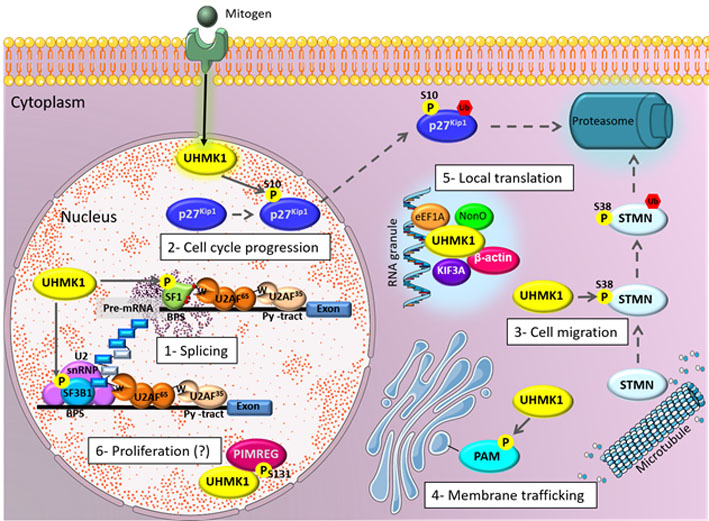
UHMK1 is the only kinase that possesses the N-terminal kinase core juxtaposed to a C-terminal U2AF homology motif (UHM) (Maucuer et al., 1997). Through the UHM motif, UHMK1 interacts with the splicing factors SF1 and SF3B1 (Manceau et al., 2008). Upon interaction, UHMK1 phosphorylates SF1, which enhances SF1 specific binding to U2AF65 and reduces the SF1-U2AF65 binding to the 3 splice site RNA (Chatrikhi et al., 2016; Manceau et al., 2006). In addition, UHMK1 expression is necessary for normal phosphorylation of SF1 in vivo (Manceau et al., 2012). The fact that UHMK1 interacts with and regulates splicing factors suggests that UHMK1 might be involved in RNA metabolism.
Since UHMK1 is highly expressed in neurons, it is expected to exerts important functions in the nervous system. It was demonstrated an abnormal phosphorylation of SF1 in brain extracts of neonate Uhmk1-/- mice. Also, Uhmk1 deletion resulted in increased ratio of pre-mRNA relative to mRNA, and consequently down-regulation of brain specific genes, like cys-loop ligand-gated ion channels and metabolic enzymes. Although adult Uhmk1-/- mice did not present an obvious phenotype, animal behavior was affected. The Uhmk1-/- mice displayed locomotor hyperactivity, reduced fear conditioning and learning capacities from aversive stimuli (Manceau et al., 2012).
The murine Uhmk1 was described to interact with known components of neuronal RNA granules, such as KIF3A, NONO and EEF1A1. The protein colocalizes with KIF3A kinesin in neurites and is required for neuritic outgrowth in cortical mouse neurons. Furthermore, Uhmk1 associates with RNP-transported mRNAs and stimulate translation driven by the β-actin 3 UTR, suggesting that Uhmk1 contributes to modulate translation in RNA-transporting granules as a result of local signals (Cambray et al., 2009). Still, comparison of primary cultures derived from Uhmk1-/- mice did not reveal a significant difference in neuritic arborization of cortical neurons (Manceau et al., 2012).
Furthermore, a study investigating Uhmk1 action on hippocampal synaptic plasticity in mice, showed that Uhmk1 knockdown impaired spine development, altered actin dynamics, and reduced postsynaptic responsiveness. Moreover, Uhmk1 depletion resulted in decrease of the postsynaptic scaffolding protein PSD-95 and of AMPA receptor subunits. Thus Uhmk1 enhances translation of AMPA receptors and stimulates dendritic spine remodeling (Pedraza et al., 2014).
Another described function of UHMK1 involves the regulation of secretory pathway in neurons and endocrine cells through its interaction with peptidylglycine α-amidating mono-oxigenase (PAM) (Alam et al., 1996). PAM cytosolic domain (CD) phosphorylation by UHMK1 (Ser-949) is required for the correct routing of this protein and consequently for its ability to affect trafficking in the regulated secretion pathway (Alam et al., 2001; Caldwell et al., 1999). Lately, it was described an intramembrane proteolysis pathway for PAM, generating a soluble fragment of the cytosolic domain (sf-CD), which accumulates in the nucleus in a phosphorylation-dependent manner, modulating the expression of genes involved in the secretory pathway. UHMK1 phosphorylates sf-CD, diminishing its localization in the nucleus and negatively regulating the expression of a subset of genes (Francone et al., 2010; Rajagopal et al., 2010).
An extensively documented function of UHMK1 is its ability to positively regulate cell cycle progression through phosphorylation and inhibition of the cyclin dependent kinase inhibitor (CDKI) p27Kip1. Upon mitogenic activation, UHMK1 expression is upregulated and phosphorylates p27Kip1 on serine 10 (Ser10). As a consequence, p27Kip1 is exported from nucleus to cytoplasm, where it is targeted to the proteasome and degraded, and has no longer inhibitory effect on cell cycle. Thus, UHMK1 promotes cell cycle re-entry by inactivating p27Kip1 following growth factor stimulation (Boehm et al., 2002).
Another important target of UHMK1 is the microtubule-destabilizing protein, Stathmin (Maucuer et al., 1995). UHMK1 interacts with and phosphorylates Stathmin on serine 38 (Ser38), targeting this protein to proteasome. Through negative regulation of Stathmin, UHMK1 alter microtubule dynamics and consequently impairs cell migration (Langenickel et al., 2008).
UHMK1 expression is upregulated upon hematopoietic cell differentiation, thus a possible role of UHMK1 in cell differentiation was proposed (Barbutti et al., 2017). This idea was supported by the fact that UHMK1 mRNA is highly expressed in the mature brain and in terminally differentiated neural cells (Bieche et al., 2003) as well as during osteoclasts differentiation (Choi et al., 2016). The human UHMK1 shares high homology with a number of species as depicted in Table 1. PIMREG (previously known as FAM64A; CATS) is a proliferation marker shown to interact with UHMK1. The fact that UHMK1 interacts with and phosphorylates PIMREG suggests that UHMK1 regulates PIMREG function and/or localization. Nevertheless, the functional implication of this interaction remains elusive (Archangelo et al., 2013).
Homology
Table 1. Homology between the human UHMK1 and other species
| Homo sapiens UHMK1 | Symbol | Protein (% Identity) | DNA(% Identity) |
| vs. P. troglodytes vs. M. mulatta | UHMK1 UHMK1 | 99.8 (XP_001174268) 99.8 (NP_001253697) | 99.7 (XM_001174268) 99.0 (NM_001266768) |
| vs. C. lupus | UHMK1 | 99.8 (XP_536143) | 95.8 (XM_536143) |
| vs. B. taurus | UHMK1 | 99.8 (NP_001192514) | 95.9 (NM_001205585) |
| vs. M. musculus | Uhmk1 | 99.3 (NP_034763) | 93.0 (NM_010633) |
| vs. R. norvegicus | Uhmk1 | 99.3 (NP_058989) | 92.6 (NM_017293) |
| vs. G. gallus | UHMK1 | 88.2 (XP_015145890) | 81.6 (XM_015290404) |
| vs. D. rerio | uhmk1 | 73.6 (NP_001070127) | 69.4 (NM_001076659) |
(Source: http://www.ncbi.nlm.nih.gov/homologene/)
Mutations
Somatic
Implicated in
Article Bibliography
| Pubmed ID | Last Year | Title | Authors |
|---|---|---|---|
| 11251076 | 2001 | Signaling mediated by the cytosolic domain of peptidylglycine alpha-amidating monooxygenase. | Alam MR et al |
| 23419774 | 2013 | The CATS (FAM64A) protein is a substrate of the Kinase Interacting Stathmin (KIS). | Archangelo LF et al |
| 19158809 | 2009 | Case-control association study of 59 candidate genes reveals the DRD2 SNP rs6277 (C957T) as the only susceptibility factor for schizophrenia in the Bulgarian population. | Betcheva ET et al |
| 12782393 | 2003 | Quantitative RT-PCR reveals a ubiquitous but preferentially neural expression of the KIS gene in rat and human. | Bièche I et al |
| 12093740 | 2002 | A growth factor-dependent nuclear kinase phosphorylates p27(Kip1) and regulates cell cycle progression. | Boehm M et al |
| 26350515 | 2016 | Novel genetic causes for cerebral visual impairment. | Bosch DG et al |
| 19747464 | 2009 | Expression of kinase interacting with stathmin (KIS, UHMK1) in human brain and lymphoblasts: Effects of schizophrenia and genotype. | Bristow GC et al |
| 10574929 | 1999 | The novel kinase peptidylglycine alpha-amidating monooxygenase cytosolic interactor protein 2 interacts with the cytosolic routing determinants of the peptide processing enzyme peptidylglycine alpha-amidating monooxygenase. | Caldwell BD et al |
| 19015237 | 2009 | Protein kinase KIS localizes to RNA granules and enhances local translation. | Cambray S et al |
| 28002734 | 2016 | SF1 Phosphorylation Enhances Specific Binding to U2AF(65) and Reduces Binding to 3'-Splice-Site RNA. | Chatrikhi R et al |
| 25656485 | 2015 | Upregulated WDR5 promotes proliferation, self-renewal and chemoresistance in bladder cancer via mediating H3K4 trimethylation. | Chen X et al |
| 27424934 | 2016 | Genome-wide association study in East Asians suggests UHMK1 as a novel bone mineral density susceptibility gene. | Choi HJ et al |
| 17726090 | 2008 | GA-binding protein regulates KIS gene expression, cell migration, and cell cycle progression. | Crook MF et al |
| 21399567 | 2011 | Genetic and molecular exploration of UHMK1 in schizophrenic patients. | Dumaine A et al |
| 20573687 | 2010 | Signaling from the secretory granule to the nucleus: Uhmk1 and PAM. | Francone VP et al |
| 15231733 | 2004 | U2AF homology motifs: protein recognition in the RRM world. | Kielkopf CL et al |
| 19033656 | 2008 | KIS protects against adverse vascular remodeling by opposing stathmin-mediated VSMC migration in mice. | Langenickel TH et al |
| 15611642 | 2005 | HER2-targeting antibodies modulate the cyclin-dependent kinase inhibitor p27Kip1 via multiple signaling pathways. | Le XF et al |
| 20811053 | 2011 | PI 3-kinase/Rac1 and ERK1/2 regulate FGF-2-mediated cell proliferation through phosphorylation of p27 at Ser10 by KIS and at Thr187 by Cdc25A/Cdk2. | Lee JG et al |
| 21948550 | 2011 | Human corneal endothelial cells employ phosphorylation of p27(Kip1) at both Ser10 and Thr187 sites for FGF-2-mediated cell proliferation via PI 3-kinase. | Lee JG et al |
| 22937132 | 2012 | The protein kinase KIS impacts gene expression during development and fear conditioning in adult mice. | Manceau V et al |
| 16420481 | 2006 | Major phosphorylation of SF1 on adjacent Ser-Pro motifs enhances interaction with U2AF65. | Manceau V et al |
| 7724523 | 1995 | Stathmin interaction with a putative kinase and coiled-coil-forming protein domains. | Maucuer A et al |
| 10880969 | 2000 | Specific Ser-Pro phosphorylation by the RNA-recognition motif containing kinase KIS. | Maucuer A et al |
| 9287318 | 1997 | KIS is a protein kinase with an RNA recognition motif. | Maucuer A et al |
| 25319695 | 2014 | KIS, a kinase associated with microtubule regulators, enhances translation of AMPA receptors and stimulates dendritic spine remodeling. | Pedraza N et al |
| 17984092 | 2008 | FoxM1 regulates growth factor-induced expression of kinase-interacting stathmin (KIS) to promote cell cycle progression. | Petrovic V et al |
| 18414510 | 2008 | Confirmation of the genetic association between the U2AF homology motif (UHM) kinase 1 (UHMK1) gene and schizophrenia on chromosome 1q23.3. | Puri V et al |
| 20817724 | 2010 | Secretion stimulates intramembrane proteolysis of a secretory granule membrane enzyme. | Rajagopal C et al |
| 21045138 | 2010 | Silencing kinase-interacting stathmin gene enhances erlotinib sensitivity by inhibiting Ser¹⁰ p27 phosphorylation in epidermal growth factor receptor-expressing breast cancer. | Zhang D et al |
Other Information
Locus ID:
NCBI: 127933
MIM: 608849
HGNC: 19683
Ensembl: ENSG00000152332
Variants:
dbSNP: 127933
ClinVar: 127933
TCGA: ENSG00000152332
COSMIC: UHMK1
RNA/Proteins
| Gene ID | Transcript ID | Uniprot |
|---|---|---|
| ENSG00000152332 | ENST00000489294 | Q8TAS1 |
Expression (GTEx)
References
| Pubmed ID | Year | Title | Citations |
|---|---|---|---|
| 38597390 | 2024 | KIS counteracts PTBP2 and regulates alternative exon usage in neurons. | 1 |
| 38597390 | 2024 | KIS counteracts PTBP2 and regulates alternative exon usage in neurons. | 1 |
| 36919755 | 2023 | UHMK1 promotes lung adenocarcinoma oncogenesis by regulating the PI3K/AKT/mTOR signaling pathway. | 2 |
| 36919755 | 2023 | UHMK1 promotes lung adenocarcinoma oncogenesis by regulating the PI3K/AKT/mTOR signaling pathway. | 2 |
| 35151311 | 2022 | UHMK1-dependent phosphorylation of Cajal body protein coilin alters 5-FU sensitivity in colon cancer cells. | 3 |
| 35501324 | 2022 | UHMK1 aids colorectal cancer cell proliferation and chemoresistance through augmenting IL-6/STAT3 signaling. | 4 |
| 35151311 | 2022 | UHMK1-dependent phosphorylation of Cajal body protein coilin alters 5-FU sensitivity in colon cancer cells. | 3 |
| 35501324 | 2022 | UHMK1 aids colorectal cancer cell proliferation and chemoresistance through augmenting IL-6/STAT3 signaling. | 4 |
| 31975428 | 2020 | UHMK1 promotes gastric cancer progression through reprogramming nucleotide metabolism. | 25 |
| 31975428 | 2020 | UHMK1 promotes gastric cancer progression through reprogramming nucleotide metabolism. | 25 |
| 30936457 | 2019 | YAP-dependent induction of UHMK1 supports nuclear enrichment of the oncogene MYBL2 and proliferation in liver cancer cells. | 36 |
| 30936457 | 2019 | YAP-dependent induction of UHMK1 supports nuclear enrichment of the oncogene MYBL2 and proliferation in liver cancer cells. | 36 |
| 29307747 | 2018 | The U2AF homology motif kinase 1 (UHMK1) is upregulated upon hematopoietic cell differentiation. | 5 |
| 29307747 | 2018 | The U2AF homology motif kinase 1 (UHMK1) is upregulated upon hematopoietic cell differentiation. | 5 |
| 27424934 | 2016 | Genome-wide association study in East Asians suggests UHMK1 as a novel bone mineral density susceptibility gene. | 7 |
Citation
Vanessa Cristina Arfelli ; Leticia Fröhlich Archangelo
UHMK1 (U2AF homology motif kinase 1)
Atlas Genet Cytogenet Oncol Haematol. 2017-11-01
Online version: http://www.atlasgeneticsoncology.org/gene/41071/uhmk1-(u2af-homology-motif-kinase-1)
